
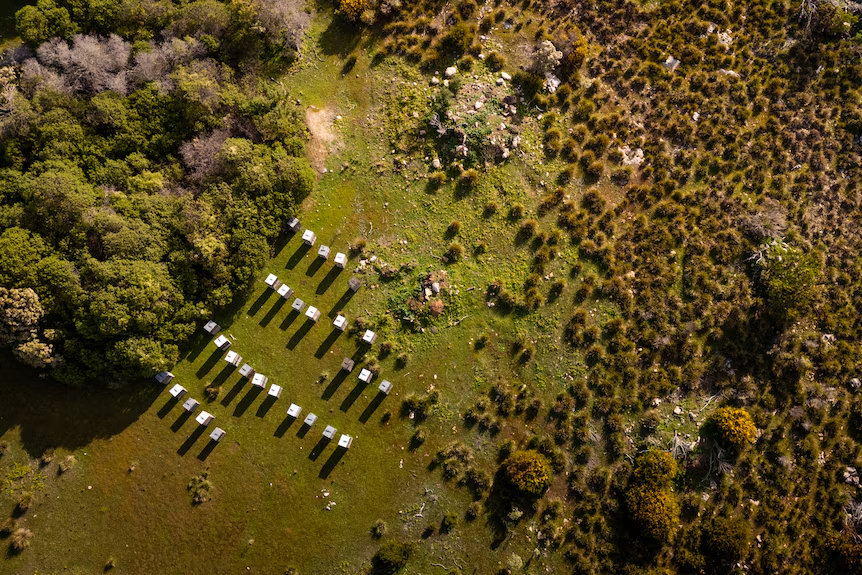
The small but globally significant bee sanctuary on South Australia’s Kangaroo Island is facing its most serious challenge in more than a century. The deadly Varroa destructor mite, which has already devastated hives in other parts of the country, has now been detected in South Australia. Local apiarists, farmers, and conservationists fear that unless biosecurity controls are urgently tightened, the world’s purest population of Ligurian honey bees could be wiped out.
A Unique Sanctuary at Risk
Kangaroo Island was declared a bee sanctuary in 1885, just a year after Ligurian bees were brought from northern Italy. Since then, the island has maintained the purest strain of Ligurian bees in the world, free from pests and diseases that have long plagued bee populations elsewhere. Today, five to six commercial beekeepers and nearly 100 hobbyists operate on the island, producing honey, beeswax, and propolis. Many businesses also rely on bee tourism, running guided tours and retail shops that support more than 50 local jobs.
For families like Shawn Hinves’, who left a career as a tyre fitter to build a life around beekeeping, the bees are more than livestock. “They’ve been recognised as the most pure strain of Ligurian bee left in the world,” Hinves explained. “Everything they produce has a positive effect on the human body.” That purity—and the livelihoods it sustains—is now under threat.
The Varroa Destructor’s Spread
The Varroa mite is no bigger than a sesame seed, but its impact on bee health is catastrophic. It attaches to adult bees and larvae, feeding on their fat reserves while exposing them to lethal viruses. Entire colonies can collapse within months.
The mite was first detected in the Port of Newcastle, New South Wales, in June 2022. Despite eradication efforts, it spread rapidly to Victoria, Queensland, the ACT, and most recently South Australia’s Riverland region earlier this month. National authorities abandoned eradication attempts in September 2023, shifting instead to a management strategy aimed at slowing the spread.
But slowing is not enough, say local beekeepers. Kangaroo Island’s isolation, while a strength, is also a vulnerability. Bees are regularly transported across borders to pollinate crops such as almonds and stone fruits. It was this movement of hives from Queensland that brought Varroa into South Australia. “We need to do everything we can to stop the Varroa from getting to Kangaroo Island,” warned South Australian Apiarists Association president Brenton Davis.
Beekeepers Call for Stronger Biosecurity
Many on the island believe the government’s current measures are inadequate. At present, restrictions prohibit the import of bee products, hives, and equipment to Kangaroo Island. Ferry terminal staff ask travelers if they are carrying honey, but inspections are often cursory.
Brian Morrison, a retired diver turned hobbyist beekeeper, is blunt: “At the moment, biosecurity basically just asks you, ‘do you have honey?’ If you’re dishonest, or if there’s a language barrier, things slip through. We need something like the West Australian model, where every vehicle is stopped and searched.”
Western Australia enforces some of the strictest biosecurity controls in the country, stopping and inspecting every car entering from interstate. Many on Kangaroo Island are calling for similar controls, fearing that a single lapse could destroy the sanctuary forever.
Government’s Position
South Australia’s Primary Industries Minister, Clare Scriven, has defended the state’s management strategy, noting that no honey, used hives, or bee equipment are permitted on the island. “We have our checks at the ferry terminal,” she said. “We’re certainly happy to expand that if it is necessary.” Scriven confirmed that the state is recruiting additional staff to strengthen frontline checks.
Still, many locals feel reassurances fall short of the urgency required. Hinves believes authorities should have acted more aggressively when the mite was first detected. “It’s very frustrating,” he said. “If they’re serious about biosecurity and protecting beekeepers, the food industry, and everything around it, then they need more regulation, more monitoring, and more staff. I just don’t think enough is being done.”
A Compounded Crisis
The looming threat comes as Kangaroo Island’s beekeeping industry is still recovering from the catastrophic 2019–2020 bushfires. Those fires destroyed large swathes of native vegetation on the island’s western end, wiping out countless hives and crippling honey production. Five years later, many trees still do not produce nectar in quantities sufficient for full recovery.
Bev Nolan, whose family runs Clifford’s Honey Farm, one of the island’s most prominent apiary businesses, said the fires forced diversification. “We’ve upgraded our shop and diversified our products to stay profitable,” she said. “The Ligurian bees are a really big tourist story. They’re calm, hardworking, and isolated from pests. Protecting them is vital not just for us, but for the world.”
Economic and Global Importance
The economic stakes are high. Australian honey production is worth about $150 million annually, with pollination services—critical for crops like almonds, apples, and canola—contributing an additional $14 billion to agriculture. While Kangaroo Island’s honey industry is small by comparison, its global importance lies in the genetic purity of its Ligurian bees. Researchers and breeders regard the population as a genetic reservoir, a safeguard against the collapse of other bee strains.
Losing Kangaroo Island’s bees would mean losing a living laboratory, one that has been preserved for nearly 140 years. It would also undermine South Australia’s growing reputation for premium honey products, often marketed worldwide as “pure Ligurian.”
What Can Be Done
Experts argue that three urgent steps are required:
- Stricter Border Controls: Mandatory inspections of all vehicles and cargo bound for Kangaroo Island, similar to Western Australia’s approach.
- Increased Funding and Staffing: Expansion of biosecurity teams to provide thorough checks at ferry terminals and airports.
- Community Education: Targeted campaigns to ensure that visitors—particularly international tourists—understand the risks of carrying honey or bee products.
These measures are not just defensive but proactive. A single oversight could undo decades of conservation, research, and economic investment.
The Human Toll
For many island residents, the threat is not abstract but personal. Hinves admits he has considered what might happen if the mite reaches Kangaroo Island. “If it does, it could mean the end for me as a beekeeper,” he said. Morrison echoed the sentiment, admitting he may give up entirely if his hives collapse. “I’d be devastated. Maybe I’d move somewhere else. But right now, it feels like one thing after another.”
A Test of Resolve
The story of Kangaroo Island’s bees is one of survival against the odds—fires, isolation, and now disease. Whether the sanctuary can withstand the Varroa mite may depend less on the insects themselves and more on human decisions in the coming months.
If South Australia chooses to expand its biosecurity protections and enforce them with rigour, the sanctuary could endure as a global model of conservation. If not, the world may lose the last pure population of Ligurian bees—a loss felt far beyond Kangaroo Island’s shores.
The question facing policymakers is urgent and simple: will South Australia act decisively to protect its living heritage, or will it risk seeing a century-old sanctuary collapse under the weight of a mite no larger than a pinhead?