
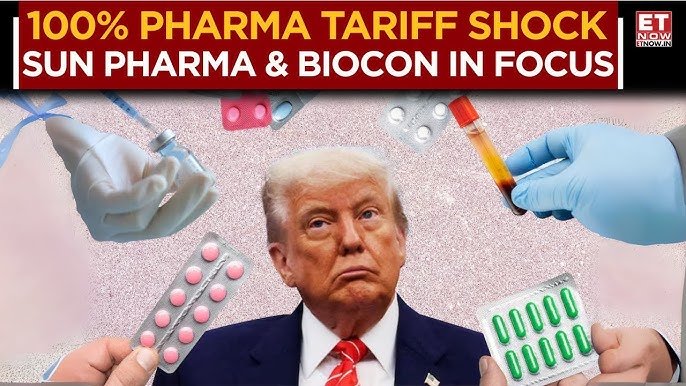
The United States will impose a sweeping 100 per cent tariff on branded and patented pharmaceutical imports starting October 1, President Donald Trump announced, escalating his administration’s protectionist trade agenda into the healthcare sector. The move, framed as a bid to revive domestic drug manufacturing, has sparked alarm among global pharmaceutical companies, healthcare providers, and patient advocacy groups who warn of rising drug prices, strained supply chains, and diplomatic fallout.
A Bold Expansion of Trade Policy into Healthcare
Trump declared that any branded or patented drug entering the US will face the tariff unless its parent company is actively building a production plant within the country. “American patients should not be held hostage to foreign-made drugs,” he said in Washington. “If Big Pharma wants access to the world’s largest healthcare market, they must make their products in America.”
The tariff is part of a broader “America First” industrial policy that has already reshaped steel, semiconductors, and electric vehicle manufacturing. By extending tariffs into pharmaceuticals, the administration is targeting a $600 billion industry where supply chains have long been globalized.
Industry Reaction: Shockwaves Across Big Pharma
Pharmaceutical companies reacted with urgency. Pfizer, Novartis, Sanofi, and AstraZeneca all have extensive global manufacturing networks, often relying on plants in Europe, India, and Singapore for both raw materials and finished products. While most companies maintain limited US manufacturing capacity, few currently produce their most profitable branded medicines domestically.
Analysts at Moody’s warned that compliance could take years. “Building a new FDA-approved manufacturing facility is a multi-billion-dollar undertaking that requires at least 3–5 years,” said senior analyst Emily Clarke. “The short timeline puts multinational drugmakers in an impossible position.”
Shares in several pharma giants dropped in early trading following the announcement. Novartis fell by 6 per cent in Zurich, while Pfizer’s stock in New York dipped 4 per cent within an hour of the news.
Potential Impact on US Patients
Healthcare providers expressed concern about immediate disruptions. According to the Kaiser Family Foundation, nearly 80 per cent of branded drugs sold in the US are manufactured abroad. Tariffs could double the cost of these drugs overnight unless exemptions or rapid domestic capacity expansions are arranged.
“This will affect cancer patients, people with rare diseases, and those needing advanced biologics the most,” said Dr. Anthony Fauci, former director of the National Institute of Allergy and Infectious Diseases. “These are not generic pills. These are cutting-edge treatments that cannot be easily substituted.”
The American Hospital Association estimated that hospitals could see drug procurement costs rise by up to 40 per cent in the short term. Insurers are expected to pass those costs onto patients through higher premiums, further inflaming debates over healthcare affordability.
Global Trade Fallout
The European Union, home to several pharmaceutical giants, has already signaled its opposition. EU Trade Commissioner Valdis Dombrovskis warned that Brussels may challenge the measure at the World Trade Organization and consider counter-tariffs on US exports, including medical devices and agricultural goods.
India, a key supplier of both active pharmaceutical ingredients (APIs) and finished drugs, called the policy “unilateral and protectionist.” The Indian Pharmaceutical Alliance said tariffs will “destabilize global supply chains, reduce access to life-saving drugs, and damage international cooperation in health security.”
China, while less dominant in branded drugs, plays a critical role in precursor chemicals. Experts worry that retaliatory actions from Beijing could choke access to essential inputs for US-based drugmakers themselves.
The Domestic Political Angle
For Trump, the announcement comes ahead of the 2026 midterm election cycle, where healthcare costs remain a top voter concern. The administration is betting that forcing pharma companies to invest domestically will create jobs, reduce reliance on foreign supply, and, eventually, stabilize prices.
“This is a populist move with deep electoral calculation,” said Larry Sabato, political analyst at the University of Virginia. “It may cause short-term pain, but the image of Trump standing up to Big Pharma resonates strongly with working-class voters.”
Democrats, however, blasted the policy. Senate Majority Leader Chuck Schumer called it “reckless,” arguing it would “skyrocket drug costs for seniors and middle-class families while doing nothing to ensure long-term affordability.”
Logistics and Legal Challenges
Industry experts highlight that beyond the political theater lies a series of daunting practical hurdles. Constructing a pharmaceutical plant in the US is not only costly but also requires navigating strict FDA approvals, environmental reviews, and local zoning laws.
Moreover, most branded drugs rely on complex supply chains involving raw materials from multiple countries. Even if final assembly takes place in the US, global dependence is unavoidable. Tariffs on finished imports may not address deeper vulnerabilities exposed during the COVID-19 pandemic, when shortages of antibiotics and personal protective equipment highlighted America’s reliance on Asia.
Legal scholars also anticipate a wave of lawsuits. Some argue that applying such tariffs to patented medicines, which enjoy intellectual property protections under global treaties, could violate World Trade Organization rules and bilateral trade agreements.
Potential Silver Lining: A Push for Generics?
While branded drugs face the brunt of tariffs, generics — which already dominate the US market by volume — may gain ground. Generic drugmakers, many of which already operate in the US or source from low-cost facilities in India and Israel, could see a sudden competitive advantage.
The Association for Accessible Medicines, which represents US generic manufacturers, cautiously welcomed the announcement, saying it could “rebalance the playing field” but urged the administration to avoid patient harm.
There is also speculation that some pharma giants may accelerate licensing deals with US-based generics to sidestep tariffs while keeping patents profitable.
The Broader Economic Context
The move is part of a larger recalibration of global trade. Trump has already targeted electric vehicles from China with 100 per cent tariffs, imposed duties on steel and aluminum imports, and pushed for “friendshoring” supply chains in allied nations. Pharmaceuticals represent both a critical industry and a symbolic battleground, combining national security concerns with pocketbook issues for American voters.
Economists warn, however, that unlike cars or steel, medicines cannot be stockpiled easily. Delays, shortages, and pricing spikes could spark political backlash if patients are unable to access life-saving treatments.
Goldman Sachs projects that if the tariffs hold, US drug spending could rise by $50–80 billion annually in the short term. That could strain Medicare and Medicaid budgets, potentially forcing the administration to consider subsidies or emergency exemptions.
What Happens Next?
Pharma companies have been given until October 1 to demonstrate they are building or planning to build plants in the US. The Department of Commerce is expected to release guidelines clarifying what constitutes “building a plant” and whether existing facilities qualify for exemptions.
Industry lobbyists are already flooding Capitol Hill, pushing for carve-outs for biologics, orphan drugs, and vaccines. Given the looming flu season and the ever-present risk of pandemics, public health officials are especially concerned about vaccine availability under the tariff regime.
The White House insists that exemptions will be “limited and tightly controlled,” but ambiguity has left the industry scrambling.
Conclusion: High Stakes Gamble
Trump’s pharmaceutical tariff is one of the boldest trade moves of his presidency. It aims to rewrite the global rules of drug production, force Big Pharma to invest domestically, and bolster his image as a defender of American industry.
Yet the risks are immense. Patients may face higher costs, international partners could retaliate, and the healthcare system may experience supply shocks. For now, the world is watching whether pharmaceutical giants will bend to Washington’s pressure or resist through legal, political, and diplomatic channels.
What is clear is that the announcement has moved the battle over globalization from factories and shipyards into the very heart of medicine — with consequences that could reshape both healthcare and trade for decades to come.