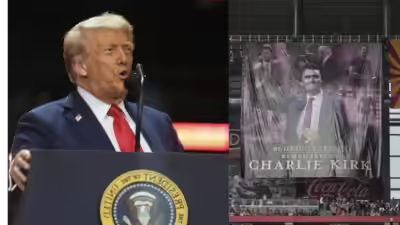
Donald Trump praised conservative activist Charlie Kirk as a “martyr” for freedom at a memorial service attended by tens of thousands on Sunday, turning the solemn occasion into both a spiritual gathering and a political rally.
Kirk, 31, was assassinated on 10 September during an appearance at a Utah college campus, an event that has ignited fierce national debate about violence, free speech, and the tenor of American politics. His death has also underscored the risks facing prominent political figures in a nation sharply divided along ideological lines.
The service, held at the home stadium of the NFL’s Arizona Cardinals, opened with Christian rock bands that made the arena shake, blending elements of worship with an unmistakable political atmosphere. For many, the tone reflected Kirk’s own career — a life lived at the intersection of faith, activism, and partisan politics.
Trump’s Tribute and Stark Words
Trump, who has long credited Kirk with helping secure his 2024 election victory, described him as “a great American hero” whose name would not be forgotten. “He’s a martyr now for America’s freedom,” Trump said to thunderous applause.
But the president’s remarks took a sharper turn as he reflected on his late ally’s approach to opponents. “Charlie did not hate his opponents. He wanted the best for them. That’s where I disagreed with Charlie,” Trump said, pausing before adding, “I hate my opponents, and I don’t want the best for them. I’m sorry, Erika.”
The admission, directed at Kirk’s widow Erika, stood in sharp contrast to her own message of forgiveness. Erika Kirk, who took the stage earlier, told mourners she forgave the man charged with killing her husband. “He left this world with no regrets,” she said. “And I will carry his legacy forward with love, not hate.”
A Divisive Legacy
Charlie Kirk rose to prominence as the founder of Turning Point USA, a conservative youth organization that built influence across college campuses. By 2024, he had become a household name in Republican politics, appearing regularly on television and at rallies.
Supporters hailed him as a fearless advocate for conservative values and free speech. Critics accused him of deepening polarization and spreading incendiary rhetoric. His assassination has only intensified these divisions.
Public debate now rages over whether political discourse has reached a dangerous tipping point. Civil rights groups have pointed to the killing as evidence of rising extremism, while conservative leaders insist Kirk’s death proves the need for greater protection of political voices they say are under attack.
The Atmosphere of a Rally
Although billed as a memorial, the event often resembled a campaign rally. Flags waved, chants of “USA” erupted, and Trump supporters packed the stadium in a sea of red hats and banners.
Political figures and religious leaders took turns addressing the crowd. Some emphasized faith and unity, while others used the moment to sharpen partisan grievances. Observers noted the blending of worship-style celebration with overt political mobilization, a reflection of Kirk’s unique role in the conservative movement.
Speculation Over Trump and Musk
The memorial also marked the first public encounter in months between Trump and Elon Musk. Once a close adviser, Musk had headed Trump’s so-called Department of Government Efficiency (DOGE) during the early months of his second administration before a dramatic falling out.
On Sunday, the two were seen shaking hands and speaking at length, sparking speculation of a possible reconciliation. Trump later hinted that Musk could play a role in upcoming government or technology initiatives, though he offered no specifics.
Policy Announcements on the Horizon
Beyond the memorial itself, the Trump administration is expected to roll out new, controversial health guidance. According to reports in the Washington Post, officials will announce that Tylenol (paracetamol), commonly used by pregnant women, may be linked to a risk of autism. This runs contrary to long-standing medical guidelines from institutions like the U.S. Food and Drug Administration and the American College of Obstetricians and Gynecologists, both of which maintain the drug is safe when taken as directed.
The administration is also preparing to announce new research into leucovorin, a drug that officials claim could hold potential in treating autism. Critics warn that politicizing medical science could undermine public trust and spread misinformation.
Foreign Policy Flashpoint
The United States State Department was forced to respond on Sunday after Britain, Australia, and Canada recognized Palestinian statehood. In a statement, an unnamed U.S. official dismissed the move as “performative.” The official stressed that Washington’s focus remains on “serious diplomacy,” prioritizing the release of hostages, Israel’s security, and long-term peace in the Middle East “free from Hamas.”
The recognition has widened the gap between Washington and several of its closest allies, who argue that acknowledging Palestinian sovereignty is essential to any lasting peace settlement.
Murdoch and the TikTok Battle
Another flashpoint emerged over the future of TikTok in the United States. Trump suggested in an interview that Rupert Murdoch and his son Lachlan may become involved in efforts to purchase the platform. The president confirmed ongoing negotiations but declined to outline details, saying only that “we are looking at the best path forward for American security and innovation.”
The Murdoch family’s involvement would bring enormous media influence into the debate, potentially reshaping the future of one of the world’s most popular apps.
Pressure on Federal Prosecutors
In a separate development, Trump announced that he will appoint Lindsey Halligan, his former personal lawyer, as U.S. attorney for the Eastern District of Virginia. The announcement followed a striking outburst in which Trump publicly urged his attorney general to pursue senior officials he regards as political adversaries.
Critics described the move as a dangerous breach of judicial independence. Supporters argued it reflected Trump’s determination to confront what he views as entrenched corruption. Either way, it has reinforced concerns about the politicization of federal law enforcement under his leadership.
Looking Ahead
The memorial for Charlie Kirk was both an emotional farewell and a vivid snapshot of the current American political climate. On one hand, it was a deeply personal gathering, filled with mourning, faith, and remembrance. On the other, it became a stage for sharp political messaging, policy previews, and public displays of power.
Trump’s declaration that he “hates” his opponents may further inflame tensions at a moment when many are calling for national healing. Yet for his supporters, it underscored a candid authenticity they believe sets him apart.
As the nation absorbs the loss of a young political figure and watches the moves of an emboldened president, one reality is clear: the lines between mourning, politics, and power have never been more blurred. Charlie Kirk’s life and death may well define not only a movement but also a turbulent chapter in American history.

