
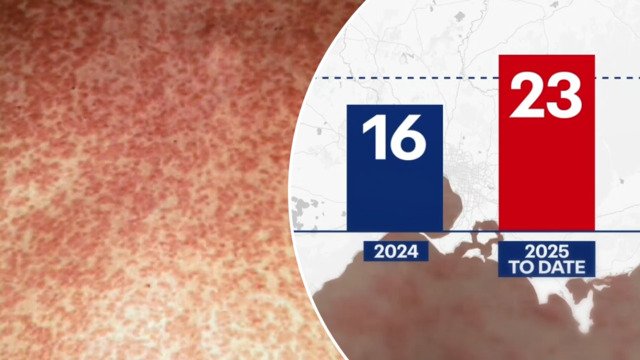
Western Australia’s Department of Health has issued a renewed public alert after confirming 16 cases of measles between July and September 2025. The cases include five in returned overseas travellers and 11 acquired locally. Health authorities say the current outbreak highlights both the infectious nature of measles and the importance of vaccination in preventing its spread.
A Highly Contagious Virus
Measles is one of the most infectious viruses known, capable of lingering in the air for up to 30 minutes after an infected person leaves a room. Transmission occurs via airborne droplets from coughing, sneezing, or even talking, making enclosed public spaces like waiting rooms or shopping centres high-risk locations.
The incubation period typically ranges from 7 to 18 days, with symptoms appearing around day 10 on average. Those infected are contagious from one day before symptoms emerge until four days after the rash appears.
Where Exposures Occurred
The Department of Health has published a list of exposure sites across Perth and regional WA. New locations include Tods Café in Halls Head (7 September), Dan Murphy’s Butler and Coles Brighton (6 September), and several shopping centres and supermarkets across Clarkson, Carine, Baldivis, Rockingham, and Mandurah.
Notably, exposures also occurred at Perth Airport’s Terminal 3 on 26 August, during Qantas flight QF2925 from Christmas Creek Mine to Perth, and on TransNusa flight 8B 80 from Denpasar to Perth on 16 August. Fiona Stanley Hospital’s emergency department was listed on two separate days, highlighting the risk to health facilities when measles goes undetected.
The Department stresses there is no ongoing risk at these sites outside the specified dates and times.
Who Is Most at Risk
Anyone born after 1965 who has not received two doses of a measles-containing vaccine remains at risk. Those most vulnerable to severe complications include:
- Young children, especially under one year of age.
- Pregnant women, due to risks of miscarriage and premature birth.
- Immunocompromised individuals, who may be unable to mount a protective immune response.
People born before 1966 are generally considered immune due to widespread exposure before vaccines became available.
Recognising Symptoms
The illness usually begins with fever, tiredness, runny nose, cough, and sore, red eyes. Three to four days later, a distinctive red blotchy rash spreads from the face down to the body. The rash lasts four to seven days.
While most people recover, complications such as pneumonia, middle ear infections, and, rarely, encephalitis (inflammation of the brain) can occur. Hospitalisation is not uncommon in severe cases.
Guidance for the Public
Health officials urge anyone who visited listed exposure sites during the specified times to closely monitor for symptoms for up to 18 days after the visit.
If symptoms develop:
- Isolate immediately to prevent transmission.
- Wear a mask before seeking medical care.
- Call ahead to general practices or emergency departments so staff can take infection-control precautions.
- Seek testing promptly, as confirmation is essential for public health tracking.
For after-hours medical advice, people can contact Healthdirect on 1800 022 222.
Vaccination Remains the Key
The Department of Health emphasises that vaccination is the most effective protection. Two doses of the measles, mumps, rubella (MMR) vaccine provide long-lasting immunity.
- People born after 1965 who are unsure of their vaccination status should confirm with records or receive two documented doses.
- Babies as young as six months can receive an early dose before overseas travel, though they should still receive the routine 12-month and 18-month doses under the National Immunisation Program.
- Free MMR vaccines are available to anyone at risk, even if they are not eligible for Medicare.
International Dimension
WA health authorities link the outbreak partly to global travel. Several cases were identified in returning overseas travellers, underscoring risks posed by international outbreaks. The World Health Organization reports increasing measles activity across Europe, Asia, and Africa.
Australians travelling abroad are advised to consult their GP or a travel clinic for vaccination well before departure. Smartraveller.gov.au continues to provide updated infectious disease alerts for international destinations.
Instructions for Health Professionals
The Department of Health has issued detailed advice to medical practitioners:
- Maintain high suspicion for measles, especially in febrile rash illnesses in returned travellers.
- Triage rapidly: provide masks and isolate suspected cases immediately. Rooms should be left vacant for 30 minutes after use by a suspected patient.
- Laboratory testing: throat swabs, urine PCR, and serology are recommended to confirm infection.
- Notification: suspected cases must be reported immediately to local Public Health Units or the Department of Health.
Hospitals and clinics are urged to ensure staff are fully vaccinated and to review infection-control protocols to avoid nosocomial spread.
Why This Matters
The appearance of locally acquired cases—11 so far—indicates measles transmission is occurring within WA communities, not just from imported cases. This is a concern, given Australia was declared measles-free in 2014.
Public health experts warn that outbreaks tend to cluster in areas with low vaccination coverage. Even small gaps in community immunity can allow the virus to spread rapidly.
Looking Ahead
With ongoing measles activity worldwide and increased travel post-pandemic, WA health officials are urging vigilance. The Department is continuing surveillance, contact tracing, and public alerts as needed.
Residents are encouraged to check vaccination records, book catch-up immunisations where required, and seek medical advice if exposed or symptomatic.
As Dr Paul Armstrong, Director of Communicable Disease Control, noted in the alert: “Measles is highly infectious but preventable. Vaccination remains our strongest defence against this dangerous disease.”
By maintaining vigilance, boosting vaccination rates, and acting swiftly on suspected cases, WA aims to halt the spread before further escalation. The public health message is clear: stay alert, stay vaccinated, and act fast if symptoms appear.