
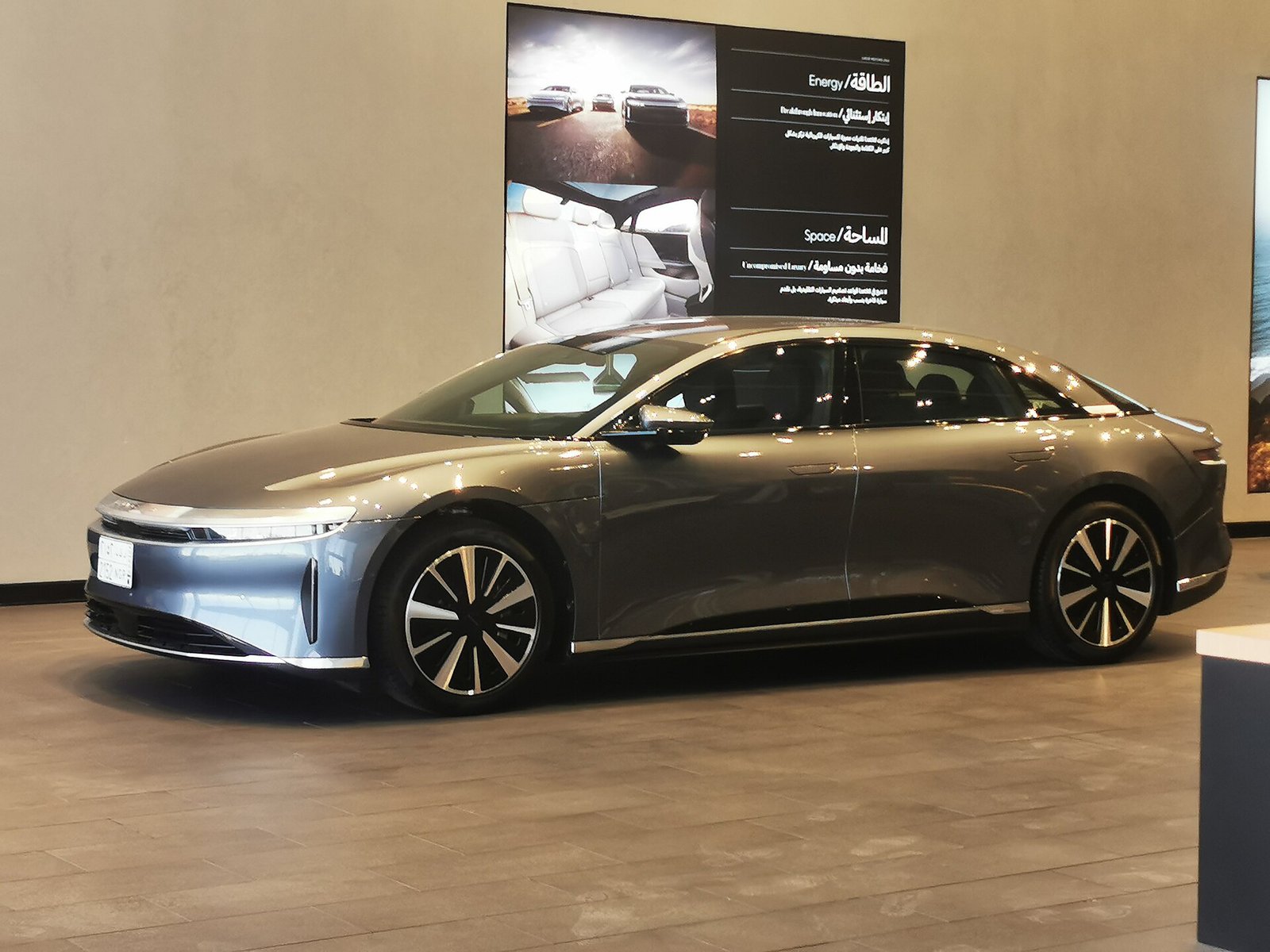
Lucid Group reported third-quarter revenue of $350 million and a loss of $2.74 per share, both below Wall Street estimates, while announcing that Saudi Arabia’s Public Investment Fund (PIF), its largest shareholder, would increase a delayed-draw term loan by $1.75 billion. Lucid said the added financing is expected to support its turnaround and key investments into the fourth quarter of 2027.[1]
The results arrive as the electric-vehicle maker pursues an operational reset under CEO Silvio Napoli, who took over in June. Lucid’s adjusted operating loss measure, adjusted EBITDA, was better than analysts expected, and its net loss narrowed from a year earlier. The combination leaves investors weighing two different signals: the company is making progress on some cost measures, but it still needs substantial financing and has not yet delivered the revenue analysts anticipated.[1]
Lucid’s revenue and per-share loss missed estimates
Analysts surveyed by LSEG had expected Lucid to report revenue of $407 million and a loss of $2.28 per share for the quarter. The company reported $350 million in revenue and a $2.74 loss per share instead. These are comparisons with average analyst estimates, not company guidance or a forecast of future results.[1][3]
Lucid’s adjusted EBITDA loss was $726 million, better than the $611 million loss analysts expected. That measure excludes interest, taxes, depreciation and amortization, so it is not the same as net income or cash flow. The company’s net loss was $830.9 million, compared with $978.4 million in the third quarter of 2025.[1]
The year-over-year comparison also shows mixed movement. Revenue rose from $336.6 million in the year-earlier quarter, while the reported per-share loss narrowed from $3.31. Adjusted EBITDA loss, however, increased from $717.7 million to $726 million. Each figure describes a different part of the business’s performance, so none alone establishes that Lucid’s broader turnaround is succeeding.[1]
| Measure | Q3 2026 result | Comparison |
|---|---|---|
| Revenue | $350 million | $407 million average analyst estimate; $336.6 million in Q3 2025 |
| Loss per share | $2.74 | $2.28 loss expected; $3.31 loss in Q3 2025 |
| Adjusted EBITDA loss | $726 million | $611 million loss expected; $717.7 million in Q3 2025 |
| Net loss | $830.9 million | $978.4 million in Q3 2025 |
| Total liquidity after added financing | $3.75 billion | $2 billion at the end of Q3 |
The liquidity figure includes the added PIF financing. It should not be read as revenue, profit, or money Lucid has already spent. Lucid described the additional funds as providing financial flexibility and supporting operations and key investments, including the planned start of production for its midsize vehicle. The company said the financing is expected to assist it into Q4 2027.[1]
What the PIF loan increase means for Lucid’s turnaround
The financing is important because Lucid is trying to reduce costs while continuing to fund a broad set of plans. The company said the capital would help it carry out its turnaround program. It did not describe the loan increase as evidence that the business has reached profitability. Nor does a larger liquidity position resolve whether the company can meet its product and production plans while narrowing losses.[1]
Lucid’s reset follows a restructuring plan announced after Napoli became CEO in June. The plan includes cost-cutting measures and a delay to the midsize vehicle. Lucid had previously been aiming to launch that vehicle at the end of 2026; the company now expects it in the second half of 2027. That is a meaningful schedule change for a company that says the vehicle is among its key investments.[1]
The company also says its turnaround plan targets $1.4 billion in cash-flow improvements this year. That is a company target, not a reported result in the third-quarter figures. Readers should keep the distinction clear: the quarterly earnings report shows what Lucid recorded for the period, while the cash-flow improvement figure describes an objective the company intends to pursue.[1]
Lucid has also identified a robotaxi program with Uber and Nuro and a factory under construction in Saudi Arabia among its areas of focus. The source report provides no production timetable, financial contribution or operating targets for those projects. Their mention shows where management says it is directing attention, but does not establish when they will produce revenue or how much they will cost.[1]
For investors, the practical question is whether future updates show the company converting its plans into measurable results. For customers and prospective buyers, the most direct item to watch is the midsize vehicle’s revised timing. Lucid has not provided enough information in this announcement to assess a final price, delivery schedule or availability for that model, so those details remain open.[1]
Key items to track in Lucid’s next updates
- Liquidity and financing: Look for updated cash and liquidity figures, and any detail on the terms or use of the expanded PIF loan.
- Cash-flow progress: Compare reported results with Lucid’s stated target of $1.4 billion in cash-flow improvements for the year. The target is not itself proof of achieved savings.
- Midsize vehicle schedule: Monitor whether Lucid maintains its stated second-half 2027 timing for the planned start of production.
- Business milestones: Check for specific progress measures on the Uber and Nuro robotaxi program and the Saudi factory. The current announcement gives no detailed targets for either.
- Guidance: Watch for the midterm plan and targets Lucid says it expects to communicate early next year.
What happens next, and what remains uncertain
Lucid said it expects to share its midterm plan and targets early next year. The company suspended its guidance and many targets in May, citing new leadership and the time needed to develop a turnaround plan. Until the promised update, readers should treat the company’s stated goals as plans rather than confirmed outcomes. The revised production timing, the scale of the cash-flow improvements and the details of the loan remain important points to follow.[1]
For updates, consult Lucid’s next company announcements and earnings materials, and compare them with the figures reported for each quarter. The next useful evidence will be specific disclosures on liquidity, costs and product timing, not simply a restatement of the turnaround ambitions.
Frequently asked questions
Did Lucid beat expectations in the third quarter?
No. Revenue of $350 million was below the $407 million average estimate, and its $2.74 loss per share was worse than the expected $2.28 loss. Its adjusted EBITDA loss was better than expected at $726 million versus an anticipated $611 million loss.[1][3]
How much did PIF add to Lucid’s financing?
Lucid announced a $1.75 billion increase in a delayed-draw term loan from PIF, its largest shareholder. The company said the additional capital was expected to increase total liquidity to $3.75 billion from $2 billion at the end of the quarter.[1]
When is Lucid’s midsize vehicle now expected?
Lucid moved its expected timing from the end of 2026 to the second half of 2027. The company said the added financing is expected to help support key investments, including the start of production, but the announcement did not give a more specific production date.[1]
References
- Wayland M. Lucid misses Wall Street’s earnings expectations, expands loan from Saudi Arabia fund. CNBC [Internet]. 2026 Nov 9. Available from: https://www.cnbc.com/2026/11/09/lucid-group-lcid-earnings-q3-2026.html
- Lucid Group. Third-quarter 2026 results and financing statements, as quoted in CNBC [Internet]. 2026 Nov 9. Cited through reference 1.
- LSEG. Average analyst estimates for Lucid Group’s third quarter of 2026, as reported by CNBC [Internet]. Cited through reference 1.