
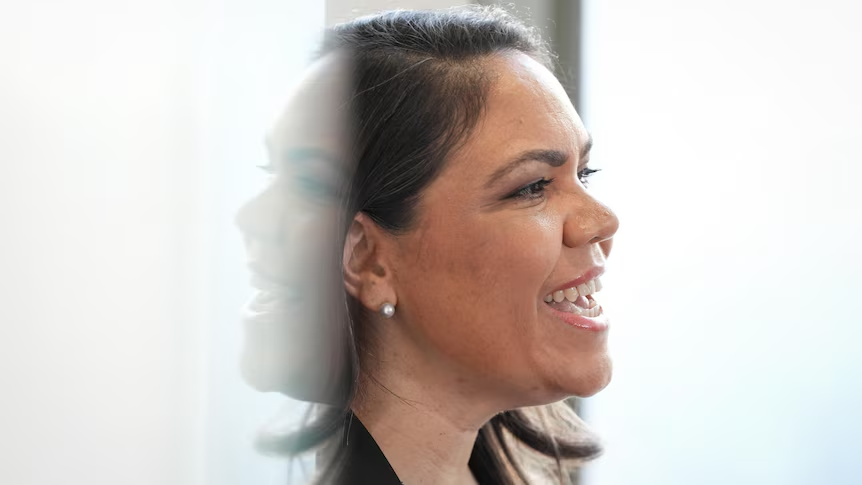
Liberal Party Senator Jacinta Nampijinpa Price has triggered a storm of debate after remarks linking Indian migration to broader concerns about national identity and economic pressure. Her comments, made during a media conference in Perth earlier this week, have drawn strong rebukes from party colleagues, sparked reactions across multicultural communities, and revived questions about what counts as acceptable language in Australian politics.
The controversy comes at a moment when migration policy, population growth, and cultural identity are once again on the national agenda. While migration has long been one of Australia’s defining features, the way politicians talk about it has shifted repeatedly over the decades—sometimes with inclusive overtones, other times through exclusionary rhetoric.
Political Fallout Within the Liberal Party
Almost immediately, senior figures within the Liberal Party distanced themselves from Price’s comments. Deputy leader Sussan Ley issued a firm public rebuke, stressing that Indian Australians have played a vital role in the nation’s social and economic life. The Liberal leadership is now navigating a delicate balancing act: appealing to voters concerned about housing shortages and infrastructure pressures while avoiding language that alienates multicultural communities.
Privately, several Liberal MPs have expressed concern that Price’s comments could damage the party’s relationship with Indian Australians, who make up one of the fastest-growing migrant groups in the country. According to the 2021 Census, more than 710,000 people in Australia reported Indian ancestry, making it the third-largest migrant group after English and Chinese backgrounds. Community leaders have already signaled that they are monitoring how the party responds.
A History of Shifting Boundaries
The uproar reflects a deeper historical question: how the boundaries of politically permissible language about race and migration have shifted over time. In the early 20th century, the White Australia policy enshrined exclusion. By the 1970s, under Gough Whitlam, multiculturalism was promoted as a cornerstone of national identity. The 1990s brought Pauline Hanson’s rise and a new wave of anti-immigration rhetoric, while John Howard’s government was often accused of using coded “dog-whistle” politics to tap into anxieties about migration and national security.
Now, in 2025, the political terrain looks different again. Migration is seen as essential to Australia’s economy, especially in addressing skills shortages, but public concerns about housing affordability, congestion, and wage pressure are reshaping the debate. This tension creates fertile ground for controversy when political figures speak bluntly—or carelessly—about migrant groups.
Community Reactions and Diplomatic Ripples
Indian community organisations responded swiftly and forcefully. Leaders described the remarks as “hurtful” and “misguided,” pointing out that Indian Australians are heavily represented in critical sectors such as healthcare, IT, engineering, and small business ownership. According to government figures, Indian migrants now make up more than 25% of new permanent residents each year.
The Indian High Commission in Canberra has not formally commented, but diplomatic observers note that such controversies have the potential to strain bilateral ties. India is one of Australia’s key strategic partners in the Indo-Pacific, and the two countries recently deepened cooperation through the Australia-India Economic Cooperation and Trade Agreement (ECTA). Negative rhetoric targeting Indian Australians risks undermining this broader diplomatic effort.
Acceptable Language in a Changing Landscape
What makes language in politics “acceptable” has never been static. As ANU historian Frank Bongiorno noted in an ABC Radio National interview, the spectrum has shifted dramatically over the last century. Today, outright racial exclusion is unacceptable in mainstream discourse, but subtler forms of coded language or group-specific criticism remain hotly contested.
Social media has also transformed the dynamic. In earlier decades, controversial remarks might take days to circulate. Now, a comment made at a press conference can trend within minutes, triggering both outrage and solidarity across digital platforms. For politicians, this means the margin for error is vanishingly small.
Practical Implications for Migration Policy
Beyond the politics of language, there are concrete policy implications. Australia’s net overseas migration is projected to add around 400,000 people to the population annually over the next two years, according to Treasury forecasts. That growth brings both opportunities and challenges. Skilled migrants help fill urgent labour gaps, yet the speed of growth intensifies housing shortages and infrastructure stress.
Policymakers face the dual task of maintaining public support for migration while addressing the underlying pressures that fuel discontent. Analysts suggest three actionable steps:
- Targeted Infrastructure Investment – Ensuring new housing, transport, and healthcare facilities keep pace with migration inflows.
- Skills Matching – Prioritising migration pathways that directly address sectoral shortages, such as nursing, aged care, and digital technologies.
- Inclusive Political Communication – Recognising migrant contributions publicly to reinforce cohesion, while addressing concerns about capacity constraints with clear data.
Risks of Divisive Rhetoric
The broader risk of controversies like Price’s remarks lies in their potential to fracture social cohesion. Australia’s success as a multicultural society has always depended on balancing diversity with shared belonging. Divisive rhetoric, even when not explicitly exclusionary, can erode trust and make communities feel targeted.
For Indian Australians in particular, such controversies strike a nerve. Many are first-generation migrants balancing hard work, family investment, and cultural adaptation. Being publicly cast as a “problem” undermines their sense of belonging. Political leaders who ignore this risk alienating not only Indian Australians but also the broader migrant population, which makes up nearly 30% of the country’s residents.
Lessons From the Past
Australia’s history offers a cautionary guide. When politicians in the 1990s deployed exclusionary language, the result was short-term political gain but long-term reputational damage. Hanson’s rhetoric energised her base but entrenched stereotypes that took years to dismantle. Similarly, dog-whistle politics during the Howard era deepened divides that later governments worked hard to repair.
Today, the stakes are even higher. Australia’s economic model depends more heavily on migration than in previous decades, and its international relationships are closely tied to its reputation as a welcoming, multicultural democracy. Missteps in language can therefore carry economic and diplomatic costs as well as social ones.
Where the Debate Goes Next
The immediate challenge for the Liberal Party is containing the fallout. Whether Price remains on the frontbench will be a key test of party discipline and strategy. Early signals suggest that she faces pressure to step aside, though her supporters argue she is voicing legitimate community concerns about rapid population growth.
For the broader political system, the episode is a reminder of how words shape policy. Debates about migration cannot be divorced from the language used to describe migrant communities. Responsible political communication means acknowledging problems without scapegoating groups. It also means recognising that rhetoric aimed at domestic audiences can reverberate globally.
A Test for Australian Politics
In the end, the controversy surrounding Jacinta Nampijinpa Price is less about one senator and more about the evolving norms of Australian politics. The boundaries of acceptable language are not fixed. They shift with society’s values, its demographics, and its aspirations.
The challenge for today’s leaders is to speak honestly about pressures facing the nation while upholding the principles of respect and inclusion that underpin social harmony. That requires discipline, empathy, and a recognition that words matter—not just in parliament, but in the daily lives of millions of Australians who call this country home.
The debate is not going away. Migration will remain central to Australia’s future, and so will the question of how politicians talk about it. The way this controversy unfolds will help set the tone for the next chapter in the nation’s political and cultural story.