
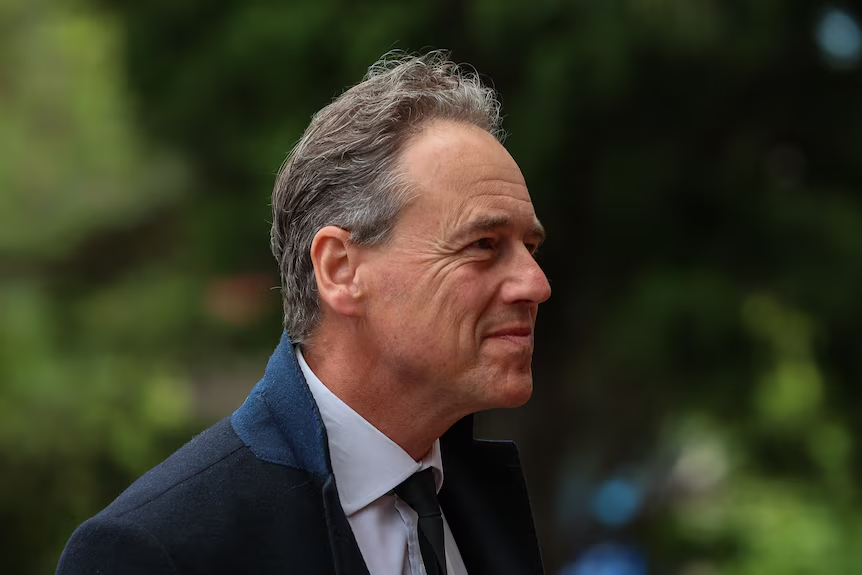
Within months of leaving politics, former health minister Greg Hunt accepted advisory roles with companies tied to senior figures in the Plymouth Brethren Christian Church. These same companies had profited from hundreds of millions of dollars in COVID-19 contracts while Hunt was overseeing Australia’s pandemic response. The revelation has triggered fresh debate over political donations, lobbying practices, and the blurred lines between public service and private influence.
A Minister Turned Adviser
Greg Hunt, who retired from parliament in May 2022, was one of the most visible faces of Australia’s COVID-19 response. Less than a year later, he began working as a board adviser to Connected Global, a company owned by Gavin and Russell Grace. Both are close to Bruce Hales, the church’s global leader.
Connected Global is linked to Westlab, a pathology supplier that received $54.1 million in contracts during Hunt’s time as minister. After his retirement, Westlab secured an additional $80.8 million in contracts within just 11 months.
The arrangement raises pressing questions. Was the timing coincidental, or does it highlight deeper issues in the way government contracts are awarded and monitored? Hunt’s office insists there is no conflict of interest. “Mr Hunt had no dealings, meetings, contact or engagement with the companies or individuals you raise while minister nor any decisions relating to them,” a spokesman said. According to the Australian National Audit Office, COVID procurement decisions were made solely by the public service, not ministers.
Expanding Roles Across Borders
Hunt’s involvement has not been limited to one firm. Since late 2022, he has added two more advisory roles, with Sydney’s Arconn design group and Auckland-based Expedite Design. Both are linked to Brethren leadership circles. The advisory roles require just a handful of days per year, but the symbolism looms larger than the workload.
Critics argue that such appointments give powerful businesses access to insider knowledge and networks built during years in office. Supporters counter that former ministers should be free to continue their careers, provided they follow lobbying restrictions and cooling-off periods.
The Brethren Business Empire
The Plymouth Brethren Christian Church, often described by critics as secretive, supports a sprawling network of more than 3,000 businesses worldwide. Former members allege the group enforces strict social controls, including limiting contact with non-members, excluding women from leadership roles, and cutting ties with those who leave.
The Brethren has about 55,000 members globally, with a strong presence in Australia. Its business reach extends into construction, manufacturing, health supplies, and logistics. The connections to politics have historically been quiet, but recent election campaigns have shifted that perception.
Donations and Election Campaigns
For the first time, evidence has confirmed that Brethren-affiliated businesses have been major donors to the Liberal Party. Just days before the 2022 election, Voltex Electrical Associates, a South Australian company tied to Brethren leadership, donated $115,000 to the party.
At the same time, Brethren members were out in force, volunteering for Liberal campaigns across Australia. Though traditionally discouraged from voting, they were seen handing out flyers and even scrutineering during counts. Labor MP Jerome Laxale, who faced intense campaigning from Brethren volunteers in Bennelong, called the experience “like nothing I’ve ever experienced before… the sheer number of people that turned up in a coordinated manner.”
The church maintains that any member volunteering is acting as a private citizen, not under instruction. In a statement, it rejected the “cult” label used by Prime Minister Anthony Albanese and others, saying its members “support the Bible’s guidance” on voting decisions and exercise individual choice when volunteering.
Political Leaders’ Relationships
Senior Liberal figures have long maintained cordial ties with the Brethren. Former prime minister Tony Abbott described them as “very good people, who contribute a lot to our society.” Angus Taylor, a Liberal MP who nearly won the party leadership post-election, praised the Brethren’s Rapid Relief Team (RRT) charity. The RRT, which spends almost $5 million annually in Australia, provides food and aid in disasters and supports political fundraising events like the “Pollie Pedal” rides.
Yet the overlap between philanthropy, business profit, and political campaigning leaves a complex picture. While donations and volunteering are legal, the perception of influence remains a challenge for transparency and public trust.
The Inquiry Ahead
A parliamentary inquiry into political donations and third-party involvement in campaigns is expected to examine the Brethren’s activities closely. Committee chair Jerome Laxale has already signaled concern. “It felt like they were there to buy the election,” he said. “This is not a standard Australians want repeated.”
The inquiry is likely to probe how much sway religiously linked business networks can wield in politics, and whether current disclosure rules capture the true scale of such influence. It may also consider tightening restrictions on post-ministerial employment in industries that benefited from government contracts.
Public Service Procurement or Political Leverage?
The heart of the matter lies in the relationship between government procurement and private sector gains. While the audit office has cleared ministers of direct involvement, the optics of a former health minister working with companies tied to multimillion-dollar contracts are difficult to ignore.
The situation mirrors broader global debates about “revolving door” politics, where senior officials move seamlessly into private firms they once regulated. In Australia, cooling-off periods exist, but critics argue they are too short and poorly enforced.
What This Means for Voters and Businesses
For voters, the story underscores the need for vigilance around donations, volunteer networks, and post-political careers. Transparency measures, such as real-time disclosure of donations and stricter oversight of advisory roles, could help restore public confidence.
For businesses, the case highlights the reputational risks of political entanglement. Companies seeking government contracts must now consider not just compliance, but also perception. Aligning with controversial religious or political groups may secure short-term gains but carry long-term costs.
The Road Ahead
Greg Hunt continues to defend his post-political work as fully compliant with rules and free from conflicts. The Brethren, meanwhile, insists it is a faith-based community unfairly maligned in public debate.
But with a $22 billion global business empire, millions in political donations, and visible election campaigning, the group is unlikely to fade from scrutiny. The forthcoming inquiry may set new benchmarks for transparency, reshaping how politics and private networks interact in Australia.
The outcome will affect not just one former minister, but the broader trust Australians place in their democratic system. And as pandemic contracts, religious influence, and political donations converge in this case, the lines between faith, business, and politics remain as blurred as ever.