
In December 2020, then-president Donald Trump declared a “medical miracle” as the first COVID-19 vaccine was approved in the United States. The announcement came after the pandemic had already claimed more than 292,000 lives in the country. Operation Warp Speed, his administration’s program to fast-track vaccine development and distribution, became a cornerstone of his claim to saving tens of millions of lives.
Five years later, Trump continues to describe it as one of the greatest achievements of his presidency. But his choice of health secretary, Robert F. Kennedy Jr., has sparked turmoil inside his own party. Kennedy, a long-time vaccine sceptic, now sits in the most powerful health policy chair in the nation, and his actions are testing the Republican coalition Trump relies upon.
A Showdown in Washington
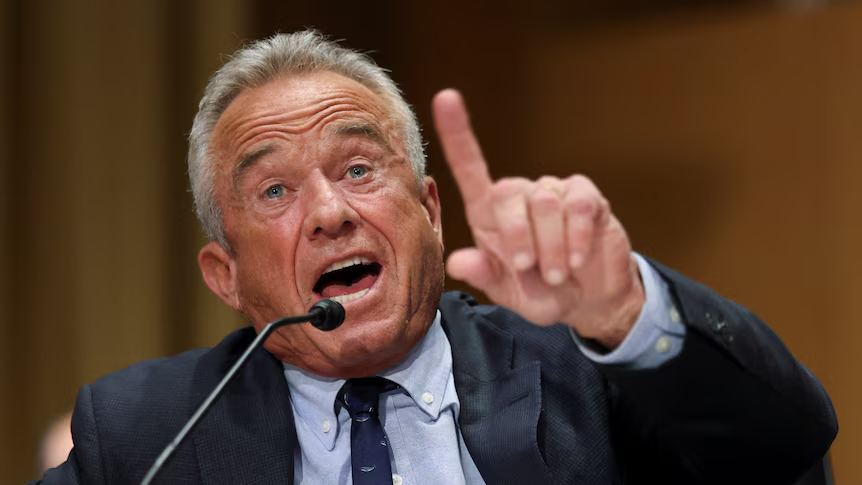
Last week, Kennedy was questioned by the Senate Finance Committee in a tense, three-hour session. Lawmakers from both parties demanded clarity on his sweeping changes at the Department of Health and Human Services.
Under Kennedy’s watch, the Centers for Disease Control and Prevention (CDC) director was forced out after less than a month. The Food and Drug Administration (FDA) moved to sharply restrict access to COVID-19 vaccines. A half-billion-dollar federal investment in mRNA vaccine research was abandoned. Most controversially, Kennedy dismissed the entire CDC immunisation advisory committee, replacing its members with several known vaccine critics.
Republican senator Bill Cassidy pressed Kennedy on whether Trump deserved a Nobel Prize for overseeing Operation Warp Speed. Kennedy agreed without hesitation, despite his years of casting doubt on the very vaccines that program delivered. The contradiction was not lost on Cassidy or the watching public.
From Activist to Policymaker
Before entering government, Kennedy chaired Children’s Health Defense, one of the most influential anti-vaccine organisations in the United States. In that role, he promoted claims that have been widely debunked, including a link between vaccines and autism.
Now, with the authority of public office, Kennedy has shifted those ideas into policy. He insists Americans should not take medical advice from him personally. Yet, his words and decisions have already begun shaping health policies at the state level.
Florida’s Experiment with Vaccine Rules
Florida became the first state to adopt sweeping changes that mirrored Kennedy’s rhetoric. In early September, Surgeon General Joseph Ladapo announced plans to end school vaccine mandates for diseases including hepatitis B, chickenpox, Hib influenza, and pneumococcal infections.
The move, described by Ladapo as a defense of parental rights, would still require vaccines for measles, polio, diphtheria, pertussis, mumps, and tetanus. The state health department expects the policy to take effect within 90 days.
Dr Mehmet Oz, now heading Medicare and Medicaid Services, backed the change on national television. He argued doctors should not face government pressure over vaccination schedules, calling mandates an overreach.
Experts see Florida’s decision as a direct consequence of Kennedy’s influence. “It undermines trust and confidence in vaccines,” said Professor Margie Danchin of the Murdoch Children’s Research Institute in Melbourne. “That has allowed states like Florida to roll back public health protections.”
Blue States Push Back
In response, Democratic-led states are working to safeguard vaccine access. On September 3, the governors of Washington, Oregon, and California announced a joint initiative to create their own vaccine recommendations. They pledged to rely on science-based evidence from respected medical organisations.
Other states, including Pennsylvania, Colorado, and Massachusetts, have taken similar steps to ensure COVID-19 boosters and routine vaccines remain widely available. The message from these states is clear: science-based health policy will not be abandoned.
Still, experts warn that policy protections are not enough. “States will need to rebuild trust at the community level,” Professor Danchin noted. “The dissension is weakening confidence in vaccines.”
A Looming Public Health Crisis
The stakes are already visible. Childhood vaccination rates are declining nationwide. According to the CDC, measles outbreaks in the U.S. are now the worst in 25 years, with more than 1,450 cases across 42 states and three reported deaths. About 92 percent of the cases involved unvaccinated individuals.
“This is not hypothetical,” said Professor Danchin. “We are seeing vaccine-preventable diseases return. More children, elderly people, and immunocompromised Americans will die if coverage continues to drop.”
Public health experts warn that polio, once eradicated in the U.S., could re-emerge if vaccination rates fall further.
Trump Balances Loyalty and Science
The crisis poses a political dilemma for Trump. Kennedy’s loyal supporters were key to his 2024 election victory and could be decisive again in the midterms. At the same time, the majority of Americans still believe schoolchildren should be required to receive routine vaccinations.
Trump has praised Kennedy’s “different” perspective, particularly his focus on parental rights and informed consent. Yet he has drawn the line at endorsing Florida’s repeal of vaccine mandates. “Some vaccines are so amazing — the polio vaccine, for example,” Trump told reporters. “You have to be careful when changing requirements.”
Scott Gottlieb, who led the FDA during Trump’s first term, told CNBC the president has always respected the importance of childhood immunisation schedules. “Kennedy is at odds with the president’s ethos, and with the Senate,” Gottlieb said.
A Divided Republican Party
The divide over vaccines is cutting through the Republican Party. Conservative governors like Ron DeSantis have embraced Kennedy’s approach, while Republican physicians in Congress have drawn a hard line in defense of science.
Harry Melkonian, a senior fellow at the United States Studies Centre, said the split could become a defining issue for the party. “Trump doesn’t want to alienate Kennedy’s followers,” he explained. “But he also can’t afford to let vaccine-preventable disease outbreaks define his presidency.”
For now, Kennedy’s position appears secure. “Trump has to make this work,” Melkonian added. “But Kennedy is stepping on toes, and that makes the balancing act harder every day.”
The Road Ahead
The U.S. faces a complex battle over science, politics, and public health. As vaccine hesitancy spreads, so do preventable diseases. States are pulling in opposite directions, one group retreating from mandates and another doubling down on scientific consensus.
For families, the choices are becoming more complicated. Parents in Florida may soon have the right to opt out of multiple childhood vaccines, while parents in California will face reinforced requirements backed by state-level commissions.
The question for Washington is whether Trump can hold his coalition together without sacrificing the nation’s public health. The answer may determine not only his political legacy but also the health of millions of Americans in the years ahead.