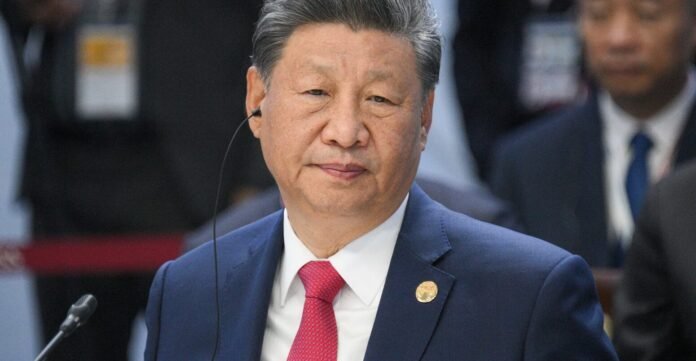
China, the world’s largest emitter of greenhouse gases, has announced a landmark commitment to cut its emissions by 7–10 per cent by 2035. The pledge was delivered by President Xi Jinping in a video address to the United Nations Climate Summit, making it the first time Beijing has formally agreed to an absolute reduction target rather than intensity-based promises.
The announcement comes at a critical moment for global climate action. While China takes a step forward, the United States is pulling back. President Donald Trump this week dismissed climate change as a “con job,” rolling back commitments made under previous administrations. The divergence highlights the widening gulf between the two largest economies and their approaches to environmental responsibility.
China’s Shift in Climate Policy
For decades, China’s climate strategy relied on pledges to reduce emissions intensity—measured as emissions per unit of GDP—rather than absolute cuts. This approach allowed emissions to keep rising so long as economic growth outpaced pollution. The 7–10 per cent reduction target, by contrast, signals a readiness to slow and then reverse the trajectory of carbon output.
The scale of the commitment is significant. China accounts for nearly 30 per cent of global greenhouse gas emissions, more than the combined output of the United States, the European Union, and India. A reduction of 7–10 per cent would translate into hundreds of millions of tonnes of avoided carbon dioxide, equivalent to removing the annual emissions of entire developed nations.
Context of the Announcement
President Xi’s remarks arrive against a backdrop of mounting international pressure. Extreme weather linked to climate change has disrupted global supply chains, raised food prices, and intensified social unrest. China itself has faced devastating floods, record-breaking heatwaves, and air pollution crises in recent years.
At the same time, Beijing sees opportunity in the global transition. China dominates the supply chains for solar panels, wind turbines, and battery production. A domestic emissions cut provides not only climate benefits but also a strategic chance to reinforce its leadership in green industries.
The Role of Global Politics
The timing of China’s commitment also carries geopolitical weight. As Washington retreats, Beijing positions itself as a responsible power filling the climate leadership vacuum. Analysts suggest that this move could strengthen China’s influence in negotiations and in institutions that shape international climate finance.
Michael Jacobs, Professor of Political Economy at the University of Sheffield and an adviser on climate and energy policy, described the announcement as “a huge deal.” He noted that while the percentage reduction may seem modest, its symbolic and practical significance lies in shifting the world’s biggest polluter toward absolute cuts.
Economic Trade-Offs
Implementing the reduction target will require deep structural change in China’s energy system. Coal still provides more than half of the country’s electricity, and heavy industries like steel and cement remain dependent on fossil fuels. Transitioning these sectors involves massive investment, potential job displacement, and complex political negotiations with provincial governments.
Yet the government has already laid groundwork. China leads the world in renewable energy investment, spending over US$500 billion on clean power projects in 2023 alone. It is also piloting carbon markets, electrifying transport, and experimenting with carbon capture technologies. The 2035 target could accelerate these trends by creating clearer long-term policy certainty.
Implications for Other Countries
China’s decision raises the stakes for other major emitters. The European Union has set a goal of cutting emissions by at least 55 per cent by 2030 compared with 1990 levels, while India continues to resist absolute reductions, focusing instead on energy intensity. The United States, under its current administration, has walked back from earlier pledges, risking international isolation.
Diplomatically, China’s new stance may pressure others in the Global South to align more closely with its approach. Developing nations often look to Beijing as a model of industrial growth coupled with increasing environmental responsibility. If China can show that reducing emissions does not undermine prosperity, the ripple effect could be profound.
Technology and Innovation Pathways
Meeting the 2035 goal will hinge on rapid deployment of technology. Renewable power generation, already competitive with coal in many regions, must expand even faster. Electric vehicles, now a booming sector in China, will need stronger infrastructure support, particularly charging networks in rural areas.
Energy efficiency standards, digital monitoring systems, and the scaling of hydrogen fuel are also likely to play central roles. China’s ability to mobilize state-led investment and control large industrial sectors gives it an advantage in implementing such systemic shifts. However, success will depend on balancing top-down directives with incentives for private innovation.
Domestic Challenges
Despite its centralised governance, China faces hurdles in enforcing climate goals. Provincial governments often prioritise local economic growth over environmental rules. The steel and coal industries wield significant political clout, and workers in fossil fuel–dependent regions fear unemployment.
Public opinion is another factor. While urban residents support cleaner air and sustainable development, rural populations may be more sceptical if the transition leads to higher energy costs or reduced employment opportunities. The government will need to manage these tensions carefully, likely through subsidies, retraining programs, and social safety nets.
Global Reaction
International responses to China’s announcement have been cautiously optimistic. European leaders welcomed the commitment but urged greater ambition, noting that a 7–10 per cent cut falls short of the scale needed to align with the Paris Agreement’s 1.5°C target. Environmental groups praised the shift toward absolute reductions but stressed that the world’s largest emitter must act faster.
The United Nations Secretary-General highlighted the announcement as “a meaningful step forward,” while reminding all nations that collective action is essential. Without broader alignment, even China’s efforts will not be enough to prevent catastrophic climate outcomes.
The Numbers Behind the Target
To grasp the impact, it is important to put the numbers in context. China’s total annual emissions exceed 12 billion tonnes of CO₂ equivalent. A 7 per cent cut would reduce that by roughly 840 million tonnes, while a 10 per cent cut would lower it by 1.2 billion tonnes. For comparison, Australia’s total annual emissions are about 400 million tonnes. This means China’s cut alone could equal two to three times Australia’s entire carbon output.
Such reductions would also ease pressure on global carbon budgets, buying time for slower-moving economies to decarbonize. Analysts, however, warn that the reductions must be genuine and not achieved through accounting mechanisms or offset purchases.
Looking Ahead
The pledge opens a new chapter in global climate diplomacy. If China follows through, it could change the trajectory of international negotiations and inspire more ambitious commitments at upcoming climate summits. The 2035 timeline also extends beyond current political cycles, suggesting a long-term policy direction that may outlast leadership changes.
For businesses, the message is clear: the world’s biggest market is serious about cutting emissions. Companies that invest in low-carbon technologies, supply chains, and green finance stand to benefit. For policymakers, the challenge is to ensure that China’s target becomes a catalyst rather than an isolated gesture.
The coming decade will test whether this announcement is remembered as a turning point or a missed opportunity. But for now, China’s move shifts the global narrative. In a world where some leaders call climate change a hoax, the largest emitter has just said it will emit less. That, by itself, changes the conversation.

