
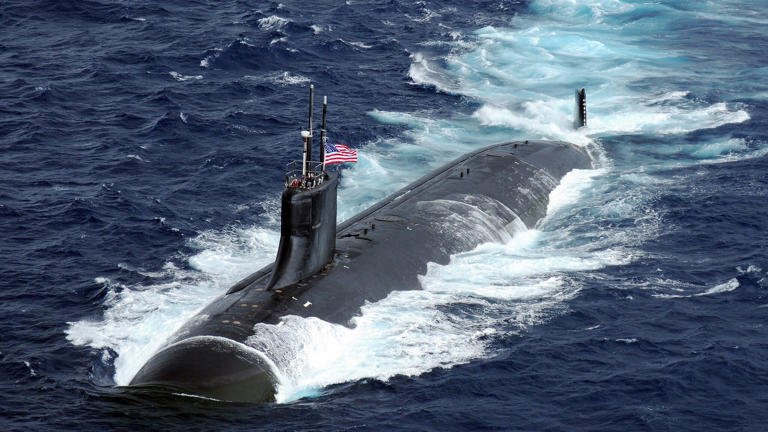
Military history is full of once-invincible machines that became obsolete almost overnight. The battleship, the tank, the bomber—all reigned supreme until new tools exposed their weaknesses. Now, Australia’s $368 billion Aukus nuclear-powered submarines, hailed as the “apex predators of the oceans,” may face the same fate.
For decades, submarines have been prized for their invisibility. Hidden beneath the waves, they were both hunters and deterrents, carrying weapons that could reshape entire conflicts. But what if that invisibility is fading? A wave of new detection technologies, led by quantum sensing, advanced satellites, and artificial intelligence, is making the world’s last opaque frontier—the oceans—alarmingly transparent.
If the forecasts hold true, Australia’s massive investment could end up producing what some analysts have bluntly called “billion-dollar coffins.”
The New Underwater Arms Race
The contest is not just about who can build submarines. It is about who can find them. Nations are pouring billions into tools designed to shrink the vast hiding spaces of the seas.
Sonobuoys, underwater drones, magnetometers, and AI-enabled satellites are being layered into dense surveillance webs. These networks don’t rely on a single detection method. Instead, they stitch together small clues: minute shifts in wave patterns, tiny changes in sea temperature, faint magnetic disturbances, even the glowing trails of disturbed plankton.
On their own, these signals might seem trivial. Combined, they can reveal the exact path of a submarine. Artificial intelligence is the force multiplier. While a human analyst might struggle to sift through oceans of data, AI can detect patterns invisible to the naked eye, linking disturbances across vast regions into a coherent map of a vessel’s movement.
Much of this progress is being driven by China, the very power that the Aukus pact was designed to counter.
China’s Quantum Leap
Chinese researchers are claiming breakthroughs that could fundamentally reshape undersea warfare.
In 2024, scientists from Shanghai Jiao Tong University unveiled a seabed sensor able to detect the faint electromagnetic waves from submarine propellers at distances of nearly 20 kilometers—ten times farther than before. A separate team in Xi’an announced an airborne magnetometer capable of following the persistent magnetic “wake” left behind by a moving submarine.
Perhaps most striking, the China Aerospace Science and Technology Corporation revealed a drone-mounted quantum sensor system. According to their claims, it rivals NATO’s advanced MAD-XR detectors but at a fraction of the cost, enabling deployment on a massive scale.
Quantum sensors operate by measuring changes at the atomic level, offering sensitivity that was once the stuff of science fiction. If these systems deliver on their promise, oceans once thought to be impenetrable could soon be crisscrossed by invisible webs of detection.
Countermeasures: Staying Hidden in Plain Sight
Of course, submarine designers are not standing still. Every detection advance is met with new attempts at stealth.
Anechoic tiles scatter sonar signals. Pump-jet propulsion reduces wake turbulence. Cooling systems help mask thermal signatures against satellites. Submarines are also “degaussed”—their magnetic fields neutralized—to evade magnetometers.
Yet the balance may be shifting. As Dr. Anne-Marie Grisogono, a systems scientist at Flinders University, explains: “The likelihood that the oceans will become transparent at some time is basically 100%. The only question is when.”
She co-authored the 2020 report Transparent Oceans, which predicted that by the 2050s—exactly when Australia’s Aukus boats will still be in service—submarines will no longer be reliably hidden.
The most likely scenario is not one technology breaking submarines’ invisibility, but networks of cheap, disposable sensors working together. “If your defensive system is cheap and can take out expensive assets, the advantage shifts to the defense,” Grisogono warns.
Australia’s Strategic Gamble
The stakes for Australia are enormous. The Aukus program represents the largest defense investment in its history, locking in decades of financial and strategic commitments. Yet the first submarines are not expected to be in the water until the 2040s. By then, detection technologies may have leaped ahead, undermining the very rationale for submarines.
Some experts argue that Australia risks preparing for yesterday’s war. The Aukus boats were conceived to deter a rising China in contested waters like the South China Sea. But if those waters become transparent, the deterrent effect could vanish.
Critics ask: Should Australia bet its defense future on platforms that may be obsolete before they even launch? Or should it diversify into emerging technologies that offer resilience and adaptability?
Ghost Sharks and Hybrid Fleets
Canberra is already hedging its bets. This year, the government committed $1.7 billion to acquire dozens of Ghost Shark autonomous underwater vehicles.
Roughly the size of a minibus, these uncrewed subs are designed for intelligence, surveillance, and long-range strike missions. Powered by AI, they can be launched from warships or coastlines and operate without risking human crews. Unlike the multi-billion-dollar Aukus submarines, Ghost Sharks are relatively cheap and expendable.
Defence Minister Richard Marles insists the investment complements, not replaces, nuclear submarines. “We are very confident about Australia’s future submarines,” he said, emphasizing that detection technologies are being matched by stealth advances.
Vice Admiral Mark Hammond, the Chief of Navy, echoed that sentiment, arguing that every new detection tool has historically been met by an equally innovative counter. “I’ve heard about ‘transparent oceans’ for 31 years, and nothing’s really changed,” he said.
Yet skeptics see the shift towards unmanned platforms as a tacit admission that the seas of the future may belong less to hulking crewed subs and more to swarms of agile, AI-driven machines.
Detectable Means Destroyable
For strategist Peter W. Singer of the New America think tank, the lesson is clear. Once a system loses stealth, it loses survival. “If they’re detectable, they’re destroyable,” he says.
Singer notes that Australia’s submarines won’t just be entering service in 20 years—they’ll still be under construction into the 2060s. In technological terms, that’s several generations away.
“The battlefield is becoming more observable, more transparent. The apex predators of today may find themselves the prey tomorrow,” he warns.
The comparison to Ukraine’s use of cheap drones against Russian tanks is telling. Drones worth a few hundred dollars have destroyed armor costing tens of millions. Undersea warfare could see a similar shift, with disposable drones neutralizing submarines that cost billions.
A Call for Strategic Reassessment
The question for Australia is not simply whether Aukus submarines will be effective in the 2040s. It is whether investing so heavily in them leaves the country vulnerable to being outpaced by technological change.
Dr. Grisogono suggests that policymakers should zoom out: “We should be asking bigger questions about our defense posture. Does this make sense if the oceans are no longer opaque?”
Some argue that nuclear submarines only make sense in the context of major conflicts alongside the United States, rather than for Australia’s independent defense needs. Others counter that the geopolitical symbolism of Aukus—cementing ties with Washington and London—justifies the cost, even if the submarines’ battlefield edge erodes.
The Future: Transparent or Opaque?
The debate may come down to timing. If the oceans remain opaque until mid-century, Aukus submarines could dominate their lifespan. If transparency comes sooner, they could quickly become liabilities.
No one can say with certainty. Military secrecy obscures the true state of detection technologies. Breakthroughs are as likely to be kept under wraps as announced.
But the trend is unmistakable: the oceans are becoming less mysterious. Networks of sensors, powered by AI, are closing the gaps. And once a submarine can be tracked, it can be targeted.
Australia’s bet on Aukus is a bet against that future. Whether it pays off will depend not just on engineering, but on the pace of discovery in physics, data science, and artificial intelligence.
For now, the oceans remain dark. But the light is spreading.