
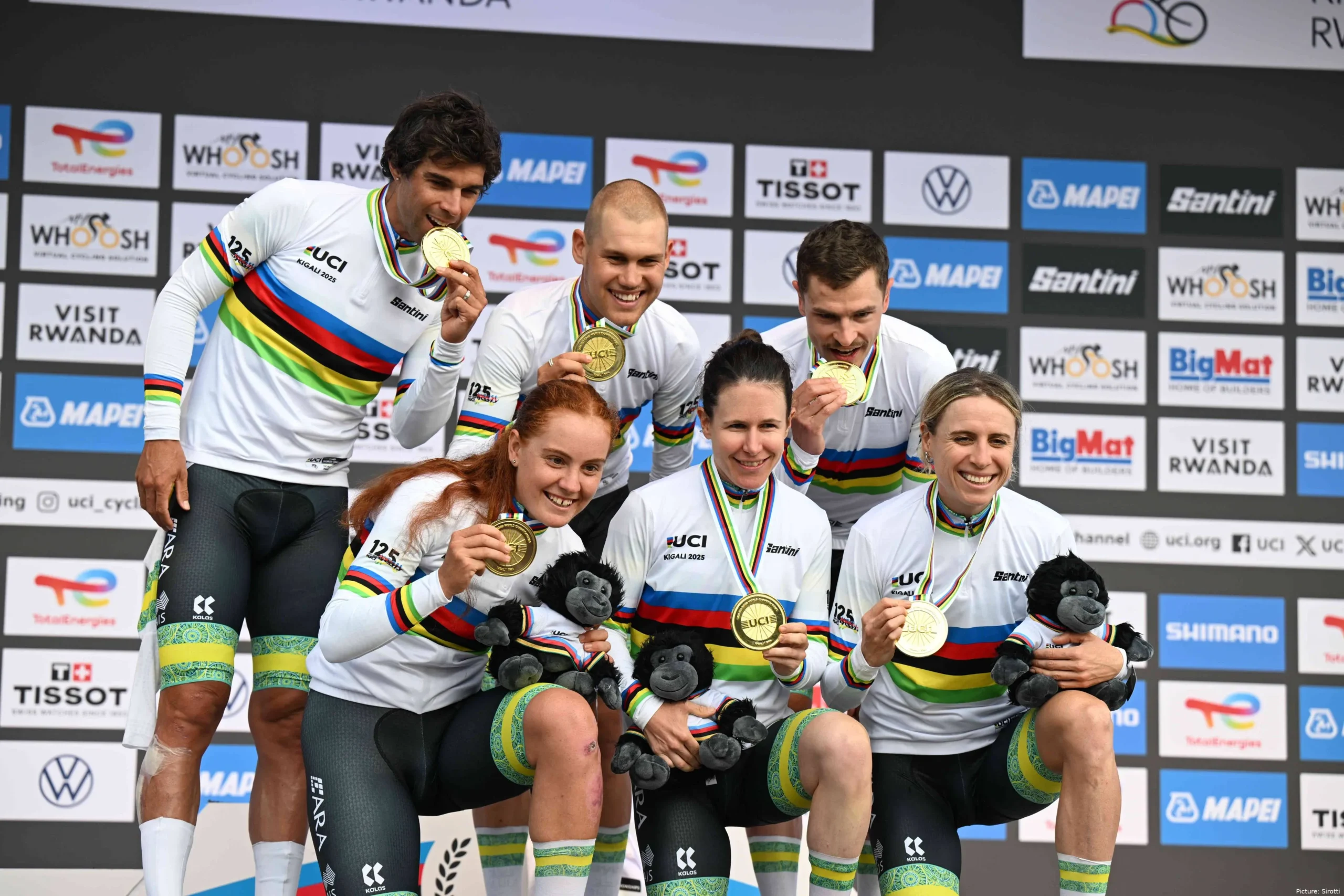
Australia has etched its name into cycling history with a groundbreaking victory in the mixed relay team time trial at the 2025 UCI Road World Championships. For the first time since the event’s introduction in 2019, the Australians captured the gold medal, edging out cycling powerhouses Germany and the Netherlands. The win was not only a triumph of endurance and strategy but also a testament to years of investment in team cohesion and athlete development.
The Race That Changed Everything
The mixed relay team time trial is unique in its format. Each squad consists of three male and three female riders, with the men setting the pace first before handing the effort over to the women. The combined time determines the final result, demanding precision, pacing, and seamless transitions.
Australia executed their plan flawlessly. The men’s trio set a blistering tempo over the opening half of the course, giving their female teammates a crucial cushion. The women then held their nerve in the closing kilometers, pushing across the line with just enough advantage to seal victory.
Germany, long considered the standard bearer in this discipline, finished second, while the Netherlands took third. Belgium and Italy rounded out the top five, underscoring the depth of European dominance that Australia had to overcome.
A Historic Milestone
This gold medal carries extra weight. Since the inception of the event, European teams have dominated the podium. For Australia to break through represents a shift in the global balance of cycling power.
Cycling Australia’s performance director noted that the victory is more than a single result. “It proves that with the right preparation, Australia can lead in events traditionally dominated by European nations. This is a statement for the future of our program,” he said.
The win also highlights the progress of Australia’s women’s cycling program, which has seen increased funding and grassroots development in recent years. The balance between the men’s and women’s squads was pivotal, showing the strength across the board.
Precision and Preparation
Success in the mixed relay requires more than raw strength. Riders must fine-tune pacing strategies to ensure smooth transitions between the men’s and women’s groups. Australia’s squad rehearsed these exchanges repeatedly, with coaches timing every detail in training.
Data analysis played a major role as well. Performance staff used advanced telemetry to model aerodynamic efficiency, power output, and recovery profiles. The team knew precisely when to push and when to conserve energy, a tactical edge that proved decisive in the closing stages.
The Athletes Who Delivered
Australia’s lineup included seasoned professionals and rising stars. The men’s squad, featuring a blend of WorldTour experience, set an uncompromising pace. Their ability to sustain high power on the flat sections gave the women a margin to manage the second half.
On the women’s side, consistency and calm under pressure were key. The anchor rider’s closing pull was particularly significant, maintaining tempo when fatigue threatened to erode their lead. The cohesion was visible; no rider was left isolated, and the final kilometers were executed like clockwork.
Global Implications
The victory has global implications for cycling. It challenges the assumption that only European nations have the infrastructure and talent depth to dominate mixed relay events. For emerging cycling nations, Australia’s success provides a model: invest in equal development across genders, leverage sports science, and prioritize teamwork over individual heroics.
The UCI has been promoting the mixed relay as a showcase for gender equality in cycling, and Australia’s win reinforces this vision. It highlights how balanced development can yield results and inspire younger generations.
Beyond the Podium
This win could be a catalyst for broader change in Australian cycling. Government agencies and sponsors are likely to view the result as validation of investment in cycling programs. Grassroots clubs across the country may benefit from increased attention, drawing new talent into the sport.
Moreover, the mixed relay format provides a rare opportunity for men and women to compete in a truly collaborative way at the highest level. For young athletes, seeing both genders contributing equally to a world championship victory is powerful. It redefines what success in sport looks like.
The Road Ahead
Looking forward, Australia’s challenge will be to build on this momentum. The mixed relay victory creates expectations for future championships and the Olympic Games, should the discipline be added to the Olympic program. Sustaining success requires continuous innovation, particularly against European nations determined to reclaim dominance.
The team has already outlined plans to refine training protocols and expand athlete depth. Identifying the next generation of riders to complement current champions will be critical. The emphasis will remain on balance—ensuring that both men and women’s programs progress in lockstep.
Lessons for Other Sports
The triumph offers lessons beyond cycling. It underscores the importance of preparation, data-driven strategy, and gender equity in high-performance sport. For nations aspiring to challenge traditional powers in any discipline, the Australian model provides a roadmap.
In a sporting culture where individual achievements often dominate headlines, the mixed relay shows the value of collective performance. The medal belongs not to one rider but to an entire system of coaches, analysts, and support staff.
A Moment to Remember
For the riders on the podium, the moment was unforgettable. Draped in gold, the team stood as symbols of persistence and innovation. Their win will be remembered not only as Australia’s first mixed relay title but also as a turning point in how nations view the potential of this event.
Cycling history is often shaped by iconic solo rides or dramatic sprints. But sometimes, history is written in the power of six athletes pulling in the same direction. Australia’s mixed relay squad proved that unity, preparation, and belief can topple giants.
Their victory in 2025 will echo for years to come—on roads, in training centers, and in the imaginations of young cyclists inspired to believe that they, too, can rewrite the script.