
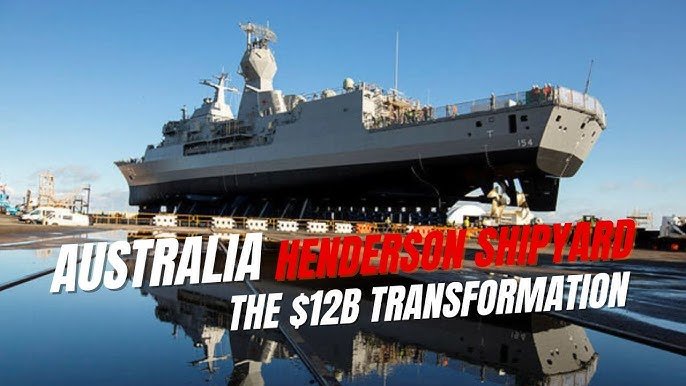
Australia’s federal government has formally pledged A$12 billion to revamp the Henderson shipyard in Western Australia. This is the first major tranche toward a decades-long, AUKUS-linked plan to build a comprehensive defence precinct. The facility will be central to Australia’s ability to build and sustain warships, landing craft, and nuclear-powered submarines under the AUKUS partnership with the United States and United Kingdom. (Reuters)
Scope of the Investment
- The A$12 billion serves as an initial down payment. Early works will begin while design, planning, and feasibility are being finalised. (The Guardian)
- The full Henderson precinct is projected to cost around A$25 billion over the decade. (The Guardian)
- Key elements to be built or expanded include:
- Facilities for constructing Australia’s Army landing craft and new general-purpose frigates. (Reuters)
- Upgraded maintenance capacity for surface combat vessels. (Sourceable)
- Docking facilities and infrastructure to support deployment and maintenance of nuclear-powered submarines starting in the early 2030s. This includes contingency docking capabilities and depot-level maintenance. (Reuters)
Strategic & Economic Significance
- Jobs and industry: The precinct is expected to create roughly 10,000 well-paid, high-skilled local jobs in shipbuilding, maintenance, and related industries. (Reuters)
- Regional defence posture: The facility strengthens Australia’s maritime capabilities under AUKUS, increases sovereign capacity to build and sustain its naval fleet, and offers strategic maintenance hubs for US & UK vessels in rotation. (Reuters)
- Long-term investment: It underpins a broader push in defence spending. The precinct is one piece among many in Australia’s Integrated Investment Program, which commits tens of billions of dollars to enhancing maritime, submarine, and surface combatant capabilities. (Defence)
Challenges & Key Considerations
- Design & engineering: Detailed engineering, environmental assessment, and design work are yet to be completed. The precise number of dry docks, supporting infrastructure, and project phasing are not yet fixed. (ABC)
- Regulatory & safety obligations: As the facility enters operations involving conventionally-armed, nuclear-powered submarines, Australia must meet international obligations under non-proliferation treaties, nuclear safety, and environmental regulations. (finance.gov.au)
- Workforce capacity: Scaling up the required skilled workforce will be essential. Training programs, industry partnerships, and pathways to attract and retain technicians, engineers, and support staff will shape project success. (finance.gov.au)
Timeline & Next Steps
| Phase | Expected Activity | Approximate Timeframe |
|---|---|---|
| Planning & Design | Feasibility studies, environmental impact, engineering designs, consultations | Now through the next 1-3 years (Sourceable) |
| Early Construction | Landing craft, frigate building preparatory works; enabling infrastructure | Soon after designs are finalised; early 2030s for major facilities (Reuters) |
| Submarine Capabilities Operational | Contingency docking, depot-level maintenance for nuclear-powered submarines; rotations | From early 2030s onward (Reuters) |
Implications for Policy & Stakeholders
- Government must ensure transparent contracting, clear milestones, risk management (especially around nuclear safety), and oversight.
- Defence industry has opportunity: companies supplying shipbuilding, dock infrastructure, propulsion, and nuclear-adjacent systems can expect contracts. Early alignment with standards and capability requirements will be crucial.
- State government of WA plays a central role in enabling land access, local infrastructure, workforce development, regulatory approvals. Strong coordination with the Commonwealth is needed.
- Local communities and environment: Proximity to residential areas, ecosystems in Cockburn Sound, and possible nuclear safety concerns will demand ongoing communication, environmental monitoring, and safeguards.
Australia’s A$12 billion investment into Henderson is more than a budget line. It is a defining moment for Australia’s defence posture, industry, and regional influence. By matching ambition with execution, the government aims to deliver a precinct that serves strategic needs, supports local economies, and ensures the nation is prepared for a more contested and complex security environment.