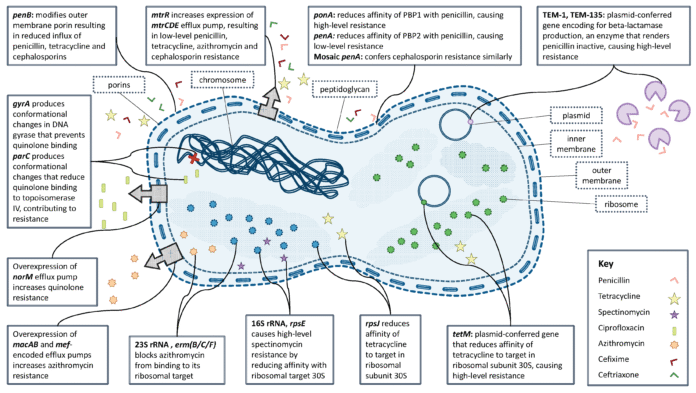
Antibiotic-resistant gonorrhoea is entering a critical phase. Recent data show resistance levels rising fast. For many infected people, the drugs once used to cure gonorrhoea are becoming unreliable. But hope is emerging in the form of a novel oral antibiotic nearing regulatory approval.
Rising Tide of Resistant Strains
Globally, gonorrhoea infects over 80 million people each year among those aged 15 to 49. (World Health Organization) Resistance to several classes of antibiotics—tetracyclines, macrolides (including azithromycin), quinolones—is well established. (World Health Organization)
In England, the number of diagnoses rose to more than 85,000 in 2023, the highest since recording began in 1918. (BMJ) Between 2014 and 2023, notification rates in some European countries increased by over 300%. (BMJ) In New South Wales (NSW), Australia, gonorrhoea cases almost doubled from 2022 to 2024, topping 14,000 in 2024—its highest count since 1991. (NSW Health)
Worryingly, cases of extensively drug‐resistant (XDR) gonorrhoea are appearing. These are strains resistant to first-line treatments such as ceftriaxone and azithromycin. (NSW Health) In England, 42 cases of ceftriaxone-resistant gonorrhoea have been recorded since 2015. (GOV.UK) In NSW, two XDR cases were notified in March 2025: one acquired overseas (Cambodia) and one with no clear travel origin. (NSW Health)
What Is Driving Resistance
Several factors are working together:
- Widespread antibiotic use without sufficient diagnostics. Countries where antibiotics are easy to obtain have fewer safeguards. (World Health Organization)
- Use of older, cheaper drugs that bacteria have long been exposed to. The bacteria adapt. (Science Publishing Group)
- Under-reporting and weak surveillance, especially in low- and middle-income regions. Many resistant strains are probably circulating without being detected. (World Health Organization)
- Pharyngeal and rectal infections that go unnoticed. These sites are harder for treatment to reach well. They act as reservoirs for resistant strains. (World Health Organization)
Consequences
The consequences of unchecked antibiotic resistance in gonorrhoea are serious:
- Treatment failure becomes more common. Standard therapies may not work.
- Increased spread of infection. When treatments fail, infected people can transmit longer.
- Greater risk of complications: infertility, pelvic inflammatory disease, ectopic pregnancies, neonatal eye infections. (World Health Organization)
- Rising healthcare costs. More complex and longer treatments. More diagnostic tests. More hospital care.
Surveillance Data Shows Alarming Trends
Recent surveillance reports confirm what many public health experts feared:
- WHO’s Enhanced Gonococcal Antimicrobial Surveillance Programme (EGASP) documented rising resistance to ceftriaxone in the WHO Western Pacific Region in 2023. (ScienceDirect)
- In the UK, during January 2024 to March 2025, 17 ceftriaxone‐resistant gonorrhoea cases were recorded. That number nearly matches the total in the previous two years combined. (GOV.UK)
- XDR cases in England rose: 9 in the Jan 2024-Mar 2025 period vs. 5 in the prior two years. (GOV.UK)
Promising New Treatment: Gepotidacin
A key development may shift the balance. Gepotidacin, an oral antibiotic, is under evaluation. It has shown promising results in large clinical trials. (The Guardian)
- It was compared against the standard treatment (ceftriaxone injection plus azithromycin pill). It met its primary goal of non-inferiority, meaning it was as good as the standard therapy in many cases. (The Guardian)
- It was effective even against many strains resistant to current drugs. (The Guardian)
- The U.S. Food and Drug Administration (FDA) has accepted gepotidacin for priority review, with a decision expected in December 2025. (Reuters)
If approved, gepotidacin would provide a much easier option: oral rather than injectable. That simplifies treatment. It reduces strain on clinics. It may improve patient compliance.
What Clinicians and Policy Makers Must Do Now
To counter this threat and to make the most of new tools, action is needed across several fronts.
- Improve diagnostics and testing practices.
- Use culture-based testing before initiating treatment wherever possible. Culture allows detection of resistance. (NSW Health)
- Use PCR and other molecular tests, but do not neglect culture and sensitivity testing.
- Collect swabs from all relevant sites: throat, rectum, genital tract—especially in patients with risk factors like travel, multiple partners, or men who have sex with men.
- Travel history must be part of patient assessment.
- In regions where XDR strains are more common (e.g. parts of South-East Asia), travel increases risk. NSW Health guidance emphasizes this. (NSW Health)
- Follow-up and test of cure.
- Conduct test of cure (e.g. PCR) 2 weeks after finishing treatment. (NSW Health)
- Advise patients to avoid sexual contact until treatment is complete and symptoms resolve.
- Contact tracing aggressively.
- It reduces reinfection and stops spread.
- Clinics and public health units must ensure tracing for at least the prior two months of partners.
- Stewardship of existing antibiotics.
- Use standard treatments only when they are likely effective.
- Avoid overuse and misuse.
- Limit use of older antibiotics to cases where susceptibility is known.
- Prepare for the arrival of new treatments.
- If gepotidacin becomes approved, clinics must plan for obtaining supply.
- Update treatment guidelines to include new options.
- Train clinicians about when to use gepotidacin vs when standard therapy still suffices.
- Strengthen surveillance systems globally.
- Increase reporting in countries with limited data.
- Support labs capable of culture, sensitivity testing.
- Share data rapidly to detect emerging strains.
- Support research into vaccines and novel antibiotics.
- WHO and other agencies already emphasize this. (World Health Organization)
- New drug classes (like those triggering “self-destruction” mechanisms in bacteria) are under study. (ScienceDaily)
What This Means for Patients
For individuals, the rise of resistance changes what patients should expect and ask for:
- If you are having symptoms (discharge, pain, sores), get tested from all possible infection sites, not just where symptoms appear.
- Ask whether culture or drug-sensitivity testing was done.
- If treated, return for test-of-cure even if symptoms go away.
- If you have travelled recently, especially to regions with known high resistance, inform your health provider.
- Practice safer sex. Regular screening even without symptoms matters, because many infections are asymptomatic.
Looking Ahead
The situation is precarious. Without strong stewardship, the bacteria will catch up and make treatment harder. But the tools are coming. Gepotidacin may soon join the arsenal. New antibiotics and vaccine research offer hope. Yet, they are not immediate fixes.
In the next 12-18 months, regulatory decisions, guideline updates and strong public health interventions will determine whether rising resistance can be turned back. The world needs to act decisively.

