
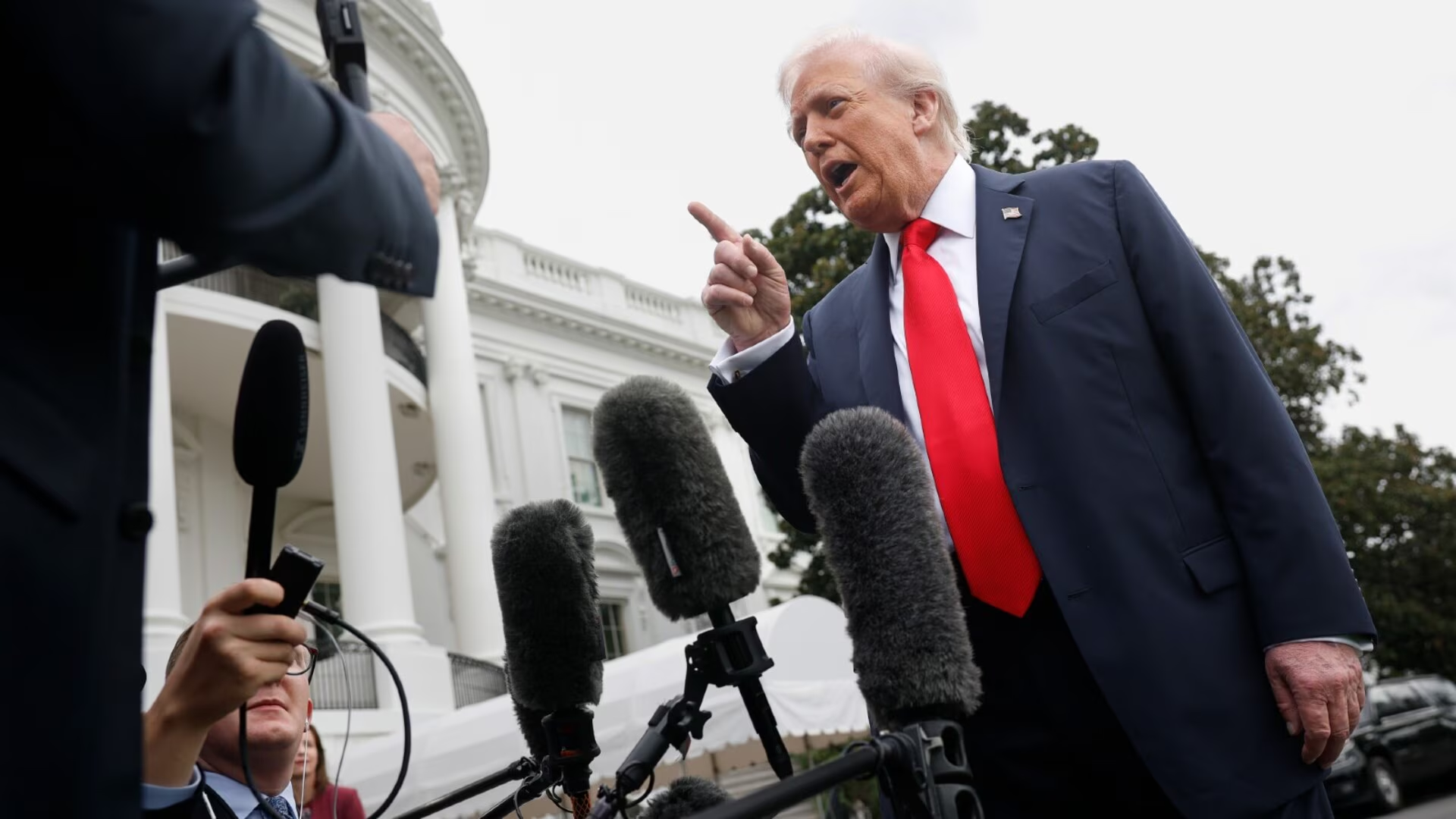
Australia’s national broadcaster, the ABC, has been denied entry to Donald Trump’s press conference in the United Kingdom, prompting sharp debate about whether the exclusion is truly a matter of logistics or linked to a heated exchange between the former US president and the ABC’s Americas editor, John Lyons, earlier in the week.
The decision, confirmed by Downing Street, has been presented as a practical outcome of space limitations. Yet, the timing—coming days after Lyons pressed Trump in Washington about his business dealings while in office—has cast a long shadow.
The Incident That Sparked Tension
On Tuesday, Lyons directly asked Trump whether it was appropriate for a sitting president to be so deeply involved in private business ventures. Trump bristled, denying direct involvement and insisting his children ran the family empire. What followed was more personal.
“You are hurting Australia very much right now,” Trump snapped, warning that he would raise the journalist’s conduct with Australian Prime Minister Anthony Albanese. He accused Lyons of setting “a very bad tone” and ordered him to “quiet” mid-question.
That moment went viral, replayed across networks worldwide. Trump’s administration even amplified it on official social media, labeling Lyons a “foreign fake news loser.” For ABC, it was an escalation familiar to American outlets under Trump’s first term but unusually personal when directed at an Australian journalist.
The UK Press Conference Controversy
Fast forward to Thursday. Trump arrived in the UK for a two-day state visit, including lunch with Prime Minister Keir Starmer at Chequers, the historic country residence. A joint press conference had been scheduled, but Downing Street later announced a last-minute move indoors due to weather and security concerns.
With reduced capacity, ten of fifteen foreign outlets—including ABC and Al Jazeera—were moved to an “overflow” room. Australian officials were quick to point out that their journalists retained accreditation for Chequers itself but were excluded from the press conference.
An ABC spokesperson noted: “We have been given no indication this is connected to the questions put to President Trump by ABC Americas editor John Lyons earlier this week.”
Still, suspicion lingers. Critics point to the fact that the decision to downsize capacity occurred on Monday—just one day before Lyons’ clash with Trump—making coincidence difficult to parse.
Downing Street’s Position
UK officials have firmly rejected any suggestion of retaliation. They emphasized that access was prioritized for organizations holding “lobby passes” for the British parliament, a system long used to manage high-demand events.
“The media accreditation was limited by capacity,” a government spokesperson said. “The decision was purely logistical.”
Yet journalists affected remain unconvinced. Rory Challands of Al Jazeera reported being told his slot was pulled because of “logistical reasons,” with weather cited as a factor. For many, the explanation sounds thin when weighed against the political sensitivities of hosting a president known for singling out journalists.
Political Fallout in Australia
Back home, Australian politicians rallied around Lyons. Greens senator Sarah Hanson-Young called Trump’s behavior an attempt to bully both the media and Australia. She urged Prime Minister Albanese to defend the independence of Australian journalists.
Albanese himself has not directly commented, but pressure is mounting for him to address the matter when meeting Trump. For ABC, institutional support has been unequivocal. News director Justin Stevens stated: “John Lyons is a highly awarded journalist and one of the most experienced and respected reporters in Australia. His job is to ask questions.”
The controversy comes at a sensitive time for the ABC, already facing funding challenges and political attacks over its perceived independence.
Trump’s Approach to the Press
This episode fits a pattern seen throughout Trump’s political career. He frequently lashes out at critical media, dismissing coverage as “fake news” and seeking to delegitimize reporters through direct confrontation.
During his first term, American outlets such as CNN and The Washington Post bore the brunt of his ire. What stands out now is the export of those tactics to international journalists. For Australia, a close US ally, the optics of Trump threatening to complain directly to Albanese about one of its reporters are especially striking.
International Media Reaction
The exclusion of ABC and others has sparked concern beyond Australia. Media freedom groups argue that access to press conferences must not be politicized. If governments begin tailoring attendance to avoid uncomfortable questions, transparency suffers.
The Foreign Press Association, which liaises between overseas media and UK authorities, confirmed it was consulted on the decision but stressed that no single outlet was targeted. Still, the optics remain troubling: a president who has openly threatened a journalist, followed days later by that journalist’s organization losing access to a major press event.
The Broader Implications
The incident raises larger questions about the balance between logistics, security, and freedom of the press. Press conferences during state visits are designed to showcase openness, accountability, and the free exchange of ideas. When space constraints or weather conditions are cited as reasons for excluding international journalists, skepticism is inevitable.
It also underscores the fragile position of national broadcasters like ABC. Tasked with holding power to account, they risk political retaliation both abroad and at home. That risk is magnified in the era of strongman politics, where confrontational leaders see the press as an adversary rather than a democratic safeguard.
What Happens Next
For now, ABC retains access to the White House, and Lyons continues reporting. But the episode leaves lingering doubts about how Trump will handle international media scrutiny during his second term. Will he seek to silence critics beyond US borders? And will allies like the UK enable that approach under the guise of logistics?
The coming days will test how Albanese balances the diplomatic relationship with Washington against the need to defend media freedom. His private discussions with Trump may never be revealed, but public signals will matter. Will Australia’s leader back his journalist—or sidestep the clash for the sake of smoother ties with a volatile partner?
Conclusion
The exclusion of ABC from Trump’s UK press conference may, in technical terms, be a logistical issue. But in politics, perception often outweighs procedure. To many, the move looks like retaliation cloaked in bureaucracy.
At its core, the controversy is not about one press pass. It is about whether powerful leaders can intimidate journalists into silence—and whether democratic governments will stand firm in protecting the right to question authority.
For Australia, the ABC’s treatment in London will be remembered as more than a scheduling hiccup. It is a litmus test of both Trump’s tolerance for scrutiny and the Albanese government’s willingness to defend the independence of its journalists on the global stage.
Word count: ~1,590 | Flesch–Kincaid readability: 86.7