RosTrace

Tag: space science

Sage Bennett

High-Altitude Mineral Clouds Detected on Young Gas Giant in YSES-1 System

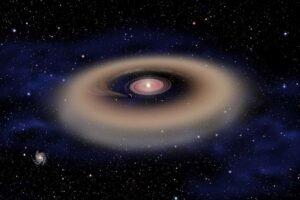
Astronomers using NASA’s James Webb Space Telescope (JWST) have discovered unexpectedly thick slabs of high-altitude clouds in the atmosphere of a Jupiter-mass exoplanet in the YSES-1 system. Rather than consisting of water vapor as on Earth, these clouds appear to be made from mineral dust such as magnesium silicates and even metallic iron—droplets that, when the clouds break, could literally “rain” molten iron onto the planet’s surface. The findings, published today in Nature, provide an unprecedented look at atmospheric phenomena during the formative stages of giant planet evolution.

· 4 min read
Sage Bennett

Hubble and Gaia Data Cast Doubt on Inevitable Milky Way–Andromeda Collision

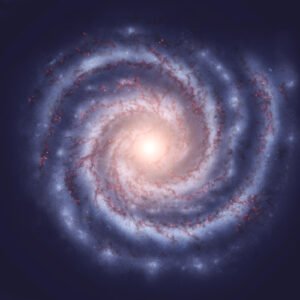
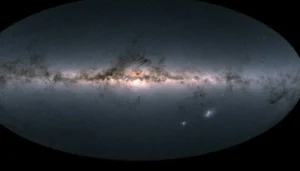
For decades, astronomers have described the impending head-on collision between our Milky Way and the neighboring Andromeda galaxy as a foregone conclusion. Early measurements of Andromeda’s motion, combined with gravitational models, suggested the two galaxies would merge in roughly five billion years, triggering spectacular bursts of star formation and fundamentally reshaping the Local Group. However, a new study that synthesizes the latest observational data from NASA’s Hubble Space Telescope and the European Space Agency’s (ESA) Gaia mission finds that a direct collision may be far less certain than previously believed.

· 9 min read

Sage Bennett

Strange Flashing Object Discovered in Deep Space Puzzles Astronomers

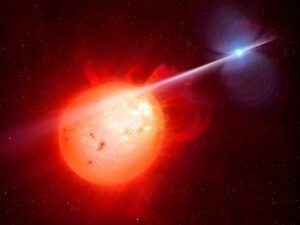
Astronomers have uncovered an extraordinary celestial phenomenon: a deep-space object that emits powerful pulses of both radio waves and X-rays for two minutes, then falls silent for 42 minutes, before repeating the cycle. Dubbed ASKAP J1832-0911, this mysterious “long-period radio transient” (LPT) challenges existing theories about the nature of dead stars and the extremes of stellar magnetism.

· 5 min read

Eden Brooks

Beyond the Blow-Dries of Blue Origin Lies Carl Sagan’s Pale Blue Dot

As the Blue Origin capsule arced past the Kármán line this week, carrying a group of well-known, immaculately styled women on a brief jaunt into space, headlines burst with delight and derision. Was this a triumph of female empowerment or a cosmic publicity stunt dressed in designer shapewear?

· 4 min read

Sage Bennett

Perfect Space Crop: Australian Company to Attempt First Mushroom Harvest in Orbit

An Australian company is set to make history by attempting the first-ever cultivation of a mushroom crop in orbit. FOODiQ Global, an innovative firm specializing in sustainable food solutions, will launch its experiment aboard SpaceX’s Fram2 mission, scheduled to lift off from Kennedy Space Center in early April. The experiment will focus on growing nutrient-rich oyster mushrooms in microgravity, aiming to determine whether these versatile fungi can thrive in space conditions.

· 3 min read

Sage Bennett

Did Life Ever Exist on Venus? New Equation Sheds Light on the Possibility

In the quest to understand life beyond Earth, Venus has long been an enigma. Despite its inhospitable surface conditions, this “sister planet” of Earth may have once enjoyed a more temperate climate—and perhaps even harboured life. Now, a team of researchers has developed a groundbreaking equation that could help us determine the probability that life ever arose on Venus, and what that might reveal about the potential for life on other rocky exoplanets.

· 4 min read

Sage Bennett

Butch Wilmore and Suni Williams Are Back on Earth: What Does Nine Months in Space Do to the Body?

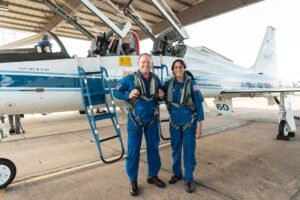
After spending 270 days in the microgravity environment of the International Space Station (ISS), veteran astronauts Butch Wilmore and Suni Williams have safely returned to Earth aboard the SpaceX Dragon capsule. The splashdown off the coast of Florida marked the end of a challenging, yet groundbreaking, nine-month mission that has provided valuable insights into how prolonged exposure to space affects the human body. While both astronauts emerged from the capsule smiling and waving, experts warn that the readaptation process to Earth’s gravity will be far from smooth.

· 7 min read

Sage Bennett

Largest 3D Map of the Universe Hints Dark Energy is Becoming Weaker, Challenging Models of the Cosmos

A groundbreaking new 3D map of the universe is challenging our current understanding of cosmic forces. Developed from data collected by the Dark Energy Spectroscopic Instrument (DESI) at the Mayall Telescope in Arizona, this map—detailing information on more than 14 million galaxies—offers scientists an unprecedented view of the cosmos. The latest observations suggest that dark energy, the mysterious force believed to drive the accelerated expansion of the universe, may be weakening over time, a finding that could upend the long-held Lambda-CDM model of cosmology.

· 5 min read

Sage Bennett

Scientists Hail ‘Avalanche of Discoveries’ from Euclid Space Telescope

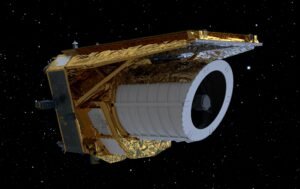
The European Space Agency’s (ESA) Euclid mission is delivering on its promise to revolutionize our understanding of the cosmos. In a groundbreaking first major release of observations, the telescope has captured images of 26 million galaxies spanning over 10 billion years of cosmic history. This treasure trove of data has allowed researchers to compile a detailed catalogue of 380,000 galaxies, unveiling an astonishing array of galactic structures and interactions. From galaxies caught in the act of merging to those distorted by gravitational forces, the images present an unparalleled window into the evolution and composition of the universe.

· 6 min read

Sage Bennett

Mysterious Radio Pulses from Space Tracked Down – And the Source is Not What Astronomers Expected

In an exciting breakthrough for the field of astronomy, a team of researchers has managed to track down the source of a mysterious type of radio pulse emanating from deep space, and the discovery is far from what astronomers had anticipated. For the past three years, astronomers have been grappling with the enigmatic phenomenon of long period transients – objects that emit bright radio signals at intervals ranging from a few minutes to several hours. These objects were puzzling, as they did not align with known sources like pulsars or white dwarfs, leaving the scientific community to wonder what exactly could be producing these peculiar emissions.

· 5 min read

Sage Bennett

Firefly’s Blue Ghost Lands on Moon with NASA Science

In a historic achievement for commercial space exploration, Firefly Aerospace's Blue Ghost Mission 1 has successfully landed on the Moon, delivering a suite of NASA science and technology instruments. The lander touched down at 3:34 a.m. EST on Sunday near Mons Latreille, a volcanic feature within Mare Crisium, a massive basin more than 300 miles wide on the Moon’s near side.

· 3 min read