Tidal says it will remove tracks it determines were made entirely by artificial intelligence, with its ban taking effect on 9 December. The company reports that 27 million tracks on its service,…
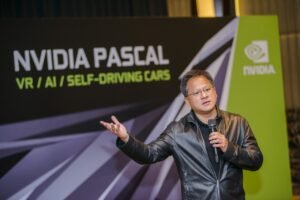
Nvidia CEO Jensen Huang has been reinstated by the company’s board after resigning earlier this month, but his return leaves the chipmaker facing questions about China, export controls and corporate oversight. A…
US President Donald Trump has threatened to impose a “tremendous tax” on American companies that build data centres overseas, saying the United States should keep the facilities at home. He gave no…
Anthropic’s seven co-founders are collectively worth more than $180bn on paper after the company’s shares began trading on Thursday at $111.50 each, above expectations, according to The Guardian’s report [1]. The reported…
Nine large data centres proposed for Australia could produce 39 million tonnes of greenhouse gas emissions over 10 years if powered mainly by fossil fuels, the Climate Council says. The estimate, set…
Nvidia has reported quarterly revenue of $115.8bn, more than double the figure a year earlier, while its board says it will not reinstate co-founder Jensen Huang as chief executive. Interim CEO Colette…
Nvidia has not announced that Jensen Huang will leave as chief executive, and the succession names circulating in a new TechCrunch article are speculation, not a confirmed shortlist. The Nov. 12 report…
Nvidia says its board has launched an independent investigation after reports that chief executive Jensen Huang had a relationship with Alice Huang, a Chinese businesswoman whom US intelligence officials reportedly believed was…
After major layoffs, an Xbox Game Studios executive advised former Microsoft employees to use AI tools like Microsoft Copilot to handle the stress of job loss. This advice, from Executive Producer Matt Turnbull in a now-deleted LinkedIn post, sparked debate about AI's role in mental health, the suitability of tech-based coping strategies, and the impact of automation at work.
Concrete underlies nearly every modern city’s infrastructure—from skyscrapers and highways to bridges and sidewalks. Yet its primary binding agent, Portland cement, accounts for an estimated 7–8 percent of global carbon dioxide emissions. As governments, companies, and researchers pursue decarbonization strategies, reimagining concrete’s composition emerges as a critical frontier. A recent collaboration between the Olivetti Group and MIT’s Concrete Sustainability Hub (CSHub) has turned to artificial intelligence to tackle the vast search for alternative cementitious materials. Their results, published in Nature Communications Materials on May 17, outline a data-driven framework that combs through scientific literature and geochemical databases to identify viable replacements for cement. By pairing AI-powered text mining with experimental insights, the team has charted a path toward more sustainable, circular concrete that could dramatically cut emissions and costs—without compromising durability or strength.
In a major step toward more intuitive and efficient human-robot collaboration, engineers at the Massachusetts Institute of Technology (MIT) have unveiled a groundbreaking system called “Relevance”, which enables robots to determine, in real time, what objects in a scene are most important for assisting humans.
You may have seen ads by Apple promoting its new Clean Up feature that can be used to remove elements in a photo. When one of these ads caught my eye this weekend, I was intrigued and updated my software to try it out.
· 3 min read
Your privacy
We use essential cookies to run this site. With your permission, we and our advertising and analytics partners, including Google, also use cookies to measure readership and show more relevant ads. You can change your choice at any time from "Cookie settings" at the bottom of every page. Read our Privacy Policy
Accessibility
Adjust how this site looks and behaves for you. Your choices are saved on this device only.
Darker text and stronger lines, borders and links.
Shows text in the OpenDyslexic typeface.
More space between lines, letters and words.
Makes every link easy to spot.
A bold outline shows where you are when using a keyboard.
Turns off animations, transitions and autoplaying video.