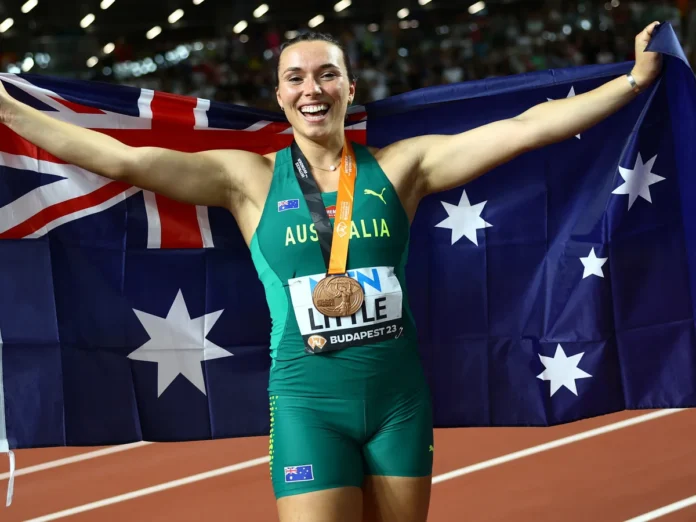
Australia’s Mackenzie Little has once again proven that her talent with the javelin can match her dedication to medicine, securing a bronze medal at the World Athletics Championships while maintaining her full-time career as a doctor. The 28-year-old, who works in the emergency department at Sydney’s Royal North Shore Hospital, continues to juggle the twin demands of elite sport and medicine—a balance many critics thought was unsustainable.
Little entered the championships under pressure, having struggled in last year’s Paris Olympic final where she was eliminated early. Yet she silenced doubts with a stunning 65.54-metre throw in qualifying, followed by 63.58 metres in the final that immediately put her among the frontrunners. For a moment, she even held the lead, until Ecuador’s Juleisy Angulo surpassed her with a 65.12-metre effort. Latvia’s Anete Sietina claimed silver with a last-round 64.64 metres, pushing Little into bronze.
For Little, the medal symbolises more than just performance. It is a story of resilience, persistence, and the ability to defy conventional wisdom about what an elite athlete’s life should look like.
The Demands of Dual Careers
Balancing two full-time roles would overwhelm most people. Little’s days often start at 6:30 a.m. in the hospital, where she handles emergency cases, before rushing to training in the evening. By her own admission, this sometimes means she arrives an hour late to practice, exhausted but committed. “That’s really hard,” she reflected after her bronze-winning performance. “But I’ve maintained even in the toughest times that this is best for me. I compete the best when I’m happy and fulfilled, and work is so fulfilling right now.”
This perspective runs counter to traditional elite sports models, where athletes are often encouraged to narrow their focus and make sacrifices outside competition. Many suggested she scale back her medical commitments after the disappointment in Paris. Little considered the advice but ultimately rejected it. “It’s not the path I want to take forward,” she said.
Her decision underscores a growing conversation in athletics about mental health, work-life balance, and identity beyond sport. By holding onto medicine, she ensures her professional life doesn’t hinge solely on medals—a mindset that, ironically, may be what enables her to perform so well under pressure.
Redemption After Olympic Heartbreak
For Little, this medal also represents redemption. Her 12th-place finish in Paris was a crushing blow, especially after years of preparation. She admits the aftermath was tough. “After the Olympics, it was devastating. It took months to really get back into it again,” she revealed.
The road back was paved with lonely training sessions and quiet determination. Winning bronze in Budapest two years ago had raised expectations, but failing to deliver at the Games left her vulnerable to self-doubt. This year’s championship showed not only her physical form but also her mental resilience. “I feel like this is a bit of redemption from the Olympics,” she said, “and it’s more reflective of what I can do.”
Her words resonate with athletes worldwide who struggle with the peaks and valleys of form. For many, one bad tournament can define a career in the eyes of fans and critics. Little’s ability to bounce back sends a message: setbacks need not dictate the future.
The Science of Performance Under Pressure
Interestingly, Little credits her hospital work with sharpening her athletic edge. Emergency medicine requires rapid decision-making, composure, and stamina under extreme stress. Those same qualities transfer directly to competition.
When she steps onto the runway, the mental discipline honed in trauma cases allows her to block out noise and focus on execution. “The frantic nature of being a doctor actually helps me during competitions,” she explained. It’s a rare insight into how seemingly conflicting commitments can, in fact, reinforce each other.
Sports psychologists often emphasise that diverse experiences can buffer athletes against performance anxiety. In Little’s case, saving lives daily redefines what pressure really means. Compared to hospital emergencies, the stress of a javelin final feels manageable.
A Medal Beyond Numbers
Australia’s track and field team has had its share of ups and downs in recent years, but Little’s medal adds to a growing list of encouraging performances. It is the nation’s third bronze of the championships and her second career medal at this level. For a country constantly looking to build depth in athletics, especially in field events, her consistency is a welcome development.
But beyond statistics, Little’s story connects with people because it reflects broader struggles—balancing careers, handling setbacks, and finding fulfilment in multiple areas of life. She represents a model of success that doesn’t require choosing one path at the expense of another.
Critics and Admirers
Not everyone is convinced. Some argue that Little might achieve even greater results if she dedicated herself exclusively to athletics. In a sport where marginal gains can separate champions from contenders, the question lingers: could she have gone further with total focus?
Yet Little counters with her own evidence. Twice now, she has stood on the podium at the world stage while keeping her medical career intact. Her achievements challenge the binary thinking that insists athletes must sacrifice everything else to succeed.
This dual-identity athlete is building a legacy that goes beyond distance thrown. She is reshaping what it means to be elite, proving that high performance can coexist with professional ambition outside sport.
Looking Ahead
After celebrating her bronze medal, Little plans to travel with her family to the Philippines before returning to Sydney for night shifts in the hospital. Once back, she will dive into the familiar rhythm of long days in emergency medicine followed by training sessions. The cycle begins again, with new targets on the horizon.
For Australia, her continued presence on the world stage provides both inspiration and stability. For Little herself, it means sustaining the balance that gives her joy and strength. “I compete the best when I’m happy,” she emphasises.
With the next Olympics approaching, the question is not whether she can handle the demands—she has already proven that. Instead, it’s whether her unique balance of medicine and athletics might just unlock her best performance yet.
Lessons Beyond the Field
Little’s journey offers actionable lessons for professionals in any field. First, fulfilment in multiple roles can fuel excellence rather than diminish it. Second, setbacks—even devastating ones—can be reframed as stepping stones with the right mindset. Third, resilience is not about avoiding difficulty but about finding meaning that makes the struggle worthwhile.
For young athletes, her story illustrates that success is not a one-size-fits-all path. For medical professionals, it highlights the importance of balance and personal passion. And for broader audiences, it is a reminder that life’s challenges can be turned into powerful motivators when approached with clarity and purpose.
A Role Model for Modern Athletics
In an era when sports are increasingly professionalised and commercialised, Mackenzie Little stands out as a role model who proves that athletes do not have to surrender their broader identities to succeed. She is part of a growing cohort redefining what it means to compete at the highest level—athletes who are also doctors, engineers, activists, or parents.
By winning bronze, she has secured not just a medal but a story that resonates far beyond athletics. It is a story of balance, of resilience, and of rewriting the rules about how champions are made. And as she heads back to her hospital shifts with another medal in her collection, she embodies a truth that is as relevant in life as it is in sport: success is not only about the podium, but about the person who stands on it.

