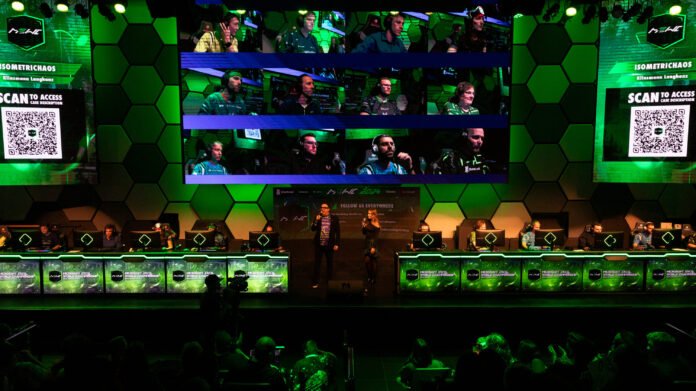
Theme music blares. A championship belt gleams under bright stage lights. Competitors sit at their computers, fingers flying across keyboards as a live audience roars. This isn’t professional wrestling or a video game tournament—it’s the Microsoft Excel World Championship (MEWC), where the planet’s fastest and sharpest spreadsheet minds battle for prestige, prize money, and oversized WWE-style belts.
Yes, that Excel—the same tool most people associate with office work, budgeting, and the occasional painful assignment. But in this parallel universe, Excel is the ultimate arena, transforming formulas, macros, and problem-solving into spectator sport.
The Rise of Excel Esports
The MEWC has turned what many thought was a mundane skill into an electrifying global event. With qualifiers taking place worldwide, the top 256 competitors are funneled into a knockout round each October. From there, only 32 make it to the grand stage in Las Vegas.
The competition is anything but dull. Matches are livestreamed on YouTube, broadcast on ESPN, and framed with the kind of hype usually reserved for boxing or football. There are commentators providing play-by-play, cheering fans, and even a catchy theme song that asks: “It’s the Excel World Championship, who’s going in the spreadsheet bin?”
The atmosphere has helped elevate Excel esports into a quirky but surprisingly serious global spectacle.
Australia’s Excel Elite
One of the sport’s biggest names comes from Australia. Actuary Andrew “The Annihilator” Ngai dominated for three consecutive years and earned the nickname “the Kobe Bryant of Excel.” His reign was finally toppled by British-Canadian Michael “The Jarman Army” Jarman, showing just how competitive the field has become.
Now, another Australian—Melbourne’s Grayson Huynh—is making headlines. A self-proclaimed foodie who first used Excel to track restaurant reviews, Huynh reached the finals in 2024 and narrowly missed out on the crown. This year, he’s determined to do one better.
“It was nerve-wracking on stage,” Huynh recalls. “You’re on someone else’s computer, commentators are calling every move, and there’s a live audience watching you. It feels like public speaking on steroids.”
Training Like an Athlete
Huynh treats preparation like any professional athlete would. His regimen includes timed practice runs of past challenges, strategy discussions with fellow competitors, and mental conditioning to handle stage fright.
“I didn’t do too well last year because I couldn’t manage the nerves,” he admits. “I was wondering if I could even type properly. This time, I’m focusing less on formulas and more on mindset. Just like in other sports, mental strength is something I overlooked.”
Challenges at the MEWC aren’t basic data-entry tasks. One recent final asked competitors to design formulas for tracking avatars and vital signs in a World of Warcraft-style simulation. Some use Python to speed up solutions, while others stick to pure Excel wizardry. In the end, what matters is speed and accuracy.
“It’s like solving a Rubik’s Cube,” Huynh says. “There are lots of algorithms, but everyone has their own approach.”
The Other Big Stage: Office Specialist Championship
Parallel to the MEWC is the Microsoft Office Specialist World Championship (MOSWC). Unlike the professional league, this competition is only open to students aged 13 to 22.
Winners represent their countries and fly to Florida for a one-time chance at global glory. Once you compete, you can’t return.
Guatemalan teenager Carmina Solares knows the stakes well. At 16, she made it to the top 10 globally—the only girl and the only Latin American to reach that level.
“I used to dream of Excel spreadsheets,” Solares says. “I’d invent formulas in my sleep and test them when I woke up.”
For her, the achievement was bigger than personal recognition. “Guatemala doesn’t get much attention in these areas. Opportunities are limited. You either have to be brilliant enough to win a scholarship or wealthy enough to leave.”
Her story was featured in Spreadsheet Champions, an Australian documentary that premiered at the Melbourne International Film Festival. Director Kristina Kraskov admitted she initially thought the competitions were a joke but soon realized their cultural significance.
“In some countries, being good at school isn’t cool. But in places like Vietnam, there’s deep respect for test-taking. That cultural difference makes the competition a huge deal,” Kraskov explains.
The prize money also changes lives. “Seven thousand dollars is nice pocket money for an Australian teen,” she says. “But for a competitor from Cameroon, it’s more than the average annual income.”
Spreadsheets as a Subculture
Excel esports is not just about the stage—it’s a growing online subculture. From TikTok to Reddit, “Excel influencers” are building communities around formulas, shortcuts, and creative spreadsheet applications.
One TikToker even tracks her dating life in Excel, building formulas to predict ghosting patterns. Others sell templates for habit tracking, budgeting, and even Christmas shopping. On Reddit, the Excel community boasts more than 800,000 members, and YouTubers teaching Excel tricks rack up millions of views.
Huynh himself has logged Melbourne restaurant reviews in a spreadsheet for more than a decade. He uses Excel to track flight itineraries, house inspections, and investments. For him, spreadsheets are less about work and more about structure, memory, and creativity.
“It was always a joke among my friends that I should compete,” he says. “Eventually, I realized it was a great way to push myself to learn more and see how far I could go.”
Why Excel Works as a Sport
The success of Excel esports highlights a key shift: entertainment can be built around almost anything if the competition is structured well. Like chess, Rubik’s Cube speedsolving, or poker, Excel offers clear goals, measurable outcomes, and limitless strategies.
Viewers may not understand every formula, but they can appreciate the intensity and suspense. Watching a pro rip through a complex dataset in seconds is oddly addictive.
For competitors, the sport validates a skill that often goes underappreciated in workplaces. In fact, financial firms, tech companies, and consultancies increasingly view Excel mastery as a prized asset. The MEWC and MOSWC are not only entertainment—they’re talent showcases.
What Comes Next
Excel esports may still be niche, but momentum is building. Last year, more than 600 people registered for the MEWC, and interest is growing worldwide. As livestreams attract bigger audiences and sponsors recognize the potential, prize pools and visibility could expand dramatically.
Huynh believes the community will only grow. “I feel like there’s more traction this year. I’m also exploring content creation, because people love learning little tricks that make their lives easier.”
The next frontier may involve greater crossover with mainstream esports, partnerships with tech giants, or integration with educational platforms. Already, Excel is a core skill in business schools, and competitions like these are making the learning process both aspirational and entertaining.
A Final Thought
Most people think of Excel as mundane. Yet, in the right hands, it becomes a stage for creativity, logic, and lightning-fast decision-making. The MEWC proves that even spreadsheets can inspire drama, passion, and global fandom.
“Excel is my bread and butter,” Huynh says. “Give it a try—you might enjoy it. You might get hooked like me.”
And that’s the surprising truth: a program designed for accountants and analysts is now producing champions, inspiring documentaries, and creating a sport all its own. For competitors and fans alike, the gridlines are just the beginning.

