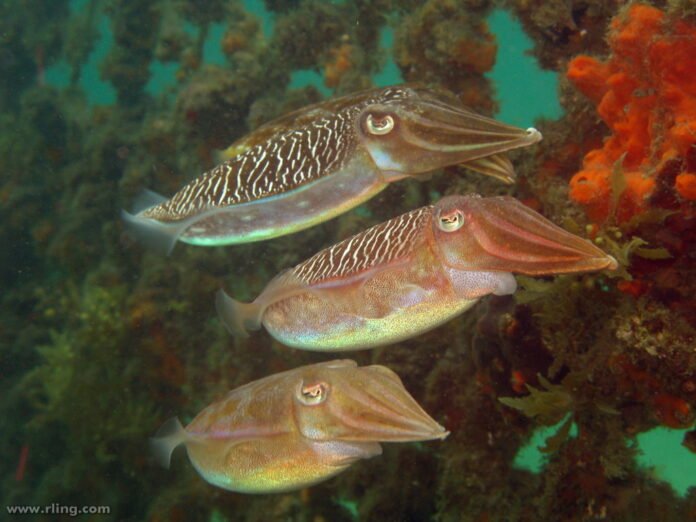
When marine biologist Sophie Cohen‑Bodénès glanced at the playback monitor in her Paris laboratory this spring, she froze. Two common cuttlefish (Sepia officinalis) in the tank were lifting a single arm, undulating it in a deliberate, almost theatrical sweep—then the other animal responded with a mirror‑image flourish. The exchange, repeated dozens of times across separate pairs, revealed a previously unknown behavior: cuttlefish appear to wave at each other. The finding, first reported this week in a bioRxiv preprint, suggests that these famously color‑shifting cephalopods may also possess a visual “sign language” of arm gestures that complements their kaleidoscopic skin displays.
Beyond Camouflage: A New Communication Channel
Cuttlefish already rank among the ocean’s most versatile communicators, able to flash high‑contrast color bars to warn rivals or shimmer iridescent courtside lights to woo mates. Arm waving adds a fresh dimension. Cohen‑Bodénès’s team documented the ritual in two species—the European common cuttlefish and the dwarf cuttlefish (S. bandensis)—while filming animals in large circular tanks outfitted with 360‑degree cameras. The gestures were not random twitches: each lasted several seconds, involved slow, sinuous motion rather than quick snaps, and appeared only when another cuttlefish was nearby.
Four Distinct Gestures With Unknown Meanings
Frame‑by‑frame analysis revealed a quartet of stereotyped movements the team calls “arm wave signs.”
- Up: a vertical lift followed by a gentle oscillation
- Side: an outward sweep parallel to the mantle
- Roll: a spiraling corkscrew motion of the limb
- Crown: simultaneous elevation of multiple arms in a radial fan
READ MORE: Mathematician Cracks 200-Year Algebra Mystery With Polygon-Based Breakthrough
The patterns recur in predictable sequences; one cuttlefish might perform an up–roll–up series, while its counterpart answers with an up–crown. To test whether these waves held social currency, the researchers presented the animals with high‑definition videos of conspecifics executing each sign. Cuttlefish waved back 63 percent more often when the footage appeared upright than when it was flipped, indicating they recognized orientation as part of the signal.
Invisible Ripples: Feeling the Message
Vision is only half the story. The scientists suspected that the sweeping arms also generate low‑frequency water vibrations detectable by the cuttlefish’s lateral line—a sensory organ akin to a fish’s underwater hearing system. Using miniature hydrophones, they captured distinct pressure waves during each gesture. When these vibrations were replayed through submerged speakers behind opaque partitions, the cephalopods still responded with matching arm signs, even though they could not see the source. The dual responses point to a multimodal signal, combining sight and mechanoreception—an elegant solution in the often‑murky coastal habitats cuttlefish frequent.
What Are They Saying? Hypotheses From Aggression to Romance
Interpreting the waves’ meaning remains tricky. One clue is context: in 46 percent of trials, the receiving animal retreated after a wave, hinting at a dominance display. Yet juvenile cuttlefish, months away from sexual maturity, also used the signs, muddying courtship interpretations. Arm flares in related species can telegraph everything from “back off” to “I’m ready to mate” to “I’m stressed.” Cohen‑Bodénès’s group leans toward a flexible, symbolic code—more alphabet than single word—whose translation depends on accompanying color patterns, body posture, and perhaps even previous interactions.
Machine Learning: Decoding an Aquatic Alphabet
To parse that complexity, the researchers are turning to artificial intelligence. Building on an algorithm previously developed to classify cuttlefish skin patterns, the team is training deep‑learning software to track arm trajectories in three dimensions and label each gesture automatically. By integrating chromatic shifts with limb motion, the system could reveal subtle combinations—an orange mantle plus a crown wave, for instance, versus a dark mantle plus up—and map them onto outcomes such as retreat, approach, or mating. Similar AI pipelines have already cracked structural rules in sperm‑whale click sequences and nightingale songs
Cephalopod Cognition: Adding to a Growing Résumé
The discovery slots neatly into a decade of research expanding our appreciation of cephalopod intelligence. Cuttlefish can pass the “marshmallow test,” delaying gratification for a bigger reward, and remember past events to plan future actions—traits once thought exclusive to primates and corvids. The arm waves bolster the idea that these animals possess sophisticated social cognition, including the capacity for flexible, context‑dependent signaling that borders on symbolic language
Skepticism and the Peer‑Review Path Ahead
Because the study is a preprint, its methodology and interpretations await scrutiny. Behavioral ecologist Trevor Wardill, who was not involved, praises the clever experimental design but urges caution: “We still need causal evidence that vibration plus vision equals communication—the gold standard is demonstrating that removing one channel disrupts the interaction.” Upcoming peer review will probe sample size (16 animals), tank acoustics, and the possibility that the waves are merely by‑products of locomotion.
Why It Matters: Broader Implications for Multimodal Signaling
If confirmed, arm waving would rank among the clearest examples of symbolic multimodal signaling in a marine invertebrate. Many animals combine sound and vision—think frog croaks plus throat‑sacs or peacock screams plus fan displays—but few harness hydrodynamic cues perceptible only underwater. The finding could reshape how biologists model communication networks in aquatic ecosystems, expanding the role of non‑auditory vibrations in species ranging from mantis shrimps to reef fish.
Future Experiments: Robots, Red Light, and Wild Populations
Cohen‑Bodénès’s group plans a battery of follow‑ups. One involves programmable silicone “robofish” arms that can reproduce the four gestures precisely while controlling vibration amplitude, allowing researchers to test which elements trigger responses. Another will film cuttlefish in nocturnal red‑light conditions to isolate mechanoreception from vision. Longer term, the team hopes to attach miniature accelerometers to wild animals off the French Atlantic coast, capturing natural wave exchanges amid hunting and predator encounters. Collaborations with Italian and Japanese institutes are in progress, leveraging Mediterranean and Pacific species for cross‑cultural comparisons.
Technology Spin‑offs: From Subsea Messaging to Soft Robotics
Beyond biology, deciphering cuttlefish gesture codes could inspire underwater communication technology. Engineers are already exploring hydrodynamic signaling for low‑bandwidth data transfer where radio waves fail. Similarly, the biomechanics of flexible arm movements may aid the design of soft robots capable of silent, efficient propulsion through cluttered reef environments. Such biomimicry projects often trace their lineage to cephalopod research; the wave study adds another blueprint to the toolbox.
Ethical Considerations: Protecting a Remarkable Mind
The revelations arrive as public sentiment swings toward granting cephalopods greater welfare protections. The United Kingdom added octopuses and cuttlefish to its Animal Welfare (Sentience) Act in 2022; the European Union is debating similar moves. Demonstrations of complex communication strengthen the case that these animals experience rich subjective lives, meriting stricter standards in fisheries, research, and aquarium display.
Conclusion: A Tentacled Mystery Unfolds
For now, the meaning behind each arm wave remains an enigma—part warning, part courtship dance, perhaps even a cephalopod “hello.” What is clear is that cuttlefish continue to defy expectations of invertebrate simplicity. With machine‑learning tools poised to eavesdrop on their conversations, researchers edge closer to translating a silent, rippling language carried on both light and water. One day soon, a human‑made robot may wave a silicone arm and receive an unmistakable wave back—proof that in the ocean’s twilight realms, eloquence takes many forms.

