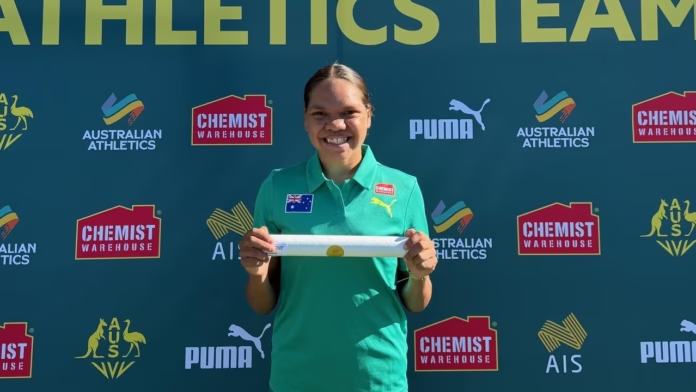
Briseis Brittain’s journey began far from the floodlit stadiums of world sport. On the red dirt tracks of Ramingining in remote Arnhem Land, the 17-year-old discovered her joy for running. Today, that playful pastime has evolved into something far greater: a place on Australia’s team at the 2025 World Para Athletics Championships in New Delhi, India.
Brittain, who competes in the T-38 classification for athletes with motor impairments, describes running as feeling “fun and free.” Yet the discipline, sacrifice, and vision guiding her path are anything but casual. Wearing the green and gold for the first time overseas, she is stepping into an arena that will test her resolve and carry the pride of her people thousands of kilometres from home.
A First for Arnhem Land
The significance of Brittain’s debut extends well beyond her personal dream. She is the first woman from Arnhem Land’s Ramingining and Maningrida communities to compete at this level. For her, it is a chance to represent not just a country, but an entire culture.
“I am going to make proud my people and my culture,” she says, standing tall on the track in Darwin before her departure. The moment is already resonating in her community, where families are preparing to watch online as she lines up against the world’s best.
The Cathy Freeman Effect
Brittain was not yet born when Cathy Freeman won gold in the 400 metres at the Sydney 2000 Olympics. Still, that victory has shaped her trajectory. Like countless Aboriginal and Torres Strait Islander children, she grew up on stories of Freeman’s courage and triumph.
“Cathy Freeman was my favourite athlete, she was really amazing and talented, I want to be like her,” Brittain explains. For her, Freeman’s win was more than a race—it was proof that Indigenous women could shine on the biggest stage of all.
Her dream of following in Freeman’s footsteps was clear from childhood. And when her potential became undeniable, her family made the difficult decision to relocate to Darwin. It was there she could access training and competitions not available in remote Arnhem Land.
A Family’s Sacrifice
Her mother, Marcey Garrawurra, recalls the move as a leap of faith. “There’s lots of talented kids from Arnhem Land but it’s just there’s not much opportunity,” she says. “That’s why I came to Darwin.”
Garrawurra has watched every race, every stumble, and every surge with pride. “It’s really, really special for me and my family that she is going to represent Australia and our family. It’s what I want for her.”
Training Against the Odds
Living in Darwin comes with its own challenges. The city is Australia’s most isolated capital, with just over 150,000 residents. For a para athlete like Brittain, the pool of competitors is even smaller. There are not enough athletes in her classification to create separate races, so she lines up against able-bodied peers.
This has sharpened her skills but also required creative solutions. Her coach, Roger Chin, has turned to artificial intelligence for performance insights. By sending sprint footage to interstate specialists, he receives detailed biomechanical analysis to refine her powerful stride.
“She is a raw runner,” Chin says. “She uses a lot of power when she does run and she never gives up.” But he also recognises the challenge ahead. “New environment, new country, new people, new cultures—the pressures put on her will be quite high.”
Preparing for the World Stage
The World Para Athletics Championships are not only a proving ground for medals. For many, they are a vital stepping stone toward the Paralympics in Los Angeles in 2028 and Brisbane in 2032. That is the path Brittain now sees ahead.
The Australian team has been preparing in Dubai, acclimatising to tropical conditions before heading to India. Training alongside squads from the Netherlands, Denmark, Great Britain, and Canada, the Australians are staging mock races to simulate championship intensity.
“We’ve got Briseis Brittain who will be competing in the 200 and 400m,” says Stephen Caddy, head of the Para Program at Athletics Australia. “She’s in the T-38 class, for athletes with minimum impairments but with motor impairments.”
A Historic Australian Squad
This year’s Australian contingent is the largest since the Sydney 2000 Paralympics. Fifty-one athletes will compete, signalling the depth of talent being cultivated nationwide. For Caddy, Brittain’s inclusion carries added weight.
“I can’t remember the last time, or if in my time, there’s been a Northern Territory athlete on our para team,” he says. Her selection reflects not only personal excellence but also the growing recognition of athletic potential in remote communities.
Federal Support for Para Sport
Brittain’s rise is also linked to a surge in government investment. The federal government has pledged almost $55 million to para sport through the Para Uplift program. The initiative is designed to help athletes overcome barriers, from lack of facilities to limited competition.
“It’s great to see some opportunities present in that region,” Caddy says, noting that Arnhem Land and the Top End have long produced gifted athletes. “It’s only a matter of time before we start recognising the potential in the para athletic space.”
Carrying Dreams Beyond Medals
When Brittain lines up on October 1 for her first race, she will do so with more than medals in mind. For her community in Arnhem Land, she represents hope, visibility, and the promise that future athletes from remote regions can also reach the world stage.
Her story underscores a larger truth: sport is as much about opportunity as it is about talent. Without the move to Darwin, without the AI-driven training support, without family sacrifice, her potential might have remained hidden on dirt tracks far from the global spotlight.
Now, as she competes against the best in New Delhi, Brittain steps into a role bigger than herself. She is not only racing for Australia but also carrying the dreams of Arnhem Land onto the world stage—dreams first lit by Cathy Freeman, and now blazing forward toward Brisbane 2032.

