
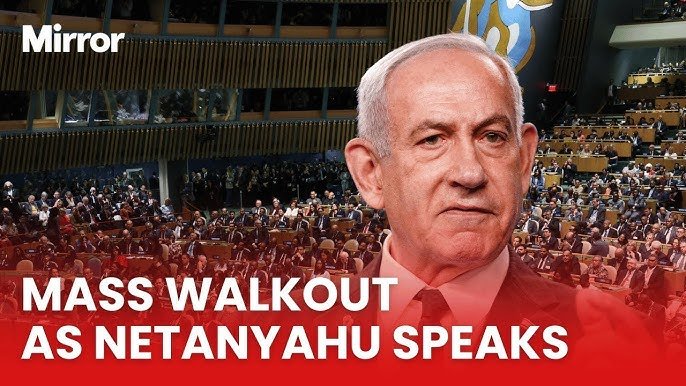
In an extraordinary moment at the United Nations General Assembly, scores of diplomats walked out as Israeli Prime Minister Benjamin Netanyahu took the podium, underscoring Israel’s growing diplomatic isolation. The walkout followed several major nations, including Australia, the United Kingdom, France, and Canada, formally recognising Palestine as a state—a move Netanyahu condemned in stark, combative terms.
The Israeli leader’s remarks, delivered to a largely empty hall but a packed public gallery, left little doubt about his frustration with the shifting global tide. “This week, the leaders of France, Britain, Australia, Canada and other countries unconditionally recognized a Palestinian state,” Netanyahu declared. “Murdering Jews pays off.” The charged statement drew immediate backlash, both inside and outside the UN, with critics accusing him of deepening divides at a time of escalating violence in Gaza.
The Walkout and Its Symbolism
The mass walkout was more than a protest. It represented a coordinated rejection of Israel’s handling of the conflict in Gaza, which has claimed thousands of Palestinian lives. Delegates from across Europe, Latin America, and parts of Africa left as Netanyahu approached the microphone, leaving rows of empty seats. While public supporters in the gallery cheered the Israeli leader, the absence of diplomats spoke louder than applause.
Israel’s UN ambassador dismissed the action as “a staged performance” orchestrated by Palestinians. Yet, the optics were undeniable. International patience with Israel’s military actions is thinning, and Netanyahu’s sharp rebuke of Australia and others seemed to confirm rather than challenge that perception.
Australia in Netanyahu’s Crosshairs
Australia’s decision to formally recognise Palestine marked a significant shift in its Middle East policy. Traditionally a strong supporter of Israel, Canberra’s recognition aligned it with a growing bloc of Western nations willing to formalise Palestinian statehood.
Netanyahu’s direct criticism of Australia—singling it out alongside France, the UK, and Canada—suggested a deep sense of betrayal. Australian Foreign Minister Penny Wong responded diplomatically but firmly, stating, “Our recognition reflects Australia’s commitment to a two-state solution and lasting peace. That peace cannot be achieved without acknowledging the legitimate aspirations of the Palestinian people.”
A QR Code, a Claim of Control, and Global Eyebrows Raised
Beyond rhetoric, Netanyahu’s address was marked by theatrical flourishes. He wore a badge emblazoned with a massive QR code, urging viewers to scan it to “see why we fight and why we must win.” The same code was plastered on billboards in New York’s Times Square and displayed by members of Israel’s delegation. Critics called the stunt a distraction from substantive diplomacy, while supporters argued it was a bold digital-age appeal.
Even more controversial was Netanyahu’s claim that Israel had commandeered Palestinian mobile phones to broadcast his speech live. “We have taken control of their devices,” he boasted. Israeli officials later clarified that Palestinians received text messages with links to his speech rather than forced broadcasts. The distinction did little to ease concerns, with Israeli opposition leader Yair Lapid calling the move “megalomaniacal madness.”
Gaza, Hostages, and Escalating Rhetoric
Central to Netanyahu’s speech was the ongoing war in Gaza. He claimed loudspeakers had been placed near the border so hostages could hear his words, an assertion many interpreted as symbolic rather than literal. He also vowed to “hunt down” Hamas leaders, pledging that Israel would never relent until hostages were returned.
Humanitarian groups, however, criticised the speech for downplaying civilian suffering. Gaza’s health ministry reports that thousands of children and women have died in the conflict, figures Netanyahu dismissed as “Hamas propaganda.” Independent agencies, including the United Nations Relief and Works Agency (UNRWA), have confirmed widespread destruction and severe shortages of food, water, and medical supplies.
Trump’s Parallel Drama
While Netanyahu dominated headlines at the UN, US President Donald Trump also stirred controversy. On the same day, Trump celebrated the indictment of former FBI director James Comey, branding him a “dirty cop.” He denied maintaining an “enemies list” but ominously added, “there will be others.”
Simultaneously, Trump hinted at progress toward a Gaza ceasefire. Speaking to reporters en route to the Ryder Cup golf tournament, he said, “I think we maybe have a deal on Gaza, and very close to a deal on Gaza.” Netanyahu made no such suggestion, creating an unusual public divergence between the two leaders, typically aligned on Middle East policy.
Adding to the spectacle, footage of Trump pointing his finger in a heated exchange with First Lady Melania aboard Marine One went viral, prompting speculation about tensions behind closed doors.
China’s Subtle Jab and Global Repositioning
China also used the UN stage to criticise the United States, with Premier Li Qiang calling Beijing a “defender of world peace” while denouncing Western tariffs. Given China’s supply of military components to Russia, the statement was met with skepticism. Still, it reflected a growing global realignment where multiple powers are leveraging the Israel–Palestine conflict to redefine their roles in international diplomacy.
Implications for Israel’s Global Standing
The walkout underscored the erosion of Israel’s diplomatic support. While the United States remains its strongest backer, the formal recognition of Palestine by Australia, France, the UK, and Canada signals a fundamental shift in Western consensus. Where once support for Israel was nearly unconditional, today it is conditional on tangible progress toward peace.
Israel’s strategy of branding recognition of Palestine as rewarding terrorism risks alienating potential allies further. For Australia, the calculation is clear: aligning policy with the international majority on Palestinian statehood positions it as a principled actor in multilateral forums.
What Comes Next
The fallout from Netanyahu’s speech is likely to intensify debates in capitals worldwide. For Israel, the immediate challenge is balancing domestic political survival with global diplomatic credibility. For nations like Australia, the task is navigating a complex balance: recognising Palestine while maintaining constructive ties with Israel.
The broader question remains whether symbolic gestures—walkouts, QR codes, and viral videos—can translate into meaningful steps toward peace. For now, the spectacle of empty chairs at the UN has become a powerful image of Israel’s isolation. Whether it spurs policy change or entrenches further division will shape the trajectory of the Middle East for years to come.