
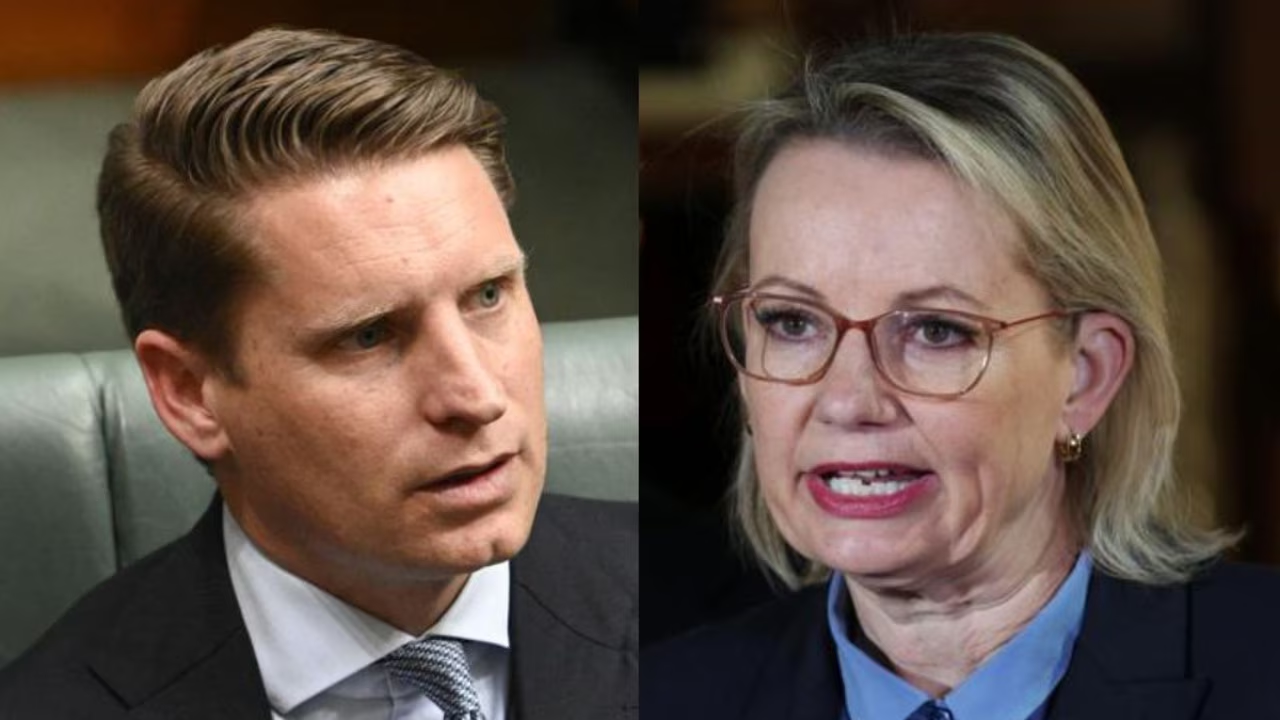
Andrew Hastie, the West Australian MP and shadow home affairs minister, has long been tipped as a future leader of the Liberal Party. This week, that speculation turned into something more immediate, as the former SAS soldier launched a series of provocative interventions that unsettled colleagues, thrilled conservatives, and sharpened questions about where the party goes next. His blend of military grit, Shakespearean flair, and conviction politics is both his calling card and his greatest risk as the Liberal Party struggles to define its post-election direction.
From the Battlefield to the Ballot Box
Hastie’s story begins in the shadow of September 11. Then an arts student, the terrorist attacks prompted him to abandon academia and join the Australian Defence Force. After serving seven years, he fought his way into the elite SAS Regiment in 2010, surviving a notorious selection course that saw just 26 of 132 candidates succeed. By 2015, he was ready for another challenge—parliament. Winning the Canning by-election during the chaotic Abbott-Turnbull leadership spill, he entered federal politics with the motto that had guided his service: Who dares, wins.
Hastie’s early days in Canberra revealed a man determined to refine his image. He enrolled in voice coaching, studied the cadence of Churchill and Lincoln, and openly embraced his love of Shakespeare and history. His self-construction as a soldier-scholar has become central to his brand, a carefully balanced persona that mixes battlefield grit with literary gravitas. Yet it has also drawn criticism, especially when he used campaign material featuring himself in uniform—an act that cost him his army reserve role.
A Social Media Offensive
The current leadership chatter stems from a burst of social media posts that quickly went viral. First came a video of Hastie stroking a vintage Ford, lamenting the decline of domestic car manufacturing and declaring that Australia should aspire to more than “flat-white making.” Then came an attack on colleagues he branded “nameless cowards” and “muppets” for questioning him in the press. Finally, in a pointed message on migration, he warned: “We are starting to feel like strangers in our own home.”
Collectively, the posts attracted hundreds of thousands of views. They also stirred accusations that Hastie was undermining party unity. Former Liberal senator Amanda Vanstone bluntly reminded him: “You are not the star of the show.” Yet among his base in Mandurah, voters shrugged off the controversy, praising his authenticity and conviction. For them, his willingness to speak bluntly is a feature, not a flaw.
Convictions That Cut Both Ways
Hastie’s political style is defined by steadfast conviction, even when it pits him against his own party. He abstained from the 2017 same-sex marriage vote despite majority support in his electorate. He has consistently argued that women should not serve in combat roles, a position at odds with the Coalition platform. More recently, he threatened to resign from the frontbench if the Liberal Party did not abandon its net-zero commitment.
Supporters view these positions as proof he is a principled leader who refuses to bend. Critics see them as destabilising and politically risky. Either way, they reinforce the perception that Hastie is not afraid to put himself at the centre of controversy.
A Party in Flux
The timing of Hastie’s moves is crucial. Four months after a heavy election defeat, the Liberals are still searching for a coherent identity. Opposition Leader Sussan Ley has promised a new direction but has delayed policy announcements until party reviews are complete. This vacuum has allowed internal disputes—over climate targets, immigration, and cultural politics—to fester.
The demotion of Northern Territory senator Jacinta Nampijinpa Price, a close ally of Hastie, underscored these divisions. Her refusal to back Ley’s leadership was seen as untenable, but her downfall has only deepened the sense of factional tension. Hastie called the move “sad but inevitable,” while Advance Australia, a powerful conservative lobby group, rallied behind him with Facebook campaigns amplifying his positions on immigration and energy.
Friends, Foes, and Factions
Hastie’s outspokenness has won praise from figures on the party’s right flank. Nationals senator Matt Canavan declared he had tapped into a “vein of frustration,” while Nampijinpa Price accused “factional warlords” of undermining debate. Even some centrist colleagues, such as Nationals deputy Kevin Hogan, acknowledged Hastie’s “frank and fearless” contributions.
Others, however, warn that the party risks tearing itself apart. Former minister Arthur Sinodinos stressed that Australia is “a centrist country” and that chasing votes on the far right is futile. For him, unity and policy coherence matter more than rhetorical firepower. Liberal backbencher Tony Pasin, meanwhile, suggested that Hastie intimidates colleagues because he is “a natural-born leader”—a compliment that also implied growing unease in the ranks.
The Ley Equation
For now, Hastie insists he supports Ley. “Anyone who is speculating is being mischievous,” he said on 2GB radio. Yet the ambiguity of his interventions leaves the door open to interpretation. Some party insiders believe his target is less Ley than Angus Taylor, the shadow defence minister and a rival leadership prospect who lost narrowly to Ley in the post-election ballot. Hastie himself declined to contest that ballot, citing his three young children, but his allies now wonder if circumstances—and ambition—have changed.
Ley has attempted to downplay the drama, welcoming “strong views” as part of healthy debate. But she faces a delicate task: crafting a policy platform that can bridge the gulf between moderates and conservatives without alienating voters who delivered the party’s defeat. Whether Hastie’s firebrand conservatism aligns with her strategy—or undermines it—remains to be seen.
The Risks of Standing Out
Hastie is acutely aware of the perils of being too visible. In a 2019 interview, he noted that politicians must “put on your metaphorical breastplate” daily to survive attacks. That mindset helps explain his willingness to weather internal criticism and media scrutiny. Yet the bigger question is whether his approach builds the broad coalition of support necessary for leadership—or hardens divisions that keep the party in opposition.
His supporters argue that he embodies the conviction and clarity voters crave in an era of political drift. His detractors warn that his rhetoric risks alienating centrists and reigniting culture wars that cost the party dearly at the last election. Both perspectives hold truth, and the stakes could not be higher.
Timing Is Everything
Ultimately, leadership is not just about ambition but about timing. Hastie has built a profile that positions him as a contender, but the pathway to the top is fraught. If he moves too early, he risks being branded a destabiliser. If he waits too long, momentum may fade or rivals may outflank him. For now, he has taken leave, but the speculation will not rest.
In politics, as in special forces selection, the true test is endurance under pressure. Andrew Hastie has shown he can endure, adapt, and project strength. Whether that translates into leadership of the Liberal Party will depend not only on his own resolve but also on whether his colleagues—and the Australian electorate—are ready to follow him.
What is clear is that his presence has already reshaped the conversation, forcing the party to confront uncomfortable questions about its identity, direction, and future. And as history shows, those who dare often do win—but not without risk.