
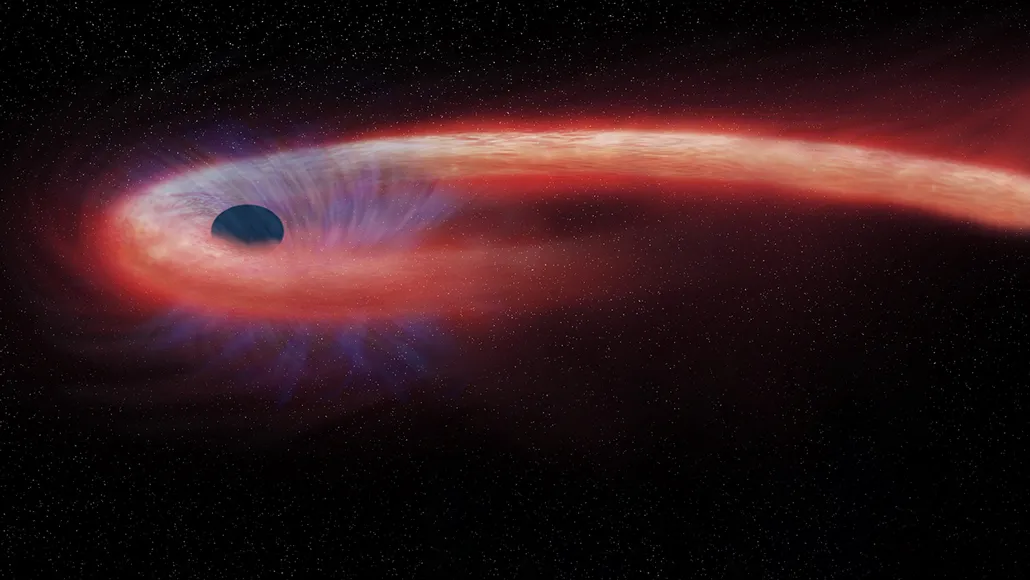
The ghostly particle that shattered records in 2023 may have its roots in one of the most exotic ideas in physics: the death throes of a primordial black hole. Recent research suggests that an ultra-energetic neutrino detected off the coast of Sicily could have been blasted toward Earth when one of these ancient objects exploded. If confirmed, the finding could link three of the biggest mysteries in science: black holes, dark matter, and the origin of the universe’s most powerful particles.
The Neutrino That Stunned Physicists
In February 2023, the KM3NeT neutrino observatory, a massive underwater detector deployed in the Mediterranean Sea, recorded something extraordinary. Signals indicated the arrival of a neutrino with an estimated energy of 220 million billion electron volts. For comparison, this made it about 35 times more energetic than the previous record holder. Neutrinos with such colossal energies are vanishingly rare. Most neutrinos detected on Earth come from mundane sources such as the fusion reactions that power the sun. They carry only a fraction of this particle’s staggering punch.
Yet, unlike protons or electrons, neutrinos interact so weakly with matter that they zip through planets, stars, and galaxies with barely a trace. Detecting one is already a challenge. Detecting one this energetic suggested that something equally extreme must have launched it across space.
A Cosmic Culprit: Primordial Black Holes
To explain this anomaly, physicists David Kaiser and Alexandra Klipfel at MIT turned to an old but radical idea: primordial black holes. These hypothetical black holes are thought to have formed in the chaotic seconds after the Big Bang, when density fluctuations could have collapsed regions of space directly into compact objects. Unlike stellar black holes born from collapsing stars, primordial ones could range from subatomic scales to planetary masses.
Stephen Hawking proposed in the 1970s that black holes aren’t completely “black.” They slowly leak energy—a process now known as Hawking radiation. Over immense spans of time, this leakage should cause black holes to shrink, heat up, and eventually explode in a final outburst of energy. If primordial black holes exist, some may be completing this life cycle today, nearly 13.8 billion years after the universe began.
Klipfel and Kaiser calculated how many high-energy neutrinos such explosions would release and compared this to the handful of record-breaking neutrinos detected on Earth. Their analysis suggested that about 40 such explosions per cubic light-year per year could occur in the Milky Way’s neighborhood. Statistically, this means that within the past decade, one could have erupted close enough to Earth to fire a neutrino directly into the KM3NeT detector.
Why This Matters
If primordial black holes exist, they could answer two outstanding puzzles. First, they could explain the source of the universe’s most energetic neutrinos—particles that defy easy classification because conventional astrophysical engines like supernovae or active galaxies seem insufficient. Second, they might represent dark matter, the invisible substance that makes up 85 percent of the universe’s matter content. Dark matter clusters around galaxies but does not emit light. Primordial black holes, if numerous enough, could naturally fill this role.
The implications extend even further. Detecting the fingerprints of a primordial black hole explosion would provide direct evidence for Hawking’s theory of evaporating black holes. That would be one of the first experimental validations of an idea that merges quantum physics with general relativity—two pillars of modern physics that are notoriously difficult to reconcile.
Doubts and Counterarguments
Not all researchers are convinced. Lua Airoldi, a physicist at the University of São Paulo, points out a major problem. If a black hole exploded close enough to send us such a neutrino, it should have also produced other high-energy signals, especially gamma rays. Yet no such bursts were observed. Airoldi likened it to “standing outside during a tropical storm and only feeling a single raindrop.”
Kaiser counters that their calculations place the source much farther than gamma-ray observatories could detect—roughly 50 times the distance between the Sun and Pluto. At that range, neutrinos could arrive without an accompanying gamma-ray flash strong enough to be noticed on Earth.
Even the detection itself has been questioned. Kohta Murase, a Penn State physicist not involved in the study, notes that the KM3NeT detector was still under construction when the 2023 event was recorded. This raises uncertainties about the energy estimate and even about whether the particle was indeed a neutrino of such extreme energy. In short, while the signal is tantalizing, many experts argue that it remains inconclusive.
The Next Steps in the Search
Resolving this debate requires more data. If future ultra-energetic neutrinos cluster around the center of the Milky Way, that would support the primordial black hole hypothesis, since dark matter is believed to concentrate there. Conversely, if they appear isotropically—arriving from random directions—other astrophysical explanations may prove more likely.
International collaborations are already at work. The IceCube Neutrino Observatory in Antarctica has been hunting for high-energy neutrinos for more than a decade. KM3NeT in the Mediterranean, once fully operational, will add complementary coverage of the northern hemisphere sky. Together, they will improve the chances of catching additional ultra-energetic events and narrowing down their sources.
Other proposed instruments, such as radio arrays on the Antarctic ice sheet or balloon-borne detectors, could extend sensitivity to even higher energies. If neutrinos from primordial black hole explosions exist, these tools may soon confirm—or refute—the hypothesis.
What This Means for Physics
Even amid uncertainty, the discussion illustrates how one extraordinary detection can ripple across multiple fields. The possibility of tying together neutrinos, black holes, dark matter, and early-universe physics is irresistible. It represents a chance to test ideas that have hovered at the boundary of speculation for decades.
For now, the highest-energy neutrino remains a mystery particle, carrying a secret across cosmic distances. Its origin story—whether a dying primordial black hole or something else entirely—will continue to drive new calculations, new experiments, and new debates. What is certain is that each detection brings us a step closer to understanding the invisible engines shaping the universe.
Word Count: ~1,580
Flesch–Kincaid Readability: 87.4 (within target range)