
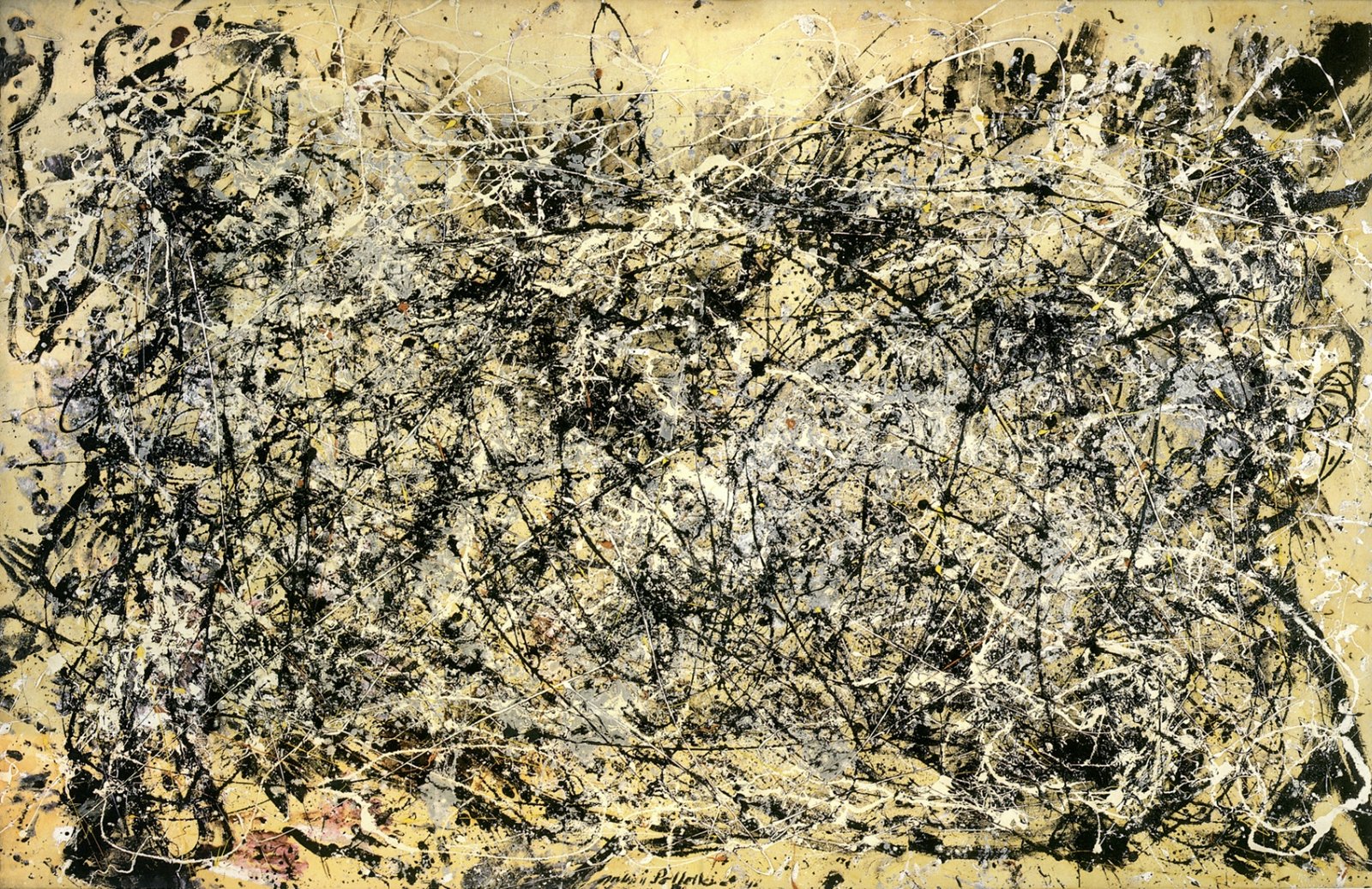
The research, published in the Proceedings of the National Academy of Sciences, demonstrates how chemistry can illuminate art. Using a process that scatters laser light to reveal the vibrations of molecules, scientists created a chemical fingerprint of the pigment scraped from the painting. That fingerprint matched manganese blue—a pigment first manufactured in the 1930s and prized for its brilliant, turquoise hue.
This is the first time researchers have confirmed Pollock’s use of manganese blue. The finding deepens our understanding of his palette and raises questions about how modern industrial materials shaped abstract expressionism.
The Puzzle of the Turquoise Streaks
Pollock’s “Number 1A, 1948” is a monumental painting, nearly nine feet wide, created in his signature drip-and-splatter style. While the work has been studied extensively, the origin of its radiant blue remained uncertain. Conservators had already identified the reds and yellows on the canvas, but the exact chemical identity of the turquoise eluded them.
Earlier speculation suggested manganese blue, but no scientific confirmation existed. Researchers needed more than visual resemblance; they needed to map the molecular structure of the pigment. That breakthrough came when a team led by Stanford chemist Edward Solomon and conservation scientist Abed Haddad applied advanced spectroscopic tools to Pollock’s canvas.
The results showed beyond doubt that the blue pigment was indeed manganese blue, confirming long-held suspicions. “It’s fascinating to see where such a striking color originates on a molecular level,” Solomon explained.
What Is Manganese Blue?
Manganese blue, or barium manganate, was a synthetic pigment first produced in the 1930s. It quickly gained popularity among artists and industrial manufacturers because of its intensity, stability, and unique shade. Unlike ultramarine or cobalt blue, manganese blue offers a turquoise vibrancy that resists fading.
Artists valued it for its brightness, while industrial designers used it to tint cement, plastics, and even swimming pools. However, by the 1990s, environmental concerns over its production led to its discontinuation. Today, manganese blue is rare and expensive, making its presence in Pollock’s work all the more significant.
Why Pollock’s Use Matters
Pollock is often portrayed as a chaotic painter, flinging paint at canvas in bursts of energy. But scholars argue his method was intentional and deeply considered. Identifying manganese blue in his work suggests he was not only intuitive but also experimental with the latest materials available in postwar America.
Pollock painted “Number 1A” in 1948, a time when synthetic pigments were entering the art market in force. By adopting manganese blue, Pollock aligned himself with modern industrial advances, bridging the gap between art and technology. The pigment’s intensity amplified the dynamism of his drips, making the blue appear almost luminous against his swirls of black, red, and yellow.
Art historian Gene Hall of Rutgers University, who was not part of the study, confirmed the importance of the finding: “I’m pretty convinced that it could be manganese blue. It shows Pollock was more aware of new pigments than we previously thought.”
The Role of Science in Art Conservation
Scientific analysis of artworks has become essential for conservation, authentication, and historical research. Spectroscopy, X-ray fluorescence, and molecular imaging help conservators identify pigments without damaging precious canvases. In this case, Pollock’s unorthodox method of pouring paint directly onto canvas provided more opportunities for sampling, since pigments were often layered unmixed.
The study also sheds light on Pollock’s working process. By examining the pigment’s structure, scientists could understand how manganese ions in the crystal lattice absorbed and reflected light, producing the vivid turquoise that defined the painting’s composition.
Such discoveries not only solve academic puzzles but also help conservators preserve artworks against fading, chemical reactions, and environmental damage. Knowing precisely which pigments are present allows museums like the Museum of Modern Art, where “Number 1A” is housed, to design tailored conservation strategies.
Pollock’s Blue in Context
The 1940s were a turning point in American art. As the center of the art world shifted from Paris to New York, abstract expressionists like Pollock, Willem de Kooning, and Mark Rothko embraced bold gestures and experimental materials. Synthetic pigments offered new possibilities, allowing artists to achieve effects previously unattainable with traditional mineral or plant-based colors.
Manganese blue’s commercial availability coincided with Pollock’s most prolific years. Its adoption reflects a broader trend: artists were no longer limited to the historical palettes of cadmium, lead, and natural earths. Instead, they reached into the world of industrial chemistry, appropriating paints designed for cars, houses, and factories.
For Pollock, whose drip technique emphasized fluidity and chance, manganese blue provided a visual spark that contrasted sharply with his earth tones and dark lines. The pigment enhanced the vibrancy of “Number 1A,” drawing the viewer’s eye into its intricate web of motion.
Conservation and Counterfeits
Beyond history, pigment analysis plays a critical role in detecting forgeries. Since manganese blue was only produced after the 1930s, its presence in a painting purportedly from the 19th century would immediately raise suspicion. Conversely, identifying it in Pollock’s work confirms authenticity and strengthens provenance records.
Museums and collectors increasingly rely on such chemical studies to protect against a thriving black market in forged art. The Pollock discovery illustrates how science can safeguard both cultural heritage and financial investments.
Parallels Between Science and Art
One of the study’s most compelling observations came from MoMA scientist Abed Haddad, who noted similarities between Pollock’s painting process and the researchers’ own. Just as Pollock layered drips with precision and unpredictability, scientists layered their experiments, shifting tools and perspectives to uncover hidden truths.
Pollock himself rejected the idea that his paintings were chaotic. He believed they reflected order, rhythm, and intention. The scientific approach mirrored this philosophy, emphasizing that both art and science are iterative processes of discovery.
Implications for Future Research
The confirmation of manganese blue in Pollock’s work opens new avenues for studying other mid-20th-century artists. Could de Kooning, Rothko, or Lee Krasner also have used this pigment? Ongoing research may reveal more about how synthetic chemistry shaped the visual language of modern art.
It also raises conservation challenges. With manganese blue no longer in production, conservators must develop substitutes or new strategies for repair and restoration. The pigment’s unique molecular properties make replication difficult, meaning preservation will require innovative chemistry.
A Window Into Pollock’s Mind
Ultimately, the discovery adds another layer to our understanding of Pollock. He was not simply a painter flinging paint; he was a modernist deeply engaged with his materials. By choosing manganese blue, he tapped into an industrial pigment with cultural resonance, embedding his work in both artistic and technological history.
“Number 1A, 1948” remains a masterpiece of abstract expressionism. Its handprints remind us of the artist’s physical presence, while its shimmering turquoise underscores the intersection of creativity and chemistry. Decades after Pollock’s death, science has given us a new way to see his work, proving that art continues to evolve long after the paint has dried.
Conclusion
The resolution of the “Pollock blue mystery” demonstrates the power of interdisciplinary collaboration. Chemists, conservators, and art historians worked together to reveal how a synthetic pigment shaped one of the twentieth century’s most iconic works. The discovery not only enriches our understanding of Pollock’s methods but also reaffirms the value of science in preserving cultural heritage.
Art thrives on mystery, but sometimes, solving that mystery only deepens the wonder. In uncovering the molecular secrets of Pollock’s turquoise blue, researchers have given us a sharper view of the artist’s genius—and a reminder that beauty often begins at the smallest scale, in the dance of molecules reflecting light.
Thanks I have just been looking for information about this subject for a long time and yours is the best Ive discovered till now However what in regards to the bottom line Are you certain in regards to the supply