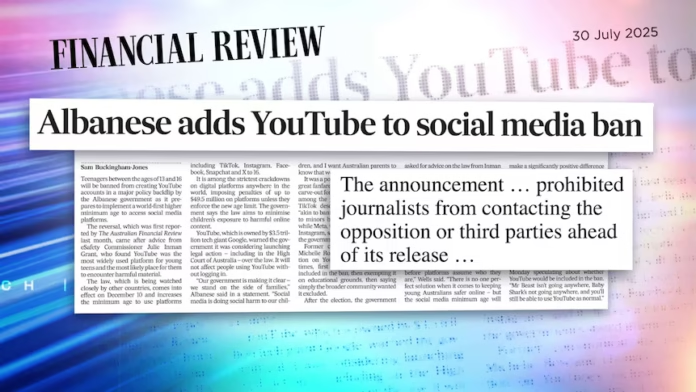
Australia’s press gallery, once the watchdog of Parliament, is now grappling with a subtle but serious erosion of its independence. Political reporting in Canberra has long been shaped by the practice of “drops,” where government or opposition figures provide journalists with embargoed stories on the condition that the first version is framed to their liking. But recent developments show that the power balance is tipping even further, leaving reporters constrained and the public underserved.
How “Drops” Became a Tool of Control
A “drop” may sound harmless—an early copy of a speech or policy announcement shared with trusted reporters. In reality, it is a form of controlled messaging. For decades, the deal has been simple: journalists get access, but they must agree not to include opposing voices or third-party quotes in the first draft. The logic is that the government of the day deserves the first word on major announcements.
What started as a tradition has morphed into a tool of influence. Politicians and staffers now use these agreements to shape not just the timing of coverage but the framing of entire news cycles. The practice often locks journalists into publishing stories that read like government press releases, with critical context delayed or diluted.
The Cost to Journalism and Democracy
The implications are profound. When journalists are prevented from including dissenting views in their initial reporting, the first wave of coverage often sets the agenda for television, radio, and digital platforms. By the time counter-arguments appear, the damage is done—the government’s preferred narrative has already circulated widely.
This undermines journalism’s role as an independent check on power. Instead of holding leaders accountable, newsrooms risk becoming distribution arms for political messaging. For readers and viewers, the result is partial truth at best, spin at worst.
A Case Study in Pressure
Consider the experience of one Canberra reporter covering Malcolm Turnbull’s 2018 plan to make Australia a top-ten global arms exporter. The journalist added context by citing a six-month-old statement from World Vision advocate Tim Costello, who had condemned the policy as “exporting death.”
The response from Turnbull’s office was swift and hostile. A senior staffer called the reporter directly, delivering a torrent of abuse for breaking the “drop” agreement—even though no fresh quotes had been sought. The message was clear: deviation from the government’s script would not be tolerated.
That episode illustrates the power imbalance. Staffers, who control access to drops, wield enormous influence over journalists’ careers. Reporters who resist risk losing future scoops, putting them and their outlets at a competitive disadvantage.
Why Editors Play Along
Why don’t newsrooms simply refuse such deals? The answer lies in fear of being scooped. If one outlet refuses a drop, another will take it and run the story first. Editors worry about waking up to find rivals dominating the headlines with a big announcement they lack.
This creates a “collective action problem.” If every newsroom in the press gallery agreed to reject strings-attached drops, the practice would end overnight. But the temptation to break ranks is powerful. The first outlet to accept a drop gains a short-term advantage, ensuring the cycle continues.
Transparency at Risk
The stakes extend beyond media ethics. The Albanese government is moving to water down transparency laws by making it easier to refuse Freedom of Information (FOI) requests. Officials argue that wide disclosure hampers the proper functioning of government. Critics say it erodes accountability.
Combined with the press gallery’s reliance on drops, this creates a dangerous environment. With less information available through formal channels and more stories shaped by political staffers, the public is left with fewer independent sources of truth.
The Role of Editors
Individual journalists cannot fix this alone. As Sydney Morning Herald’s Peter Hartcher recently argued, reporters should ignore unethical constraints and prioritize readers. Yet in practice, low-ranking journalists lack the power to defy their bosses or risk their jobs.
The solution lies with editors. News executives could announce policies rejecting any drop that comes with conditions. They could tell their reporters: if the government wants its message covered, it must compete in the open marketplace of ideas, not through backroom deals.
Such policies would not only protect journalists from abuse but also restore public trust. Outlets could even market themselves as more transparent, contrasting their independence with rivals who accept political strings.
What Audiences Want
Evidence suggests Australians crave this kind of change. Surveys by the Reuters Institute for the Study of Journalism show trust in news has declined in Australia, with audiences citing concerns about bias and hidden agendas. Yet when asked what they want most, respondents say they value truth and transparency over speed.
This is a crucial insight. Editors fear losing ground by rejecting drops, but in reality, the long-term competitive edge may come from credibility. Outlets that take a stand could differentiate themselves in a crowded media environment.
Lessons from Abroad
Other democracies have faced similar challenges. In the United States, the White House regularly offers “background briefings” with conditions attached, but major outlets like the Associated Press and Reuters enforce strict rules about anonymity and attribution. In the UK, political journalists have occasionally staged walkouts when officials tried to exclude certain reporters from briefings.
Australia’s press gallery has not yet demonstrated that level of collective resistance. But the tools exist. Media organizations could adopt shared guidelines through professional associations, creating peer pressure for compliance.
Actionable Steps for Reform
If the press gallery is serious about regaining independence, several steps are clear:
- Public Commitments: Editors should declare that their outlets will no longer accept drops with conditions.
- Shared Standards: Media unions and associations could publish voluntary codes of conduct, encouraging consistency across outlets.
- Audience Education: Journalists should explain to readers when stories are based on drops and disclose the constraints involved.
- Invest in FOI: Outlets must strengthen investigative units to pursue independent sources of information, rather than relying on controlled leaks.
- Collective Resistance: Journalists should support colleagues facing pressure or abuse from staffers, reducing the isolation that deters defiance.
Why It Matters Now
The Albanese government’s dominance of the press gallery narrative is not inevitable. It is the product of norms that can be reshaped. Yet the longer the practice persists, the harder it becomes to change.
This moment is an opportunity. With trust in news declining and public demand for truth rising, reform would not only improve journalism but also serve a clear business interest. Independence and transparency are marketable assets in today’s crowded media landscape.
A Press Gallery for the 21st Century
The institution of the press gallery has endured for more than a century, evolving with technology and politics. There is no reason it cannot adapt again. What matters is the willingness of editors and journalists to act collectively, even at short-term cost.
The culture of strings-attached drops belongs to another era—an era when news was scarce and controlled by a few gatekeepers. In today’s information environment, where trust is the scarcest resource, the press gallery must choose whether to cling to old habits or embrace new standards of independence.
The decision will shape not just the future of Australian journalism but also the health of its democracy.

