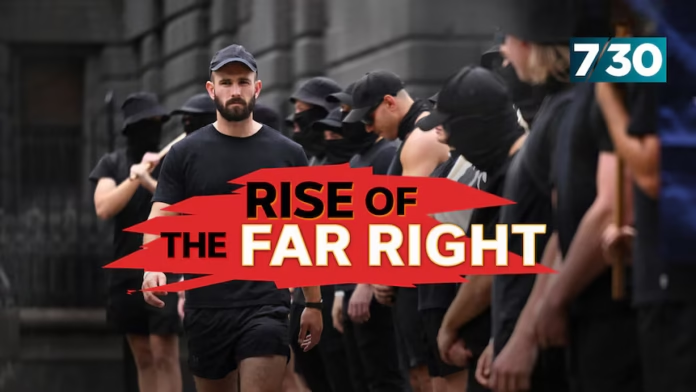
Last month, more than 25,000 Australians took to the streets in coordinated protests against mass immigration. In Sydney, Melbourne, Brisbane, Adelaide, Perth, and Hobart, crowds waved national flags, held banners, and listened to speeches that ranged from calls for tighter border controls to outright demands for “remigration.” The rallies, dubbed March for Australia, signaled to many observers that nationalist politics in the country is attempting to move into a new phase.
Yet while some activists see the demonstrations as a turning point, experts and political insiders remain divided on whether the fragmented far-right can translate public anger into long-term political power.
From Protests to Political Movements
Conservative activist John Macgowan, a former Liberal Party staffer and strategist, called the rallies “the biggest thing that’s happened in conservative and nationalist politics for a hundred years.” For him, the marches echoed the grassroots energy of Britain’s Brexit campaign and the U.S. Tea Party movement. Both began with small online groups before reshaping national politics.
Macgowan argues that Australia’s nationalist right has been chaotic and divided, but that the disorganization is not necessarily a weakness. “The Tea Party looked like a rabble at the start. So did Brexit,” he said. “It was people online, decentralized, not controlled by one party machine.”
To his mind, the future of the far-right lies less with legacy politicians like Pauline Hanson and more with decentralized online communities, independent candidates, and media-savvy influencers who speak directly to voters.
The Role of Established Minor Parties
For decades, Pauline Hanson’s One Nation has been the most prominent far-right party in Australia. In the last federal election, it won 5.7 percent of the national vote, doubling its Senate representation to four seats. But critics say its structure prevents grassroots participation.
“One Nation is a top-down party that exists to serve Hanson,” Macgowan said. “It doesn’t offer members the infrastructure to create policies or shape direction.”
Internal turmoil has also weakened the party. A wave of state-level defections, public infighting, and the resignation of Senator Warwick Stacey due to health reasons have left it struggling to maintain unity. Some extremists accuse One Nation of being too moderate, while others see it as incapable of modernizing.
Lee Hanson, Pauline’s daughter, admitted at a Hobart rally that conservatives often talk about uniting, but egos and conflicting motives prevent collaboration. Her comments reflect a broader challenge: while leaders acknowledge the need for a unified right-wing force, the reality has been splintering rather than merging.
Rivalries, Mergers, and Big Money
Clive Palmer, the mining billionaire behind the United Australia Party (UAP), has previously flirted with alliances. Reports suggest he offered millions to support Pauline Hanson in exchange for influence over her party’s structure, though both camps deny that money was on the table. Still, Palmer has a history of launching new parties and investing heavily in advertising campaigns, keeping him a disruptive force on the right.
Former Liberal senator Gerard Rennick has also entered the fray, creating People First, a new conservative party with 2,500 members and a $1 million fundraising goal for the 2028 election. Rennick has spoken with Family First about a possible merger, though he insists he does not want religious issues to dominate.
These moves highlight a broader problem: the far-right is crowded with small parties — One Nation, UAP, Libertarians, Family First, People First — all competing for similar voters. Instead of building strength, they dilute each other’s impact.
The Social Media Factor
What sets this moment apart from earlier waves, like the 2015 Reclaim Australia rallies, is the role of digital media. Activists are using Facebook, Telegram, YouTube, and TikTok to spread narratives about immigration, national identity, and sovereignty.
Macgowan believes this online culture is the breeding ground for the next generation of leaders. “The guys making videos, the guys consuming new media — that’s where the movement grows,” he said.
But experts caution that online visibility doesn’t necessarily translate into votes. Kosmos Samaras of Redbridge polling points out that the core voter base for right-wing populism in Australia is older than the activists driving the conversation online. In contrast to the U.S. or UK, there isn’t a large bloc of young conservative men mobilizing around these causes.
Expert Perspectives: A Shift but Not a Breakthrough
Dr Kurt Sengul, a researcher at Macquarie University, notes that while the numbers at March for Australia were significant, they should not be overstated. “We’ve seen rallies like this before, and they haven’t reshaped politics,” he said.
However, he does see a shift in the rhetoric. “This isn’t just about stopping immigration. It’s about re-emigration — the forced removal of migrants, including those who are legal. That’s a more radical and dangerous framing.”
Sengul warns that such language mirrors European far-right movements and is amplified by international figures like Elon Musk, who recently endorsed “remigration” online. Yet he doubts that Australia’s far-right can replicate the electoral success of Britain’s Reform Party or Donald Trump’s takeover of the U.S. Republican Party.
“The two-party system here is much stronger,” Sengul explained. “For a breakthrough to occur, it would likely need to come from within the Liberal or National parties, not from an outside minor party.”
Counter-Protests and Government Condemnation
The March for Australia rallies were met by counter-demonstrations in several cities, with anti-racist groups warning against the normalization of extremist rhetoric. In Melbourne, neo-Nazi leader Thomas Sewell’s participation led to violence and charges after he attacked Indigenous activists.
Political leaders across the spectrum have condemned the racist slogans and symbols seen at the rallies. Tasmania’s Premier Jeremy Rockliff said: “What Tasmania has is a very proud history around multiculturalism, welcoming people from all walks of life. Racism in any form has no place here.”
This response highlights a central tension. While thousands of Australians are mobilized by anti-immigration messaging, mainstream political institutions remain firmly committed to multicultural values.
What the Data Shows
Polling by Redbridge suggests the far-right’s voter pool is limited. While immigration is a concern for some Australians, especially in the context of housing shortages and wage pressures, it is not the dominant political issue nationwide. Cost of living, healthcare, and climate change consistently rank higher.
The demographic profile of far-right voters also poses challenges. They tend to be older, rural, and less digitally engaged than younger generations. This mismatch between activist energy online and voter strength offline makes it difficult to scale up.
Moreover, unlike the U.S. and UK, where rapid demographic change fueled nationalist movements, Australia’s immigration levels, while high, have been more gradual and broadly supported by business and government. Without a crisis-level event, analysts doubt the far-right can reach 20–30 percent national support.
The Path Ahead
If Australia’s far-right hopes to grow, several conditions would need to align:
- Unity Among Minor Parties: At present, the right is fractured. A merger or coalition would be necessary to build credibility.
- Leadership Beyond Hanson and Palmer: Legacy figures carry baggage that limits appeal. New leaders would need to emerge from grassroots networks.
- Policy Expansion: A singular focus on immigration may attract attention, but to win seats, parties must present economic, health, and infrastructure policies.
- Mainstream Breakthrough: Without inroads into the Liberal or National parties, a mass movement is unlikely.
The movement’s most realistic short-term future may be continued protest activity, online organizing, and sporadic electoral wins in state or Senate contests. Over the long term, much depends on whether economic pressures, cultural debates, or global crises shift public opinion further toward nationalist politics.
Conclusion: A Movement at a Crossroads
The rallies of August 2025 showed that anti-immigration sentiment remains a potent force in Australia. But rallies alone do not build sustainable political movements. For the far-right to move from the fringes to the mainstream, it would need discipline, unity, and leaders capable of appealing beyond a narrow base.
For now, the far-right is both energized and divided — a paradox that may define its trajectory for years to come. The tension between grassroots passion and fragmented leadership will determine whether this is the beginning of a new political era or simply another chapter in Australia’s long history of fringe movements.

