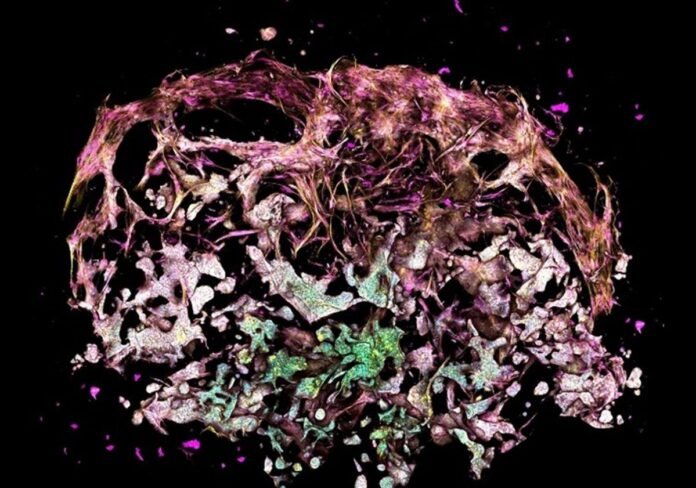
Three dimensional cell culture is no longer a niche method used by a few specialist labs. It is now central to drug discovery, disease modeling, and translational research. As spheroids and organoids move closer to clinical relevance, one challenge has remained constant. How to stain cells deep inside dense 3D structures without losing signal quality or biological meaning.
A new literature based resource released in January 2026 answers that question with rare clarity. Published by SelectScience in collaboration with Biotium, the review compiles six peer reviewed studies that validate cellular stains specifically designed for spheroids, organoids, and other 3D culture systems. For researchers searching for practical, tested solutions rather than marketing claims, the timing is precise and the value is immediate.
Why validated stains matter for spheroids and organoids
Two dimensional monolayers are easy to stain. Three dimensional cultures are not. Cells sit at different depths, oxygen gradients vary, and diffusion is slow. A stain that works well on a slide can fail inside a compact spheroid. This gap has caused wasted time, misleading images, and poor reproducibility across labs.
The reviewed studies show why validation in real 3D systems matters. Researchers used nuclear, cytoplasmic, and viability stains in intact spheroids and organoids, not sliced sections. Confocal and light sheet microscopy confirmed signal penetration and stability. Importantly, staining did not disrupt cell viability or structure. These details are often missing from standard protocols, yet they determine success in daily lab work.
Validated stains also support better science downstream. Drug response assays rely on accurate cell counts. Toxicity studies depend on clear nuclear and membrane labeling. Disease models need spatial context. When staining is inconsistent, data interpretation suffers. By contrast, validated stains reduce variability and make results easier to compare across experiments and institutions.
What the evidence shows from published 3D culture studies
The literature review brings together data from multiple application areas, including cancer biology, stem cell research, and tissue engineering. Each study highlights practical outcomes rather than abstract theory. The findings align on several core points.
- Stains designed with low molecular weight penetrate spheroids more evenly
- Nuclear stains with high photostability support long imaging sessions
- Live cell compatible dyes preserve organoid morphology
- Wash free protocols reduce handling stress on fragile 3D cultures
Across studies, researchers reported clearer nuclear boundaries and more consistent signal intensity from core to surface. Imaging depth increased without raising laser power, which lowers phototoxic risk. These results matter for labs scaling up 3D assays or moving toward high content screening.
One notable theme is reproducibility. Protocols were repeatable across different cell lines and spheroid sizes. This consistency is essential for regulatory facing research and for teams working across multiple sites. Validated stains become a quiet but powerful enabler of collaboration.
How validated staining improves workflow efficiency
Beyond image quality, validated stains affect how labs work day to day. Many researchers underestimate the cost of failed staining runs. Lost samples, repeated imaging, and delayed timelines add up quickly.
Using stains already proven in 3D systems simplifies protocol design. Researchers spend less time troubleshooting and more time analyzing data. Wash free options reduce steps, which lowers error rates and supports automation. This is especially relevant for labs integrating liquid handling robots and high throughput imaging platforms.
Workflow gains also support budget control. Reproducible staining reduces reagent waste. Imaging sessions run faster because settings are predictable. Training new staff becomes easier when protocols are robust. Over time, these gains translate into real cost savings and smoother project delivery.
Comparison of key validated stain features in 3D culture systems
| Feature evaluated | Observed benefit in studies | Practical lab impact |
|---|---|---|
| Penetration depth | Uniform signal across spheroids | Fewer false negatives |
| Photostability | Stable fluorescence over time | Longer imaging sessions |
| Live cell compatibility | Preserved viability | Real time monitoring |
| Wash free protocols | Reduced handling | Faster workflows |
| Signal specificity | Clear nuclear labeling | Accurate cell counts |
What this means for labs planning 3D culture expansion
The rise of organoids and spheroids is reshaping expectations in life science research. Funding bodies and industry partners now expect 3D data to support claims once based on 2D models. Labs that cannot deliver consistent 3D imaging risk falling behind.
This literature driven resource provides a roadmap. Instead of testing dozens of stains blindly, researchers can start with those already validated in similar systems. This approach reduces risk and shortens the learning curve. It also aligns with good laboratory practice, where methods are justified by evidence rather than habit.
For principal investigators, the implications are strategic. Validated stains support stronger grant applications and more credible publications. For lab managers, they simplify standard operating procedures. For early career researchers, they reduce frustration and build confidence in results. Across roles, the impact is practical and immediate.
Trending FAQ
Are these stains suitable for both spheroids and organoids
Yes. The reviewed studies include compact cancer spheroids and more complex organoid models derived from stem cells, showing consistent performance across systems.
Do validated stains work with standard confocal microscopes
Yes. All studies used widely available imaging platforms. No specialized hardware was required to achieve strong results.
Can these stains be used in live cell imaging
Several stains reviewed are compatible with live cell imaging and showed minimal toxicity during extended observation.
Why not use traditional 2D staining protocols
Protocols designed for monolayers often fail in 3D due to limited penetration and uneven signal. Validation in 3D systems ensures reliability.
Is this relevant for high throughput screening
Yes. Wash free and reproducible stains are particularly valuable for automated workflows and large scale assays.
By grounding staining choices in published evidence, the 2026 resource sets a new standard for how 3D culture imaging should be approached. For researchers serious about accuracy, efficiency, and reproducibility, validated stains are no longer optional. They are essential.

