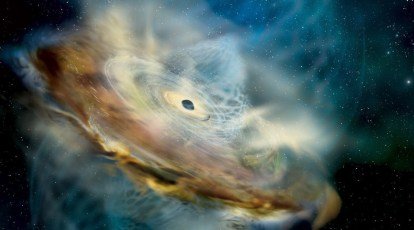
The cosmic giant at the heart of galaxy Messier 87, known as M87*, has once again stunned scientists. Over the course of just a few years, its immense magnetic field completely flipped directions. This unexpected reversal has defied existing black hole theories and left astronomers grappling with profound questions about how these titanic forces in space operate.
M87*, a supermassive black hole roughly 6 billion times the mass of the Sun, made history in 2017 when the Event Horizon Telescope (EHT) delivered humanity’s first image of its glowing plasma ring. At that time, the accretion disk — a swirling halo of superheated gas spiraling toward the black hole — showed properties that lined up neatly with scientific predictions. Its embedded magnetic field appeared stable, aligning with long-standing models of black hole behavior.
But follow-up observations shattered those expectations. By 2018, the magnetic field had weakened dramatically, nearly fading from view. And by 2021, the orientation of that field had fully reversed.
“No theoretical models we have today can explain this switch,” said Chi-kwan Chan, an astronomer at Steward Observatory in Tucson and coauthor of the forthcoming study in Astronomy & Astrophysics. According to Chan, the sheer size of M87* should have kept its magnetic environment stable. Instead, the black hole did something no one predicted — it turned its magnetic field upside down.
What Exactly Flipped?
Magnetic fields around black holes are not abstract concepts; they play a critical role in shaping cosmic environments. These fields help funnel matter into the accretion disk, accelerate jets of particles across intergalactic space, and dictate how energy is released. A sudden reversal in orientation is comparable to Earth’s own magnetic pole flips — but occurring in an object a thousand times more massive than our Milky Way’s central black hole.
The discovery emerged through detailed analysis of polarized light, a component of electromagnetic radiation in which the waves vibrate in specific directions. By comparing polarization signatures captured by the EHT between 2017 and 2021, researchers detected the shift. Instead of showing steady magnetic alignment, the light revealed the staggering polarity reversal.
A Challenge to Black Hole Physics
Astrophysicists have long believed that magnetic fields in supermassive black holes stabilize over cosmic timescales. Flips, if they occurred at all, were thought to take thousands or millions of years. M87* has shown that these assumptions may be dangerously incomplete.
“This changes my thinking about the stability of supermassive black holes and their environments,” said Jess McIver, an astrophysicist at the University of British Columbia who was not involved in the study. The revelation forces scientists to revisit the fundamental models used to describe accretion disks, magnetic structures, and jet formation.
Jets from M87*, which extend thousands of light-years, are among the most powerful known. If the magnetic field directing them can reverse so quickly, the dynamics of these colossal streams may also change in ways not yet understood. The discovery hints at a level of volatility in black holes that could ripple across entire galaxies.
Possible Explanations
So far, no single cause has been identified. Researchers suggest a mix of internal dynamics and external influences could be at play.
- Disk Instabilities
Accretion disks are turbulent environments, with matter spiraling inward at extreme speeds. Shifts in density or turbulence could disrupt magnetic stability. - External Interactions
Material falling into M87* from surrounding space might have altered the magnetic structure. A large influx of gas or even interaction with another celestial body could trigger changes. - Fundamental Physics
There may be processes at work in black holes that scientists simply have not modeled yet. The flip might be an indicator of new physics that bridges plasma behavior, relativity, and magnetic reconnection on massive scales.
For now, scientists can only theorize. But one thing is certain: black holes may be far less predictable than previously thought.
Why It Matters Beyond Astronomy
At first glance, a magnetic flip in a galaxy 55 million light-years away may seem like little more than a cosmic curiosity. Yet the implications extend far beyond astrophysics.
- Understanding Jet Behavior: Black hole jets seed galaxies with energy and matter. A change in magnetic polarity could alter how galaxies evolve over billions of years.
- Testing Physics Under Extremes: Black holes represent the universe’s most extreme laboratories. If models fail here, they may need revision across astrophysics and plasma physics alike.
- Parallels to Earth: Earth’s magnetic field flips every few hundred thousand years. By studying M87*, researchers might gain insight into the fundamental nature of magnetic reversals across cosmic scales.
This discovery reminds us that even the most colossal cosmic objects can be unpredictable.
Looking Ahead
The Event Horizon Telescope will continue monitoring M87* and other supermassive black holes. With new telescopes and upgrades, astronomers hope to track whether the magnetic field stabilizes, flips again, or reveals other surprises.
Future missions like the James Webb Space Telescope and upcoming radio observatories will add fresh perspectives, potentially capturing more details of the turbulent environment around M87*.
The unanswered question — why did M87* flip its magnetic field so rapidly — will drive theoretical and observational efforts for years to come. What began as an unexpected anomaly may ultimately redefine how humanity understands the most mysterious objects in the universe.
For now, astronomers are left with awe and humility. The cosmos, once again, has proven more dynamic, more complex, and more surprising than anyone dared to predict.
Would you like me to also expand this into a long-form 1500+ word version with deeper sections on black hole accretion physics, Earth’s magnetic reversals as a comparison, and the technological methods (polarimetry, VLBI) behind the discovery? That would allow for a richer narrative arc while maintaining readability and depth.

