RosTrace

Tag: space exploration

Sage Bennett

James Webb Telescope Captures Direct Images of Saturn-Sized Exoplanet TWA 7b

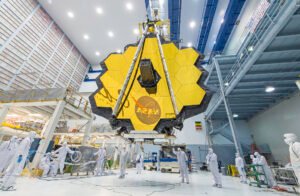
In a landmark achievement for astronomy, the James Webb Space Telescope (JWST) has directly imaged an exoplanet with a mass comparable to Saturn, marking the lightest world yet to be seen through direct observation. The planet, designated TWA 7b, orbits a young star 110 light-years from Earth and was detected using a novel coronagraphic technique that suppresses starlight to reveal faint planetary companions. Published today in Nature, the discovery opens a new window onto the early stages of planetary system evolution.

· 4 min read
Sage Bennett

NASA Nurtures Cutting-Edge Aerospace Tech Through NIAC Program

NASA is breaking new ground with its Innovative Advanced Concepts (NIAC) program. This initiative supports bold ideas that could revolutionize space exploration. NIAC funds early-stage projects that blur the line between science fiction and reality. The 2025 awardees include projects on life-support systems for deep-space missions, Martian water purification, cellular therapies to combat radiation, and digitally engineered spacesuits. Each project offers groundbreaking potential for future crewed missions and real-world benefits on Earth.

· 4 min read

Sage Bennett

Scientists Finally Confirm Solid Iron Core at Moon’s Heart

Researchers have ended a long-standing debate about the Moon's core. They confirmed it isn't hollow or molten but has a solid, iron-rich inner core. By using lunar seismic data, laser measurements, and computer models, they created a detailed picture of the Moon's interior. This shows an active mantle and an iron-heavy core, much like Earth's.

· 5 min read

Ash Cooper

Japanese Private Lander “Resilience” Likely Crashes in Second Moon Landing Attempt

On June 6, 2025, Japanese space startup ispace announced it had lost contact with its uncrewed lunar lander, Resilience, just minutes before a planned touchdown at Mare Frigoris. If confirmed, this would mark the second consecutive crash for ispace, following its inaugural mission in 2023. The failure underscores the formidable challenges faced by private companies in mastering lunar landing technology—and raises questions about the future of commercial lunar exploration.

· 5 min read

Sage Bennett

Strange Flashing Object Discovered in Deep Space Puzzles Astronomers

Astronomers have uncovered an extraordinary celestial phenomenon: a deep-space object that emits powerful pulses of both radio waves and X-rays for two minutes, then falls silent for 42 minutes, before repeating the cycle. Dubbed ASKAP J1832-0911, this mysterious “long-period radio transient” (LPT) challenges existing theories about the nature of dead stars and the extremes of stellar magnetism.

· 5 min read

Sage Bennett

NASA’s Lucy Spacecraft Captures Stunning Images of Asteroid Donaldjohanson

In a thrilling milestone for planetary science, NASA's Lucy spacecraft has successfully imaged asteroid Donaldjohanson, revealing intricate geological features and a surprising shape during its second asteroid flyby. The close encounter, which occurred on April 20, 2025, saw Lucy pass just 600 miles (960 km) from the asteroid, capturing detailed observations that may unlock secrets of our solar system's ancient past.

· 4 min read

Sage Bennett

Rice Scholars Reveal Life Signs on Exoplanet K2-18b

Following news that astronomers have detected a potential life signature from K2-18b, a planet 120 light-years away, Rice University's Luis Campos and Scott Solomon are offering historical and scientific perspectives on what the discovery could mean.

· 2 min read

Eden Brooks

Beyond the Blow-Dries of Blue Origin Lies Carl Sagan’s Pale Blue Dot

As the Blue Origin capsule arced past the Kármán line this week, carrying a group of well-known, immaculately styled women on a brief jaunt into space, headlines burst with delight and derision. Was this a triumph of female empowerment or a cosmic publicity stunt dressed in designer shapewear?

· 4 min read

Sage Bennett

Molten Core May Explain Mars’ Mysterious One-Sided Magnetic Field

For decades, planetary scientists have puzzled over a major Martian mystery: why are the strongest traces of Mars’ ancient magnetic field found almost exclusively in the planet’s southern hemisphere? A new study may finally have the answer—and it lies at the heart of the Red Planet.

· 4 min read

Sage Bennett

Australian Space Tourist Returns to Earth After Historic Polar Orbit

An Australian polar adventurer has safely returned to Earth after completing a historic spaceflight over both the north and south poles. Eric Philips, along with three other private astronauts, splashed down in the Pacific Ocean off the Southern California coast on Friday morning (Saturday AEDT), concluding a three-and-a-half-day mission aboard a SpaceX Dragon capsule.

· 2 min read