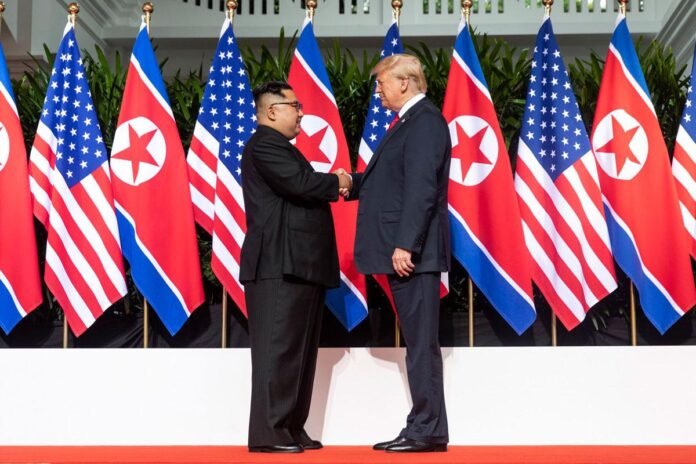
South Korea has called for swift and decisive intervention from Washington after new intelligence confirmed Pyongyang is sitting on a dangerous arsenal of highly enriched uranium. The announcement sent shockwaves through diplomatic circles, with Seoul stressing the matter is no longer a hypothetical threat but a clear and present danger.
Unification Minister Chung Dong-young revealed this week that North Korea is estimated to possess around 2,000 kilograms of uranium enriched to 90 percent or higher purity. According to experts at the Federation of American Scientists (FAS), that amount could be converted into dozens of nuclear warheads. For comparison, only five to six kilograms of plutonium is required to construct a single bomb. The revelation underscored how rapidly the security balance on the Korean Peninsula is shifting.
A Dangerous Threshold Crossed
For years, global intelligence agencies speculated about North Korea’s clandestine enrichment activities. The difference now lies in the confirmation of scale. Uranium enriched to weapons-grade levels is no longer being measured in grams or kilograms. Instead, Seoul says Pyongyang has enough to transform its military capacity into one of the most formidable nuclear stockpiles outside the five recognized nuclear powers.
Chung also said centrifuges remain active at four sites across North Korea. This suggests that production is not static but accelerating. If the claim holds, it challenges U.S. and UN monitoring mechanisms, raising serious doubts about the effectiveness of existing sanctions.
Calls for U.S. Leadership
South Korea’s government did not mince words. Officials described the situation as requiring “urgent” U.S. intervention. They want Washington to lead a coordinated diplomatic and security response before North Korea reaches a point of leverage that makes negotiations nearly impossible.
President Donald Trump, already embroiled in a volatile UN appearance this week, faces growing pressure to act. The White House, however, has been distracted by domestic turmoil, including threats of mass federal firings and escalating disputes between senior officials and state governors. Against this backdrop, Seoul’s request lands at a moment when U.S. bandwidth for foreign crises appears stretched.
The UN in the Spotlight
At the United Nations, frustration is mounting. Delegates note that while leaders trade barbs over unrelated controversies—including President Trump’s claim that he suffered “triple sabotage” during his UN address—the nuclear question is spiraling unchecked. Diplomats say the uranium revelations demand far more focus than disputes about malfunctioning escalators or partisan fights over late-night comedians.
The UN Security Council has scheduled emergency consultations. Yet insiders admit that enforcement tools are limited. China and Russia, both permanent members, remain reluctant to back stronger sanctions, arguing that pressure alone risks provoking Pyongyang into more dangerous behavior.
Regional Security Fears
For South Korea, the issue is existential. The country lives within artillery range of the North and has long relied on the U.S. nuclear umbrella for protection. With estimates now pointing to the possibility of dozens of deployable warheads, the cost of miscalculation increases exponentially.
Japan has also voiced alarm. Tokyo’s defense ministry released a statement noting that even a handful of new North Korean nuclear weapons could destabilize East Asia. Prime Minister Fumio Kishida has urged trilateral cooperation between Tokyo, Seoul, and Washington to ensure deterrence remains credible.
North Korea’s Silence
True to form, Pyongyang has not officially confirmed the uranium stockpile. State media instead highlighted the regime’s “scientific advances” and accused the West of fearmongering. Analysts believe North Korea may see value in ambiguity, keeping opponents guessing while showcasing enough capability to deter any thoughts of regime change.
Satellite imagery supports claims of continued activity at key enrichment facilities, including Yongbyon. However, pinpointing exact quantities of material remains notoriously difficult. The new South Korean estimate, therefore, represents one of the most concrete public assessments to date.
Domestic U.S. Distractions
Complicating matters is Washington’s fractured political climate. Vice President J.D. Vance has spent much of the week sparring with Democrats over issues ranging from immigration violence to late-night television. Trump himself has fueled controversy by suggesting paracetamol during pregnancy could cause autism, a claim swiftly refuted by medical experts.
With headlines dominated by these domestic clashes, foreign policy priorities risk slipping from the top of the agenda. Yet allies insist the nuclear threat cannot wait. “Every day the centrifuges spin, the danger grows,” said one South Korean diplomat privately.
Expert Assessments
Nuclear specialists stress the scale of enrichment is not just alarming—it is transformational. A stockpile of 2,000 kilograms of highly enriched uranium, if weaponized, could yield between 30 and 40 nuclear bombs depending on design efficiency. That would place North Korea in league with mid-tier nuclear powers, well beyond the limited arsenal previously assumed.
The Federation of American Scientists notes that North Korea’s weapons designs are believed to be relatively crude but still devastating. A single detonation in Seoul or Tokyo would cause mass casualties and destabilize the global economy.
Possible U.S. Responses
Options on the table include:
- Expanded Sanctions: Targeting financial networks, shipping lines, and technology transfers.
- Military Posturing: Increasing joint exercises with South Korea and Japan to reaffirm deterrence.
- Diplomatic Outreach: Exploring back-channel talks with Pyongyang, possibly through China or neutral states.
- Missile Defense Investment: Accelerating deployment of advanced interception systems in the region.
Critics argue sanctions alone have failed for decades, while military escalation risks war. Still, doing nothing is increasingly untenable.
Risks of Miscalculation
The crisis carries echoes of past nuclear flashpoints, from the Cuban Missile Crisis to India-Pakistan standoffs. The difference is that North Korea’s leadership thrives on unpredictability. Kim Jong-un has repeatedly tested missiles over Japanese airspace and flaunted his defiance of international norms.
Analysts warn that as his arsenal grows, so does the chance of accidental escalation. A misinterpreted drill, a failed missile test, or a cyberattack blamed on Pyongyang could spiral into conflict with catastrophic consequences.
The Path Forward
Seoul’s urgent call is less about immediate war than about closing a narrowing window. Once North Korea crosses the threshold into a robust, diversified nuclear arsenal, traditional diplomatic levers lose force. The challenge for Washington is to act decisively while avoiding steps that could push Pyongyang into a corner.
Former President Barack Obama, speaking in London this week, described recent U.S. health claims as “violence against the truth.” But he also reminded audiences that misinformation in public health pales beside misinformation in security. “When nuclear facts are ignored, the cost is measured in cities, not symptoms,” he warned.
Conclusion
The world now faces a stark reminder: North Korea is no longer a theoretical nuclear power. The enrichment numbers cited by South Korea signal a dangerous new reality. Unless Washington and its allies respond with urgency and clarity, Pyongyang could soon wield enough warheads to permanently alter the balance of power in Asia.
The question hanging over Washington is whether domestic turbulence will prevent decisive leadership at a moment when the stakes could not be higher.

