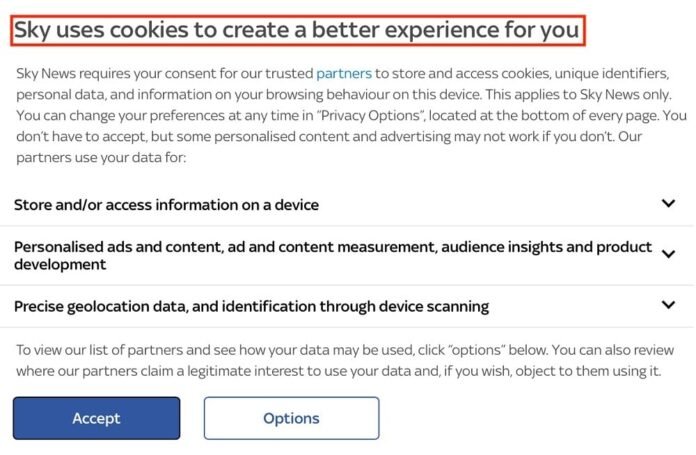
Sky has updated its cookie consent policy, prompting users to make direct choices about how their browsing data is collected and used. The change highlights a growing tension between digital convenience and consumer privacy. While the company stresses that cookies help provide tailored adverts and improve services, privacy advocates warn of the hidden trade-offs.
At the heart of the policy is a clear message: accept all cookies for fully personalised advertising, or select “Essential cookies only” to limit data collection. Sky also offers a “View options” choice, where users can fine-tune how and why their information is processed. For many, these options may seem like just another pop-up box. But beneath the surface lies a significant shift in how personal information is used in the digital economy.
What Sky’s Cookie Options Actually Mean
Cookies are small files stored on devices that track user activity, preferences, and browsing behaviour. Sky’s system goes further by combining this digital footprint with customer account information, if the user is also a Sky subscriber. This creates a more detailed profile that can be used to tailor adverts across devices and platforms.
For example, a household watching sports on Sky may receive betting promotions or athletic gear adverts across connected devices. A family using Sky broadband could see personalised offers on streaming bundles or home technology upgrades. By contrast, choosing “Essential cookies only” means the adverts will not be targeted, but they will still appear in a generic format.
Sky and its 197 trusted partners also stress that cookies fuel broader improvements. These include content recommendations, product development, and audience measurement. The policy highlights two categories: personalised advertising and services development. Both depend on collecting and analysing vast amounts of behavioural data.
The Business Case for Personalised Advertising
From Sky’s perspective, personalised advertising drives revenue while keeping subscription costs competitive. Research from PwC shows that targeted adverts can increase engagement rates by up to 400 percent compared with non-targeted campaigns. Brands value platforms like Sky because they can reach households with a higher degree of accuracy, reducing wasted advertising spend.
Advertisers are willing to pay a premium for this precision. For Sky, that revenue supports original programming, sports broadcasting rights, and customer service investments. In short, cookies are not just about adverts—they are about sustaining the broader business model.
Privacy Advocates Raise Concerns
Yet consumer-rights groups caution against the quiet expansion of surveillance capitalism. The Information Commissioner’s Office (ICO) in the UK has warned that many users do not fully understand what “legitimate interest” means in cookie policies. Sky’s disclosure states that some partners rely on legitimate interest to process data, even when personalised advertising is declined.
This creates potential grey areas. For example, data could still be used for analytics, fraud prevention, or service optimisation. While these purposes may not involve targeted advertising, they still involve the collection and processing of personal data. Critics argue that this undermines true consent.
Privacy International, a London-based watchdog, emphasises that choice should be simple, fair, and free from manipulation. “When users are confronted with multiple layers of consent windows, many simply click ‘Accept all’ out of frustration,” the group notes. Studies show that over 70 percent of internet users consent to tracking without reading the full policy, raising questions about informed decision-making.
The Legal Backdrop: GDPR and ePrivacy
Sky’s cookie policy operates under the framework of the UK GDPR and the Privacy and Electronic Communications Regulations (PECR). These rules require clear consent for storing or accessing information on a device. However, the regulations also allow certain exceptions for “essential” cookies, such as those that enable secure log-ins or shopping carts.
The General Data Protection Regulation (GDPR) also recognises “legitimate interest” as a lawful basis for processing. But the law requires a careful balance between a company’s needs and an individual’s rights. Sky’s reliance on this clause means it must demonstrate that its data practices do not override consumer freedoms.
The UK’s Information Commissioner has repeatedly called for simpler consent mechanisms, warning that complex frameworks erode public trust. In July 2023, the ICO fined TikTok £12.7 million for failing to handle children’s data properly—an example that underscores how regulatory scrutiny is tightening across industries.
Consumer Choices: Essential vs. Personalised
For users, the choice comes down to convenience versus control. Accepting all cookies ensures a seamless, personalised experience, but at the cost of more data sharing. Opting for essential cookies only limits tracking but may lead to less relevant adverts and fewer tailored recommendations.
Some digital literacy experts recommend a middle-ground approach: use the “View options” menu to select specific purposes, such as content measurement or fraud prevention, while declining personalised advertising. This allows users to support service improvements without opening the door to full behavioural profiling.
Tools like browser extensions and privacy-focused search engines can further reduce tracking. For example, DuckDuckGo blocks third-party trackers by default, while extensions like Privacy Badger let users customise blocking preferences. Sky’s consent menu is just one piece of a larger toolkit that consumers can use to control their digital footprint.
The Global Context
Sky’s move reflects a wider trend across tech and media companies. Meta, Google, and Amazon have all faced regulatory challenges over how they handle user data. The European Union’s Digital Markets Act (DMA), which took effect in March 2024, now requires large platforms to offer clearer opt-outs from tracking.
In Germany, regulators have ordered companies like Meta to stop combining data from different services without explicit consent. Meanwhile, in the United States, states like California and Virginia have introduced privacy laws modelled on GDPR, giving consumers more control over their data.
Sky’s policy may therefore be seen as part of a broader industry alignment with evolving laws. The challenge lies in balancing legal compliance with commercial interests and customer satisfaction.
The Role of Transparency
Transparency is central to building trust. Sky has published detailed explanations of each data-processing purpose, ranging from storing device information to measuring content effectiveness. The company also discloses the number of partners involved—197—a figure that gives consumers a sense of the scale of data sharing.
But transparency alone does not guarantee understanding. Technical jargon, layered menus, and vague legal terms can overwhelm even informed users. Research from the Norwegian Consumer Council found that many cookie banners are designed with “dark patterns,” nudging users toward consent.
To counter this, consumer advocates call for simpler, plain-language policies. For instance, rather than saying “audience insights,” companies could state: “We analyse how many people watch our shows and which ones are most popular.” Such clarity would help users make decisions based on comprehension rather than guesswork.
Practical Steps for Consumers
For readers navigating Sky’s cookie choices, experts suggest a few actionable steps:
- Review Preferences Regularly: Cookie settings can be updated at any time through the Privacy Options link. Revisit them to ensure they still reflect your comfort level.
- Use Browser Tools: Enable “Do Not Track” settings, block third-party cookies, or install privacy extensions to add extra layers of control.
- Separate Accounts: Where possible, use different browsers or profiles for work, entertainment, and private browsing to limit cross-profile tracking.
- Stay Informed: Follow updates from regulators like the ICO or consumer-rights groups to understand how industry practices evolve.
The Bigger Picture
Sky’s updated cookie policy is more than a technical adjustment—it is a reflection of the digital economy’s reliance on personal data. Consumers are increasingly asked to trade privacy for convenience, often without fully appreciating the long-term consequences.
For businesses, cookies represent an efficient way to monetise user attention and sustain operations. For regulators, they are a focal point of ongoing debates about fairness, autonomy, and transparency. And for users, they represent a daily choice between personalisation and privacy.
The challenge going forward is to design systems that respect consumer rights while allowing companies to innovate. Whether Sky’s approach strikes the right balance remains open to debate. But one fact is clear: the future of digital advertising, and the trust that underpins it, depends on how clearly and fairly these choices are presented.

