When OpenAI launched ChatGPT in 2022, it introduced generative AI to the mainstream. What followed was a rapid shift—industries, researchers, and everyday users began weaving the technology into daily practice. Three years later, the question dominating the field is no longer “what can generative AI do?” but “what should it become?”
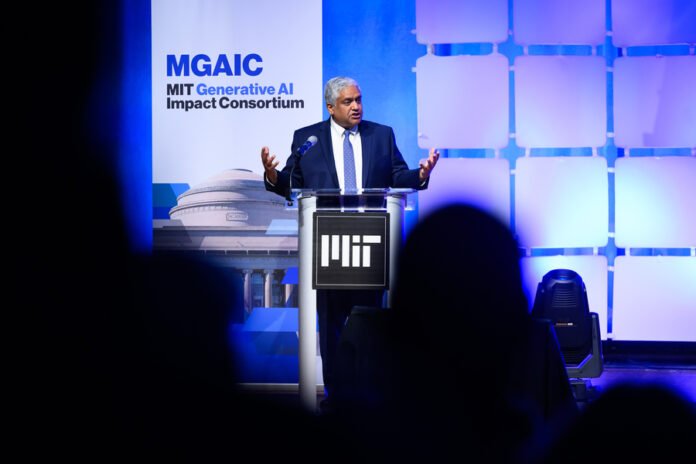
That central question framed the inaugural MIT Generative AI Impact Consortium (MGAIC) Symposium, held on September 17 at the Kresge Auditorium. The event brought together hundreds of researchers, corporate leaders, and students to examine where generative AI is heading, what innovations are on the horizon, and how society can steer its growth responsibly.
MIT Provost Anantha Chandrakasan opened the day by acknowledging both the promise and urgency of the moment: “Generative AI is moving fast. It is our job to make sure that, as the technology keeps advancing, our collective wisdom keeps pace.”
MIT President Sally Kornbluth underscored the stakes. “Part of MIT’s responsibility is to keep these advances coming for the world. How can we manage the magic so that all of us can confidently rely on it for critical applications in the real world?”
From Large Language Models to “World Models”
Keynote speaker Yann LeCun, Meta’s Chief AI Scientist, argued that the next leap in AI will not come from making today’s large language models bigger. Instead, he described a pivot toward “world models”—AI systems that learn through sensory experience, much like children do.
“A 4-year-old has seen as much data through vision as the largest LLM,” LeCun said. “The world model is going to become the key component of future AI systems.”
In practice, a robot equipped with a world model could observe its environment and learn new tasks without requiring specific training data. For example, instead of being preprogrammed with step-by-step instructions, such a robot could adapt when faced with unexpected obstacles or new goals.
LeCun dismissed fears that these systems would escape human control. Guardrails, he argued, are integral to their design. Just as societies build rules to align human behavior with the common good, engineers can embed limits to ensure AI systems remain aligned. “By construction, the system will not be able to escape those guardrails,” he emphasized.
Robotics Enters a New Era
Tye Brady, Chief Technologist at Amazon Robotics, offered a real-world perspective on how generative AI is already reshaping automation. He noted that Amazon warehouses have incorporated generative AI tools to optimize how robots navigate, sort, and transport goods.
Looking ahead, Brady predicted that the most transformative changes will emerge from human–robot collaboration. “GenAI is probably the most impactful technology I have witnessed throughout my whole robotics career,” he said. Machines, he explained, will not replace workers but enhance efficiency by reducing repetitive burdens and enabling people to focus on higher-level tasks.
One example: AI-powered planning systems that anticipate surges in demand and adjust workflows in real time. Instead of waiting for bottlenecks to appear, robots can now redirect goods, while human staff coordinate complex tasks that require judgment and flexibility.
Businesses Grapple with Integration
Throughout the symposium, corporate leaders—from multinational companies like Coca-Cola and Analog Devices to startups such as health care AI firm Abridge—shared lessons from deploying generative AI at scale.
For established corporations, the challenge often lies in balancing speed with caution. Leaders emphasized that while generative AI can unlock efficiency, it also raises questions of accountability, transparency, and bias. For example, Coca-Cola executives described how AI-assisted marketing campaigns can reach global audiences, but only if they are carefully managed to avoid reinforcing harmful stereotypes or misinformation.
For startups, the opportunities are different. Abridge, which builds AI tools for medical transcription, highlighted how generative AI can lower costs and improve accuracy in clinical workflows. Yet they also acknowledged the need for constant monitoring to avoid “hallucinations” that could compromise patient safety.
MIT Research Pushes Boundaries
MIT faculty added an academic lens, unveiling projects designed to improve both performance and trustworthiness in generative AI. Among the highlights:
- Reducing bias and hallucination: New architectures aim to make outputs more reliable, especially for decision-making in sensitive fields like health care and law.
- Improving visual learning: Teams are building systems that allow large language models to better understand and interpret the visual world, bridging the gap between text-based reasoning and real-world perception.
- Ecological monitoring: AI is being used to clean noise from ecological image data, enabling clearer identification of species and environmental trends.
Each project reflects the dual imperative that MIT President Kornbluth articulated: pushing forward technological advances while ensuring they remain usable, trustworthy, and beneficial.
Building Guardrails and Governance
The symposium repeatedly circled back to the importance of governance. Participants agreed that as generative AI becomes more capable, society will need frameworks to ensure its safe use.
This does not mean halting innovation. Instead, it means designing accountability systems, from industry-wide standards to institution-level safeguards. One practical takeaway: firms should create “AI oversight boards” within organizations, charged with reviewing deployment plans, auditing outcomes, and aligning projects with ethical commitments.
In addition, panelists stressed the need for cross-sector collaboration. Governments, universities, and companies must coordinate, not only to regulate risks but also to accelerate beneficial uses—such as sustainable energy design, medical research, and disaster response.
A Sense of Possibility and Urgency
By the close of the event, Vivek Farias, MGAIC co-lead and Patrick J. McGovern Professor at MIT Sloan School of Management, summed up the tone: “I hope everyone leaves with a sense of possibility, and urgency to make that possibility real.”
Generative AI is at a crossroads. On one hand, the technology has already become embedded in daily life, powering everything from search engines to corporate supply chains. On the other hand, its future will depend on whether researchers and industry leaders can develop systems that are both more powerful and more trustworthy.
The MGAIC Symposium marked MIT’s bid to shape that path. Its message was clear: the next era of AI will not be built by algorithms alone. It will be built through shared responsibility—between scientists, companies, and society at large.
As the conversation continues, one thing is certain: the future of generative AI will not be written by machines, but by the choices people make today about how to guide them.

