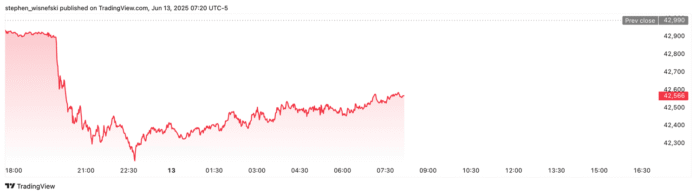
The Dow Jones Industrial Average fell 1,238 points, or 2.5 percent, in early trading on March 3, 2026, as oil prices climbed and investors reacted to rising geopolitical tension between the United States and Iran. According to CNBC market data, this marks the first potential 1,000 point decline for the blue chip index since April 10, 2025, if losses hold through the close. The S and P 500 dropped 2.2 percent, while the Nasdaq Composite slid 2.3 percent. Markets moved quickly. Volatility rose just as fast.
Investors are now searching for clear answers. What triggered the sell off. How exposed are media and music companies. And what should portfolio managers, advisors, and individual investors do next. This report draws from credible financial coverage, including CNBC and CBC News, as well as corporate market data and publicly available earnings disclosures, to provide a structured and actionable view of the developing situation.
Oil Shock and Geopolitical Risk Drive Broad Market Sell Off
Oil prices spiked again on Tuesday morning. That move alone can rattle equity markets. Higher oil prices increase transportation and production costs across industries. They also raise inflation concerns. When geopolitical tensions rise, traders often move capital into defensive assets. Stocks can suffer as a result.
CBC News reported that global markets reacted sharply as fears grew that the conflict involving Iran could widen and create sustained economic damage. Energy markets tend to respond first. Equities follow. In this case, selling pressure spread across sectors including technology, communication services, and consumer discretionary stocks. Entertainment and music companies fall into these broader classifications.
The Dow Jones Industrial Average includes 30 large companies, but not major dedicated music labels. However, companies tied to digital streaming, live events, audio hardware, and media distribution trade on the Nasdaq and the New York Stock Exchange. These stocks do not sit inside the Dow 30, yet they are highly sensitive to broader market swings. When the S and P 500 and Nasdaq fall more than 2 percent in a single session, sector wide declines are common.
Market data from public exchanges shows that music and entertainment stocks moved lower alongside technology and growth names. Investors often view these companies as discretionary plays. When economic risk rises, discretionary spending expectations fall. That dynamic places pressure on valuations. It also impacts investor sentiment.
Music and Entertainment Stocks Feel the Pressure
Jeremy Bowman of The Motley Fool identified six music related stocks worth monitoring in February 2026. These companies operate across streaming, live events, hardware, and broadcast radio. Market capitalizations, based on public listings at that time, were as follows:
- Spotify Technology at approximately 104.4 billion dollars
- Sirius XM at roughly 7.3 billion dollars
- Sonos at about 1.8 billion dollars
- Live Nation Entertainment at 37.6 billion dollars
- iHeartMedia at 465.5 million dollars
- Warner Music Group at 14.9 billion dollars
These firms span different risk profiles. Spotify trades on the NYSE under SPOT. Sirius XM trades on Nasdaq under SIRI. Live Nation trades under LYV. Warner Music Group trades under WMG. Each faces unique operational drivers. Yet all share exposure to consumer spending trends and advertising revenue.
Spotify reported 281 million paid subscribers, reflecting 12 percent growth in the third quarter of 2025, according to company disclosures cited in financial reporting. It also surpassed 700 million monthly active users, including ad supported listeners. That scale provides resilience. However, advertising revenue can weaken in uncertain economic periods.
Live Nation relies heavily on live event demand. Concert ticket sales can remain strong even in slowdowns, but margins may tighten if travel and logistics costs rise with oil prices. Sirius XM and iHeartMedia depend on advertising markets. Ad spending often contracts when businesses grow cautious.
In short, the pressure is not uniform. But it is broad.
Market Snapshot of Key Music and Entertainment Stocks
| Company | Ticker | Exchange | Approx. Market Cap (Feb 2026) | Core Revenue Driver |
|---|---|---|---|---|
| Spotify Technology | SPOT | NYSE | 104.4B USD | Streaming subscriptions, ads |
| Sirius XM | SIRI | Nasdaq | 7.3B USD | Satellite radio subscriptions |
| Sonos | SONO | Nasdaq | 1.8B USD | Audio hardware sales |
| Live Nation Entertainment | LYV | NYSE | 37.6B USD | Live events, ticketing |
| iHeartMedia | IHRT | Nasdaq | 465.5M USD | Radio and digital advertising |
| Warner Music Group | WMG | Nasdaq | 14.9B USD | Recorded music, publishing |
This table reflects publicly reported market capitalizations from financial coverage in February 2026. Investors should confirm current figures through exchange data or official filings, as valuations can change daily.
What Investors Should Watch Next
Short term volatility often creates both risk and opportunity. The key is discipline. Investors should focus on measurable indicators rather than headlines alone.
First, monitor oil prices and energy futures. Sustained increases above recent averages could pressure corporate margins. Second, track volatility indexes and bond yields. These provide insight into market stress levels. Third, review upcoming earnings calls from major streaming and live event companies. Management guidance will reveal how executives view demand and cost pressures.
It is also wise to reassess portfolio concentration. If a portfolio is heavily weighted toward growth or consumer discretionary stocks, diversification may reduce risk exposure. That does not mean selling quality assets in panic. It means reviewing allocations carefully.
Professional investors often consider the following steps during sharp market declines:
- Rebalance portfolios to target allocations
- Review liquidity needs for the next 6 to 12 months
- Avoid margin exposure during high volatility
- Focus on companies with strong balance sheets and recurring revenue
- Monitor insider buying or institutional accumulation
Each action requires data driven evaluation. Emotional decisions can erode long term returns. Markets have historically recovered from geopolitical shocks, though timelines vary. Maintaining a clear strategy is essential.
Strategic Outlook for Media and Music Investors
The current sell off highlights how interconnected sectors have become. Streaming platforms depend on global user growth. Live event companies rely on stable travel and consumer confidence. Advertising driven businesses depend on economic momentum. When oil prices spike and geopolitical risk rises, all three face headwinds.
Yet the structural transformation of the music industry remains intact. Streaming displaced physical sales over the past decade. Social media reshaped artist discovery. Live events became a major revenue engine. These shifts are documented across industry research and earnings reports. They are not reversed by one volatile session.
For long term investors, the focus should remain on fundamentals. Subscriber growth rates. Cash flow stability. Debt levels. Competitive positioning. Companies like Spotify with hundreds of millions of users operate at global scale. Live Nation controls major ticketing infrastructure. Warner Music owns valuable publishing catalogs. These assets hold enduring value.
Risk management still matters. So does patience. The market reaction on March 3 reflects immediate uncertainty, not necessarily permanent damage.
Trending FAQ
Why did the Dow Jones fall more than 1,200 points?
The decline followed a sharp rise in oil prices and investor concern about escalating geopolitical tension involving Iran. Higher energy costs and uncertainty can trigger broad equity selling.
Are music stocks part of the Dow Jones Industrial Average?
No. Major music companies such as Spotify and Warner Music Group are listed on the NYSE or Nasdaq. They are affected by broader market movements but are not components of the Dow 30.
How exposed is Spotify to economic downturns?
Spotify generates revenue from paid subscriptions and advertising. Subscription revenue tends to be more stable, while advertising may fluctuate with economic conditions.
What should investors do during market volatility?
Review portfolio allocation, avoid panic selling, monitor earnings guidance, and ensure adequate liquidity. Decisions should be based on financial data and long term objectives.
Can oil prices directly impact entertainment companies?
Yes. Higher oil prices increase travel, logistics, and operating costs, especially for live event companies. They can also affect consumer spending patterns.
Markets move fast. Data endures. Investors who rely on verified information and structured strategy are better positioned to navigate volatility, even when headlines turn sharp and numbers fall quickly.

