Researchers at National Taiwan University have unveiled a sustainable technology that could redefine wearable electronics. Their innovation, a biodegradable MXene–bamboo paper electrode encapsulated in a breathable Ecoflex layer, combines flexibility, waterproof durability, and tunable conductivity. The achievement marks an important step in tackling electronic waste while advancing human–machine interfaces, including exoskeletons, muscle activity monitoring, and wearable health sensors.
A Green Answer to Growing E-Waste
Electronic waste is one of the fastest-growing waste streams worldwide. According to the United Nations, global e-waste reached 62 million metric tons in 2022, with only about 20% being formally recycled. The rest often ends up in landfills or informal recycling centers, releasing harmful chemicals. Against this backdrop, the Taiwanese research team focused on building a material that not only delivers high performance but also degrades safely after use.
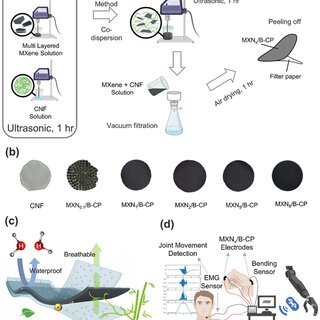
Their electrodes are made by embedding Ti₃C₂Tx MXene nanosheets into bamboo-derived cellulose nanofibers. This creates a lightweight, flexible paper structure capable of conducting electricity efficiently. When discarded, the material undergoes oxidative degradation, minimizing environmental harm.
Engineering the Electrode
The process of making these electrodes centers on two main components: MXene and bamboo cellulose. MXene, a class of two-dimensional materials, is valued for its high electrical conductivity and hydrophilic surface. Meanwhile, bamboo cellulose provides a strong and renewable scaffold.
When layered together, the MXene nanosheets adhere tightly to the cellulose fibers, ensuring mechanical stability and excellent electron transport. A porous Ecoflex coating is then applied, creating a waterproof yet breathable shield. This coating protects the electrodes from sweat and moisture while maintaining air permeability, a key feature for long-term comfort in wearable applications.
Performance and Applications
Tests show that the biodegradable electrodes perform as well as, and in some cases better than, conventional non-biodegradable options. They are particularly effective in:
- Electromyography (EMG) sensing – capturing high-fidelity muscle activity signals.
- Strain and pressure detection – enabling fine motion monitoring and wearable robotics.
- Wireless exoskeleton control – demonstrated in a knee exoskeleton trial with stable, low-noise performance.
Unlike traditional gel-based electrodes, which can dry out or irritate skin, the paper-based design is gentle, lightweight, and reusable.
Waterproof Yet Breathable
One of the standout achievements is the balance between water resistance and breathability. Wearable devices must withstand exposure to sweat, rain, or accidental splashes. However, they also need to allow airflow to prevent skin irritation.
The porous Ecoflex layer solves this challenge by repelling water while maintaining gas exchange. This dual function ensures that the electrodes remain comfortable and stable, even during extended use in demanding environments.
From Lab to Market
Scalability is often the Achilles’ heel of advanced materials research. Yet, the team highlights that their bamboo–MXene paper electrodes can be produced at scale with relatively low cost. Bamboo is abundant and fast-growing, making it an ideal renewable raw material. Meanwhile, MXene synthesis methods are maturing, with companies beginning to commercialize the material for energy storage and electronics.
If developed further, these electrodes could underpin a new generation of eco-friendly wearables, from smart textiles and fitness trackers to prosthetics and rehabilitation tools.
Academic and Institutional Backing
The work, published in Advanced Science, was led by Prof. Tzu-En Lin of National Taiwan University. His laboratory focuses on sensor development across different platforms, including microelectrodes, nano-membranes, aerogels, and semiconductors. This project received funding from the National Science and Technology Council of Taiwan under grant numbers 113-2221-E-002-211-MY3 and 113-2113-M-A49-026.
Prof. Lin emphasized the broader implications: “This innovation paves the way for green, scalable electronics designed for next-generation wearable and assistive technologies.”
Why It Matters for Wearable Tech
The global wearable technology market is projected to exceed $160 billion by 2030, fueled by demand for health monitoring, fitness, and assistive devices. Yet, the environmental cost of producing and discarding billions of devices annually has been overlooked.
By introducing a fully biodegradable, high-performance electrode, researchers have addressed one of the key sustainability gaps. Such advances could also align with emerging regulatory trends that encourage eco-friendly design, such as the European Union’s Right to Repair and eco-design directives.
Toward Sustainable Human–Machine Interfaces
The integration of biodegradable electrodes into exoskeletons is especially significant. Exoskeletons are increasingly being explored in medical rehabilitation, elder care, and industrial applications. High-quality EMG signals are essential for enabling precise, intuitive control. The Taiwanese team’s solution not only delivers this but also ensures the devices remain environmentally responsible.
The electrodes’ low noise and consistent signal quality could expand their role into brain–computer interfaces and advanced prosthetics, where precision is paramount.
Challenges Ahead
Despite the promise, challenges remain. The long-term durability of biodegradable electrodes under real-world conditions needs further testing. Regulatory approval for medical applications could also be complex, requiring extensive clinical validation. Moreover, scaling up MXene production without cost or safety issues will be crucial.
Still, the combination of bamboo and MXene offers an innovative path forward. By merging renewable resources with advanced nanomaterials, the research points to a future where sustainability and performance are not mutually exclusive.
Looking Forward
If adopted widely, biodegradable wearable sensors could reshape how industries design and dispose of electronics. Imagine fitness trackers that decompose after their life cycle, medical electrodes that leave no harmful waste, or exoskeletons powered by green interfaces.
The work by National Taiwan University is not just a laboratory success but a glimpse into the possible future of electronics—flexible, breathable, high-performing, and environmentally safe.
In an era where sustainability is no longer optional, breakthroughs like the MXene–bamboo electrode remind us that cutting-edge science can also be a force for ecological good. The challenge now lies in moving from promising prototypes to real-world adoption, where technology can serve both human needs and the planet.

