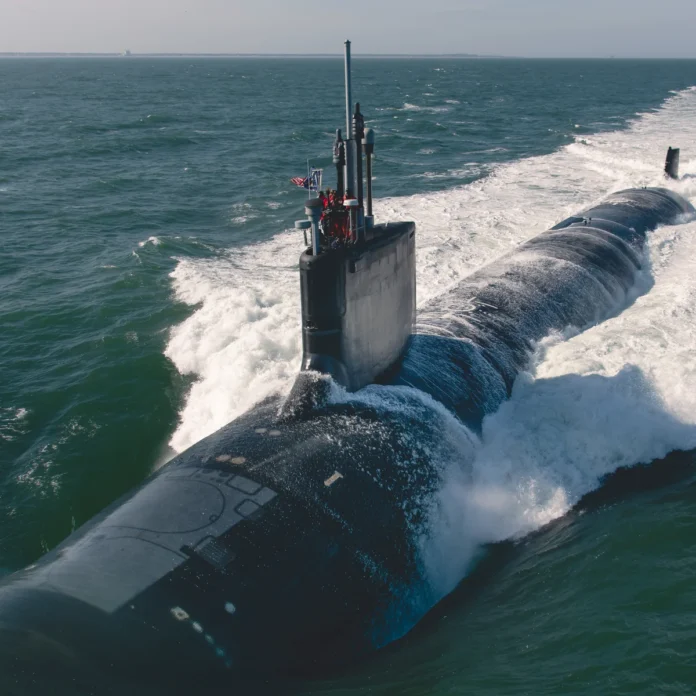
Military history teaches that dominance is fleeting. The Gatling gun once ruled the battlefield. Battleships symbolized naval supremacy. Tanks seemed unstoppable. Each was eventually overtaken by technology that rendered it vulnerable. Now, Australia’s $368 billion Aukus nuclear submarine program faces a similar question: how long can stealth endure in an age of rapid detection advances?
The Apex Predator Under Review
When the head of the Australian Submarine Agency, Vice Admiral Jonathan Mead, described the future Aukus fleet as the “apex predator of the oceans,” he captured the belief that submarines embody unmatched stealth and firepower. Nuclear-powered vessels can travel vast distances without surfacing, carry cruise missiles, and even serve as second-strike nuclear deterrents.
Yet the foundations of that dominance are shifting. Quantum sensors, AI-driven satellite surveillance, and advanced magnetometers suggest that the oceans, once opaque, may soon become transparent. If stealth falters, the advantage turns. A submarine that can be found is a submarine that can be destroyed. Critics warn these subs could become “billion-dollar coffins.”
The Detection Revolution
Across the world, billions are being poured into technologies designed to pierce the oceans’ cloak of invisibility. These include:
- Sonar networks: Expansive undersea arrays capable of identifying subtle sound waves.
- Quantum sensing: Devices so sensitive they can detect atomic-level changes in their environment.
- Magnetometers: Tools tracking minuscule shifts in Earth’s magnetic field caused by a submarine’s metallic hull.
- AI-powered satellites: Capable of identifying faint surface disturbances, such as heat plumes or bioluminescent trails triggered by subs passing beneath.
China leads many of these efforts. Researchers at Shanghai Jiao Tong University recently reported a seabed sensor that can detect the electromagnetic waves from a submarine’s propeller at nearly 20 kilometers—a tenfold improvement on previous limits. Another Chinese team in Xi’an unveiled an airborne magnetometer that can track a submarine’s magnetic wake.
Quantum breakthroughs are particularly troubling for traditional submarine strategy. In April, the China Aerospace Science and Technology Corporation introduced a drone-mounted quantum sensor system, claiming sensitivity comparable to NATO’s MAD-XR system but at a fraction of the cost. Deployed en masse, such systems could blanket contested seas.
Countermeasures in the Works
The arms race is not one-sided. Submarine designers are developing stealth upgrades to preserve invisibility:
- Anechoic tiles to absorb or scatter sonar signals.
- Pump-jet propulsors that reduce noise and wake.
- Cooling systems to mask thermal trails detectable by satellites.
- Degaussing techniques to minimize magnetic signatures.
Vice Admiral Mark Hammond, Australia’s Chief of Navy, insists the contest between detection and stealth is cyclical. For over 30 years, he has heard predictions of “transparent oceans.” None have materialized. Every new detection breakthrough, he argues, has been met with counter-stealth innovations.
“The skies and land are already transparent,” Hammond said. “Yet no one stopped building planes or tanks. Submarines will remain critical.”
Transparent Oceans: A Matter of Time
Not all experts are convinced. Dr Anne-Marie Grisogono, co-author of the 2020 Transparent Oceans report, warned that advances in AI and sensing technology make submarine detectability inevitable.
“The likelihood the oceans will become transparent is basically 100%. The question is when,” she told The Guardian. Grisogono envisions “meshes” of cheap, networked sensors—drones, buoys, satellites—operating together. Even if many fail, the system would still function.
This changes the economics of warfare. Defensive networks that are cheap but effective could neutralize submarines costing billions. “The advantage flips,” she noted. “The defender gains more by spending less.”
If Grisogono is correct, Australia risks committing massive funds to a fleet that may be obsolete by mid-century.
The Ghost Shark Factor
Acknowledging the uncertainty, Australia has invested in alternative technologies. This month, Defence Minister Richard Marles announced a $1.7 billion purchase of Ghost Shark autonomous underwater vehicles (AUVs).
These AI-powered mini-subs, about the size of a minibus, can conduct surveillance, reconnaissance, and even strikes at long range. Unlike crewed submarines, Ghost Sharks are relatively cheap and expendable. They can be launched from warships or shore facilities, filling the undersea battle space in swarms.
Marles denied the move was a hedge against nuclear subs becoming detectable. Instead, he said the Ghost Sharks “complement” crewed submarines, extending Australia’s reach. Still, their rapid rollout highlights a recognition: agility may matter more than size in future warfare.
Strategic Lessons from Ukraine
Military strategist Peter W. Singer points to Ukraine as a cautionary tale. Cheap drones costing a few hundred dollars have destroyed Russian tanks worth tens of millions. The principle carries into undersea warfare.
“Uncrewed systems won’t all be tethered to human control,” Singer explained. “Some will operate independently, filling the seas with small, cheap platforms.” He likens the Aukus program to a high-stakes bet. Valuable, yes, but vulnerable to being overwhelmed by swarms of expendable adversaries.
If a $500 drone can halt a $50 million tank, what could a $2 million autonomous sub do to a $10 billion nuclear submarine?
The Stakes for Australia
Australia’s Aukus deal is historic. It binds Canberra tightly to Washington and London, deepening military cooperation against a rising China. It also commits taxpayers to an unprecedented defence outlay—$368 billion over three decades.
But the pace of technological change raises sharp questions:
- Will these submarines remain undetectable into the 2060s, when some are still scheduled for construction?
- Could a hybrid fleet of crewed and autonomous systems offer a cheaper, more flexible alternative?
- Is Australia preparing for the wars of the future—or investing in the weapons of the past?
Critics argue the Aukus pact locks Australia into a strategy built on outdated assumptions. Supporters counter that alliances and deterrence cannot be measured only in dollars. Submarines remain symbols of power projection, and abandoning them could leave Australia exposed.
Decision Point
Ultimately, the question is not whether submarines have value but how much value they retain in a transparent ocean. If they are detectable, they are destroyable.
Singer stresses that no one can predict technological leaps decades ahead. “Twenty years is a long time in undersea warfare,” he said. “We must accept we don’t have perfect foresight or unlimited budgets.”
For Australia, the decision is stark. It can double down on Aukus, betting on stealth to endure. Or it can diversify, investing more heavily in uncrewed systems like Ghost Shark. Either way, the stakes are measured not just in billions but in national security.
Australia is standing at a crossroads. The Aukus submarines promise unrivaled strength but face a future where invisibility may be impossible. New detection technologies, from quantum sensors to AI surveillance, are racing ahead. Autonomous underwater vehicles offer promise, but they also hint at a different future: one where numbers, speed, and expendability trump stealth and prestige.
The apex predator of the seas may survive. Or it may find itself transformed into prey. The coming decades will decide whether Australia’s $368 billion gamble secures its place in the Indo-Pacific—or sinks it beneath waves that no longer hide.

