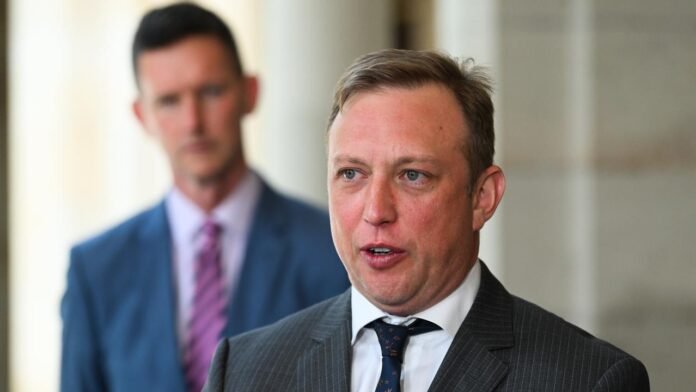
Mark Bailey, Queensland’s Opposition health spokesman, has never been known to hold back his opinions. But his latest appearance on Taylah Fellows’ political interview series lit up the state’s political conversation like few others. In a sharp exchange that quickly gained traction, Bailey roasted government and opposition figures alike, describing their approaches to health, leadership, and accountability as “as bad as each other.” The candid assessment has triggered debate across party lines about whether Queenslanders are being served by the leaders who are supposed to be shaping the state’s health future.
The Setting: A High-Stakes Conversation
The interview, part of a growing series that has attracted both loyal political junkies and casual viewers, was filmed against the backdrop of mounting public frustration with Queensland’s health system. Emergency department bottlenecks, long surgical waitlists, and rural access problems remain flashpoints. Public polling continues to show healthcare as one of the top three issues concerning voters. Against this backdrop, Bailey used the platform not just to criticise the government but to extend his critique to fellow opposition figures, framing the entire political class as caught in a cycle of “point-scoring instead of problem-solving.”
Bailey’s Roast: Equal-Opportunity Criticism
Bailey’s remarks targeted not only the government but also fellow opposition members, including Shadow Treasurer David Bates and Deputy Opposition Leader John Nicholls. “They’re as bad as each other,” he said flatly, accusing both sides of offering half-measures and political theatre rather than practical reform.
Rather than the standard back-and-forth of party rivalry, Bailey positioned himself as the rare figure willing to publicly critique his own camp. He argued that Queensland needs “real plans, not recycled slogans,” and insisted that his role as Opposition health spokesman obliges him to push for credible, transparent strategies—even if that means calling out colleagues.
Health Policy in the Spotlight
Health services in Queensland have faced sustained pressure in recent years. Ambulance ramping, where patients wait in parked ambulances due to overcrowded hospitals, has climbed to one of the highest rates in Australia. Data from the Australian Institute of Health and Welfare shows that Queensland hospitals are treating more patients than ever before, but demand is consistently outstripping supply.
Bailey has repeatedly called for reforms that include:
- Expanding regional hospital infrastructure.
- Investing in digital health records for better patient flow.
- Strengthening recruitment and retention of rural doctors and nurses.
- Increasing transparency through quarterly, independently verified hospital performance reports.
During the interview, he reiterated these points but warned that political bickering had blocked meaningful progress.
A Personal Style That Resonates
Part of what made Bailey’s appearance stand out was his blunt, conversational delivery. Political observers noted that his plain-spoken critique contrasted with the carefully scripted messaging that dominates much of state politics. By refusing to soften his language, Bailey struck a chord with voters tired of polished talking points.
Political commentator Rebecca Levingston observed, “Queenslanders are exhausted by spin. Bailey’s candour—calling out his own party while criticising the government—cuts through because it feels authentic.”
Impact on Party Dynamics
However, Bailey’s comments are not without risk. Open criticism of party colleagues can create tension behind the scenes, particularly as Queensland prepares for its next state election. Nicholls and Bates, the colleagues he roasted, represent significant power blocs within the party. Their allies may view Bailey’s candour as disloyalty rather than constructive critique.
Insiders say some opposition members were blindsided by his remarks, while others privately welcomed the shake-up. One strategist, speaking on condition of anonymity, said, “Bailey is tapping into voter frustration in a way that resonates. The danger is that he fractures unity at a time when cohesion is critical.”
Public Reaction: A Divided Response
The interview has since been clipped and shared across social media, with reactions split between admiration and criticism. Supporters praised Bailey for “saying what everyone’s thinking,” while detractors accused him of undermining his team for personal gain.
Data from media monitoring groups shows that hashtags related to the interview trended locally for over 48 hours. Talkback radio callers expressed mixed views—some saying Bailey was the only politician they trusted, others suggesting his comments revealed dysfunction in the opposition ranks.
Broader Implications for Queensland Politics
The timing of Bailey’s remarks is significant. With election campaigns ramping up, the health portfolio remains one of the most politically volatile areas. Queensland voters have consistently ranked health as a top priority in state elections, meaning any perceived weakness in this area can be politically costly.
If Bailey’s critique pressures both government and opposition to sharpen their health strategies, it could reshape the policy debate. Alternatively, if internal divisions widen, the opposition risks losing credibility as a viable alternative.
Expert Analysis: Health as the Decisive Issue
Health policy experts argue that Bailey’s central claim—that both sides have failed to deliver long-term solutions—holds weight. Professor Claire Jackson of the University of Queensland’s Centre for Health Services Research noted that “Queensland has made incremental progress, but system-wide transformation remains elusive. Without bipartisan agreement on workforce planning and digital integration, we’ll continue to see crisis headlines.”
Her view aligns with Bailey’s argument that politics too often prioritises optics over outcomes. The challenge, experts say, is turning blunt criticism into actionable reform that survives election cycles.
What Comes Next
As the fallout from Bailey’s interview continues, all eyes will be on how opposition leaders respond. Will they close ranks, or will they attempt to harness his candour as a rallying point for policy renewal? Meanwhile, the government will likely exploit the opposition’s internal rifts to reinforce its own messaging.
Bailey, for his part, seems unlikely to retreat. His reputation as a plain speaker has been cemented, and if anything, the interview has expanded his public profile. For voters weary of staged soundbites, his bluntness may prove a political asset—though whether it translates into policy influence or electoral success remains uncertain.
Conclusion: A Rare Political Moment
In an era when many politicians avoid risks, Bailey’s willingness to publicly criticise not only rivals but also his own team marks a rare political moment. His interview with Taylah Fellows underscored the growing demand for authenticity in Queensland politics, even when it comes with sharp edges.
The question now is whether Bailey’s words will be remembered as a turning point in Queensland’s health debate—or dismissed as yet another instance of political theatre. For a public desperate for meaningful change, the answer may depend on whether leaders turn critique into action.

