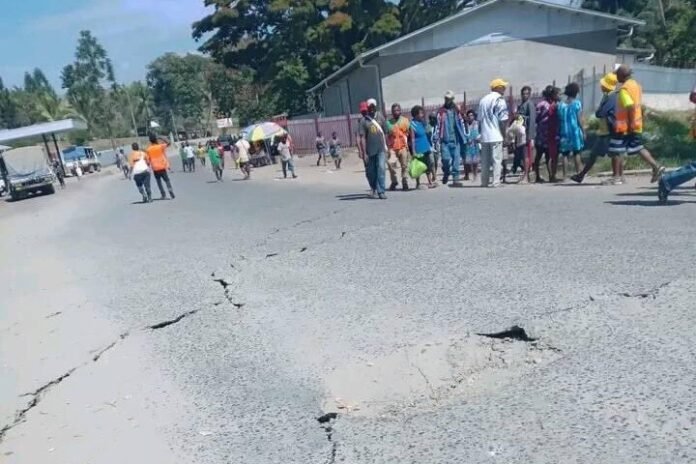
A powerful earthquake shook Indonesia’s Central Papua province in the early hours of Friday, jolting residents from their sleep and renewing concerns about the region’s vulnerability to seismic disasters. The United States Geological Survey (USGS) measured the quake at magnitude 6.1, striking at a shallow depth of just 10 kilometres. Indonesia’s Meteorology, Climatology and Geophysics Agency (BMKG), however, reported a slightly stronger reading of 6.6 with a depth of 24 kilometres.
Authorities confirmed that the epicentre was located about 28 kilometres (17 miles) south of Nabire, a coastal town that serves as one of the main gateways to Papua. While tremors were felt widely across the area, no immediate reports of fatalities or large-scale damage were released in the first hours following the quake. Several smaller aftershocks were also detected, adding to the anxiety of residents who rushed out of their homes and buildings to safer open spaces.
Conflicting Measurements Raise Questions
Earthquake magnitude and depth readings often differ between monitoring agencies. The USGS relies on global seismic networks, while BMKG uses domestic stations concentrated across Indonesia. The differences in readings—6.1 vs 6.6 in this case—highlight how local data can sometimes capture nuances in seismic behaviour that global networks miss.
Shallow earthquakes like this one, regardless of whether measured at 10 km or 24 km depth, tend to produce stronger surface shaking compared to deep quakes. This is why even a mid-range quake can feel severe in populated areas. Residents in Nabire described the ground as shaking “violently for several seconds,” and some reported cracks in walls and minor damage to household goods.
Indonesia’s Position on the “Ring of Fire”
Indonesia’s geography makes it one of the most seismically active regions in the world. Sitting atop the Pacific “Ring of Fire,” the archipelago straddles multiple tectonic plate boundaries, including the Indo-Australian, Pacific, and Eurasian plates. This geological setting subjects the country to frequent earthquakes, volcanic eruptions, and tsunamis.
According to BMKG records, Indonesia experiences thousands of tremors every year, though only a fraction are strong enough to cause damage or casualties. The 2004 Indian Ocean tsunami, triggered by a magnitude 9.1 quake off Sumatra, remains the deadliest in living memory, killing more than 230,000 people across 14 countries. More recently, a 2018 quake and tsunami in Palu, Central Sulawesi, killed over 4,000 and displaced hundreds of thousands.
Papua itself has a long seismic history, though it is less densely populated compared to Java or Sumatra. This geography often mitigates potential casualty figures, but also presents unique challenges in terms of emergency response and logistics.
Local Response and Emergency Preparedness
In Nabire, local authorities urged residents to remain cautious and stay in safe areas while inspections of infrastructure, schools, and hospitals were underway. Emergency services reported no major damage to bridges or airports, which are critical for supplying aid to remote areas.
BMKG issued reminders on safety protocols: moving away from buildings during aftershocks, avoiding coastal areas in case of tsunami risk, and ensuring that emergency kits are stocked with essentials such as clean water, food, flashlights, and radios. Although no tsunami warning was issued, shallow earthquakes near the coast always raise concerns about potential undersea landslides that can generate localized waves.
The National Disaster Mitigation Agency (BNPB) confirmed that teams had been placed on standby in Central Papua to assist if structural damage or injuries were reported. Community volunteers, who are often the first responders in remote Indonesian regions, were also activated to check on vulnerable populations such as the elderly and children.
Why This Quake Matters for Indonesia’s Seismic Policy
While Friday’s quake did not cause catastrophic destruction, experts warn that every medium-to-strong event in Papua is a reminder of the archipelago’s urgent need for better preparedness. Seismic engineers emphasize the importance of earthquake-resistant housing, particularly in provinces like Papua where construction often relies on light timber or unreinforced concrete.
Indonesia has strengthened its building codes in recent years, but enforcement outside of urban centres remains inconsistent. Many remote towns lack the resources to retrofit older structures. Additionally, poor connectivity and limited medical facilities in Papua pose risks if a major quake strikes.
Researchers have also called for expanding seismic monitoring in eastern Indonesia. Although BMKG operates hundreds of sensors nationwide, gaps remain in remote provinces, making it harder to provide rapid, precise data during emergencies.
Economic and Social Impacts
Even moderate earthquakes disrupt daily life. In Nabire, markets and shops remained closed in the morning hours as business owners inspected their properties. Some residents chose to stay outdoors, fearing further tremors. The education department announced that schools would suspend classes temporarily until buildings could be declared safe.
Economic costs are harder to measure in the immediate aftermath. However, experts estimate that recurring seismic events across Indonesia collectively cost billions of dollars each year in infrastructure damage, reconstruction, and lost productivity. For Papua, where development is already hampered by geography and limited transport links, even minor disruptions can stall progress.
Voices from the Ground
Residents described the quake as both frightening and disorienting. A teacher in Nabire said: “The ground shook so hard I could hear the windows rattling. Children were screaming and running outside.” Another resident, a shopkeeper, reported: “We have lived with earthquakes before, but every time it happens, it feels new. You never get used to it.”
Local hospitals confirmed that some patients had been treated for panic attacks and minor injuries from falls, but there were no immediate reports of serious trauma.
Lessons from History and Moving Forward
Friday’s earthquake adds to Indonesia’s growing list of seismic reminders. Each incident reinforces the need for stronger coordination between government agencies, local communities, and international partners. In 2023, Indonesia signed agreements with Japan and the United States for expanded seismic research collaboration, focusing on early warning systems and disaster response training.
Experts stress that such initiatives must translate into practical results on the ground—particularly in rural provinces like Papua, where resources are scarce and distances vast.
For residents of Nabire, the quake is both a disruption and a warning. While the damage appears limited this time, the region remains vulnerable. Preparedness, education, and resilience are key. As one local leader put it: “We cannot stop the earth from shaking. But we can prepare our homes, our schools, and our minds to withstand it.”
A Region on Edge but Moving Forward
As aftershocks continue to ripple through Central Papua, the population remains on edge. Yet the swift mobilisation of local authorities, the absence of widespread destruction, and the ongoing reinforcement of safety measures highlight Indonesia’s gradual progress in managing its seismic risks.
The earthquake serves as a stark reminder that life on the Ring of Fire requires constant vigilance. For Nabire and its surrounding communities, survival is tied not only to immediate response but also to long-term strategies that blend science, infrastructure, and local knowledge.
Indonesia’s journey toward resilience is far from complete, but every tremor adds urgency to the mission: building a nation better prepared to face the shocks of the earth beneath its feet.

